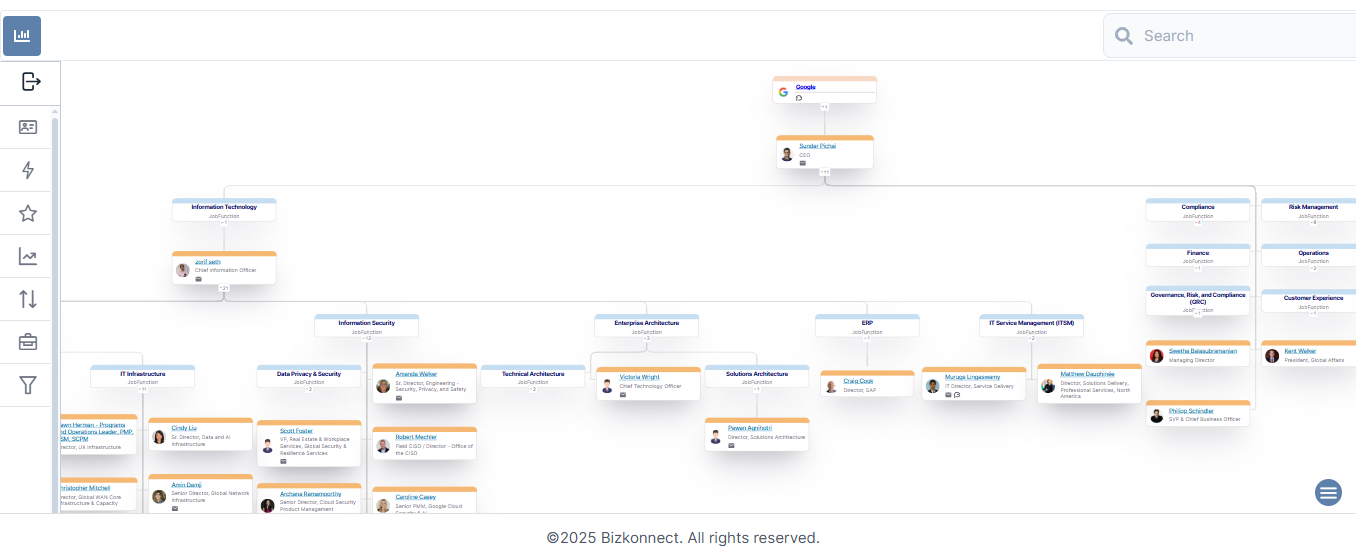
Google Organization Chart – Google’s leadership structure aligns major product platforms and engineering functions with strategic oversight from Alphabet Inc. Executive roles connect core business units such as Search and Advertising, YouTube, Android & Chrome, Google Cloud, and foundational AI research teams. Earlier in 2025, the company reported quarterly revenue of $90.2 billion and net income of $34.5 billion in the first quarter, and $96.4 billion with about $28.2 billion net income in the second quarter.
Company Overview – Founded in 1998, Google began as a search engine and has since become a central player in the global digital economy. The company develops products and platforms across search, advertising, mobile operating systems, cloud computing, artificial intelligence, and consumer hardware. Its core businesses include Google Search, YouTube, Android, Chrome, Google Cloud, and Workspace. Google’s operations are organized to balance product-led innovation with shared infrastructure, data, and AI capabilities, supported by engineering, product management, sales, and trust and safety teams.
FAQs -
1. What is the Google Org Chart?
It outlines how leadership and teams are organized across consumer platforms, advertising, cloud services, and foundational AI research, showing how decision-making and accountability are distributed.
2. How often does the Google Org Chart get updated?
The structure changes as products scale, new technologies mature, and leadership roles evolve. Major shifts often follow strategic moves in AI, cloud services, or regulatory and governance priorities.
3. Why is the Org Chart important for B2B outreach?
It helps partners understand which groups oversee advertising platforms, cloud infrastructure, hardware, and emerging technologies, allowing for more focused collaboration and alignment.
4. Which functions matter most for vendors?
Google Cloud, Ads and Commerce platforms, Android and device ecosystems, and core infrastructure teams are central points of engagement. Vendors supporting data platforms, security, AI tooling, and enterprise integration often work closely with these units.
5. How can marketers use the Google Org Chart effectively?
By identifying stakeholders across product, regional, and platform teams, marketers can align messaging with specific priorities such as cloud adoption, AI-driven services, platform growth, or advertiser performance.
1. What is the Google Org Chart?
It outlines how leadership and teams are organized across consumer platforms, advertising, cloud services, and foundational AI research, showing how decision-making and accountability are distributed.
2. How often does the Google Org Chart get updated?
The structure changes as products scale, new technologies mature, and leadership roles evolve. Major shifts often follow strategic moves in AI, cloud services, or regulatory and governance priorities.
3. Why is the Org Chart important for B2B outreach?
It helps partners understand which groups oversee advertising platforms, cloud infrastructure, hardware, and emerging technologies, allowing for more focused collaboration and alignment.
4. Which functions matter most for vendors?
Google Cloud, Ads and Commerce platforms, Android and device ecosystems, and core infrastructure teams are central points of engagement. Vendors supporting data platforms, security, AI tooling, and enterprise integration often work closely with these units.
5. How can marketers use the Google Org Chart effectively?
By identifying stakeholders across product, regional, and platform teams, marketers can align messaging with specific priorities such as cloud adoption, AI-driven services, platform growth, or advertiser performance.