Intel
Intel Corporation Organization Chart - Intel organizes its business into Client Computing Group (CCG), Data Center and AI (DCAI), Network and Edge (NEX), Mobileye, and Intel Foundry Services (IFS). The company reported revenue of $52.9 billion in 2025, executing a major IDM 2.0 transformation to rebuild foundry leadership through new fabs in the U.S., Europe, and Israel.
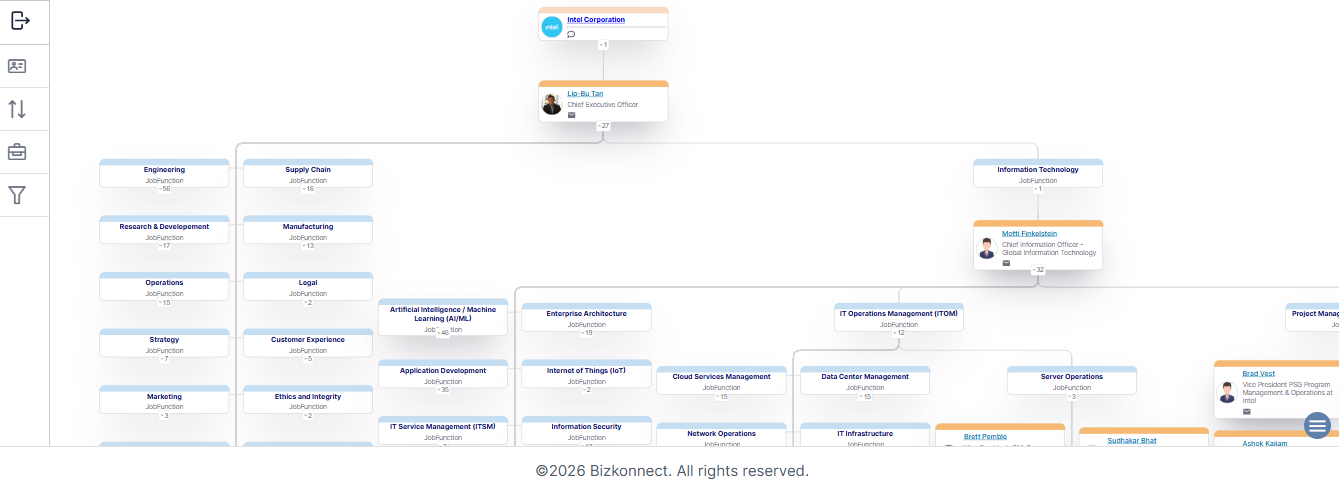
Company Overview - Intel Corporation is a global semiconductor leader headquartered in Santa Clara, California, designing and manufacturing microprocessors, AI accelerators, network silicon, and chipsets. Its Client Computing Group addresses PC and laptop processors, while the Data Center and AI segment delivers Xeon server CPUs and Gaudi AI accelerators. Intel Foundry Services operates as an external foundry business serving third-party chip designers. Mobileye provides autonomous driving computer platforms. Intel is investing in advanced process node manufacturing with its Intel 18A process targeting leadership in the semiconductor foundry market.
FAQs -
Q: What is the Intel Org Chart?
Intel structures into CCG (client processors), DCAI (data center and AI chips), NEX (network and edge silicon), Mobileye (AV compute), and Intel Foundry Services (external manufacturing), with shared R&D, manufacturing, and corporate functions.
Q: How often does the Intel Org Chart change?
Intel has undergone significant restructuring under its IDM 2.0 strategy and leadership changes since 2021. Business unit reorganizations and foundry separation efforts continue to evolve annually.
Q: Why is the Intel Org Chart important for B2B outreach?
EDA software vendors, chip packaging suppliers, AI software developers, and cloud infrastructure companies must identify whether to engage CCG platform teams, DCAI AI architects, IFS foundry customers, or Mobileye engineering groups.
Q: Which Intel functions should vendors target?
Intel Foundry Services customer engagement, DCAI AI ecosystem development, network platform engineering in NEX, Mobileye autonomous systems, enterprise procurement, and software developer ecosystem teams are primary vendor contact areas.
Q: How can marketers use the Intel Org Chart effectively?
EDA toolchain vendors engaging Intel Foundry Services process teams differ from AI framework developers targeting DCAI Gaudi ecosystem teams versus enterprise IT solution providers reaching CCG commercial platform groups, each requiring distinct technical messaging and relationship strategies.
Intel structures into CCG (client processors), DCAI (data center and AI chips), NEX (network and edge silicon), Mobileye (AV compute), and Intel Foundry Services (external manufacturing), with shared R&D, manufacturing, and corporate functions.
Q: How often does the Intel Org Chart change?
Intel has undergone significant restructuring under its IDM 2.0 strategy and leadership changes since 2021. Business unit reorganizations and foundry separation efforts continue to evolve annually.
Q: Why is the Intel Org Chart important for B2B outreach?
EDA software vendors, chip packaging suppliers, AI software developers, and cloud infrastructure companies must identify whether to engage CCG platform teams, DCAI AI architects, IFS foundry customers, or Mobileye engineering groups.
Q: Which Intel functions should vendors target?
Intel Foundry Services customer engagement, DCAI AI ecosystem development, network platform engineering in NEX, Mobileye autonomous systems, enterprise procurement, and software developer ecosystem teams are primary vendor contact areas.
Q: How can marketers use the Intel Org Chart effectively?
EDA toolchain vendors engaging Intel Foundry Services process teams differ from AI framework developers targeting DCAI Gaudi ecosystem teams versus enterprise IT solution providers reaching CCG commercial platform groups, each requiring distinct technical messaging and relationship strategies.