Toyota
Toyota Organization Chart - Toyota connects executive leadership to operational divisions spanning vehicle design and engineering, manufacturing, sales and marketing, financial services, and connected mobility solutions. The company reported global revenue of $310 billion in fiscal year 2024, with net income of $27.5 billion, operating production facilities across multiple continents and selling vehicles in over 170 countries worldwide.
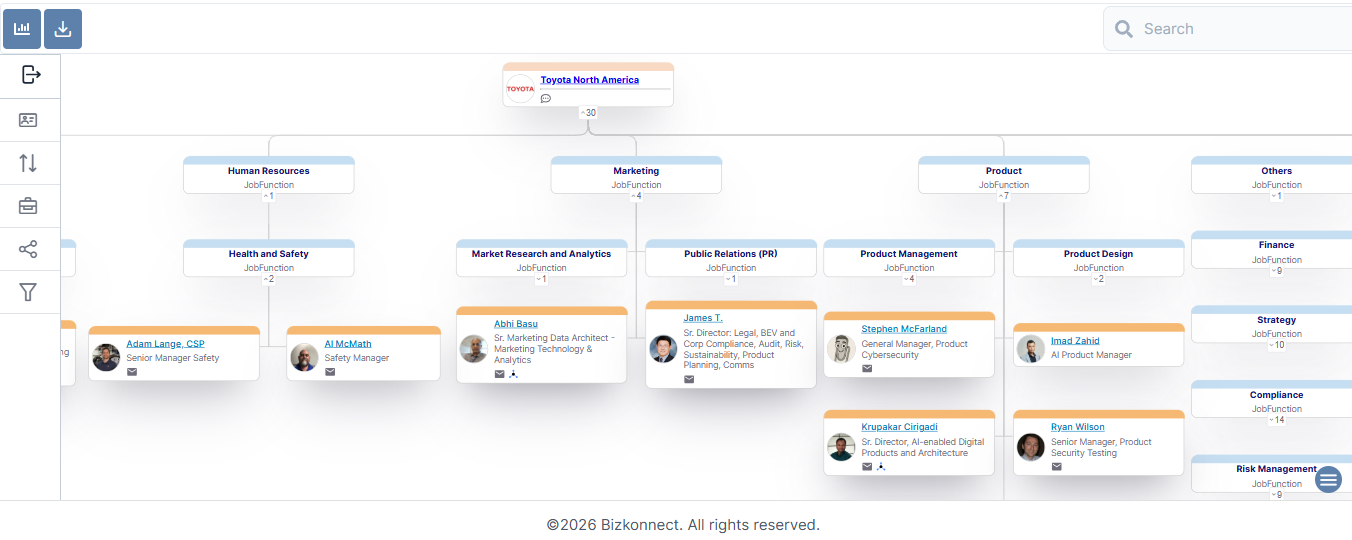
Company Overview - Toyota, with major U.S. operations in Plano, Texas, is one of the world's largest automobile manufacturers and a pioneer in hybrid and hydrogen fuel cell technology. Its operations encompass the Toyota and Lexus brand vehicles, Toyota Financial Services, and Toyota Production System. The company operates multiple manufacturing plants in North America while investing in electrification strategies, battery technology development, hydrogen fuel cells, and software-defined vehicles to advance sustainable transportation.
hydrogen fuel cells, and software-defined vehicles to advance sustainable transportation.
FAQs -
1. What is the Toyota Org Chart?
Toyota's structure includes regional operations (North America, etc.), product divisions (Toyota, Lexus), manufacturing, R&D, and Toyota Financial Services, all coordinated under global headquarters.
2. How often does the Toyota Org Chart get updated?
Updates occur with regional leadership changes, new plant openings, or strategic shifts toward electrification, typically annually.
3. Why is the Org Chart of Toyota important for B2B outreach?
Tier 1 suppliers and technology partners need to identify whether to approach powertrain engineering, manufacturing operations, or connected vehicle development teams.
4. Which functions are most relevant in the Toyota Org Chart for vendors?
Procurement and supply chain, manufacturing and production engineering, vehicle electrification, connected services, and dealer network operations are critical touchpoints.
5. How can marketers use the Toyota Org Chart effectively?
Differentiating between hybrid powertrain teams versus autonomous driving research versus manufacturing automation allows suppliers to present battery systems, sensors, or robotics to the right technical decision-makers.
1. What is the Toyota Org Chart?
Toyota's structure includes regional operations (North America, etc.), product divisions (Toyota, Lexus), manufacturing, R&D, and Toyota Financial Services, all coordinated under global headquarters.
2. How often does the Toyota Org Chart get updated?
Updates occur with regional leadership changes, new plant openings, or strategic shifts toward electrification, typically annually.
3. Why is the Org Chart of Toyota important for B2B outreach?
Tier 1 suppliers and technology partners need to identify whether to approach powertrain engineering, manufacturing operations, or connected vehicle development teams.
4. Which functions are most relevant in the Toyota Org Chart for vendors?
Procurement and supply chain, manufacturing and production engineering, vehicle electrification, connected services, and dealer network operations are critical touchpoints.
5. How can marketers use the Toyota Org Chart effectively?
Differentiating between hybrid powertrain teams versus autonomous driving research versus manufacturing automation allows suppliers to present battery systems, sensors, or robotics to the right technical decision-makers.