


The 96% vs. 44% Reality Check
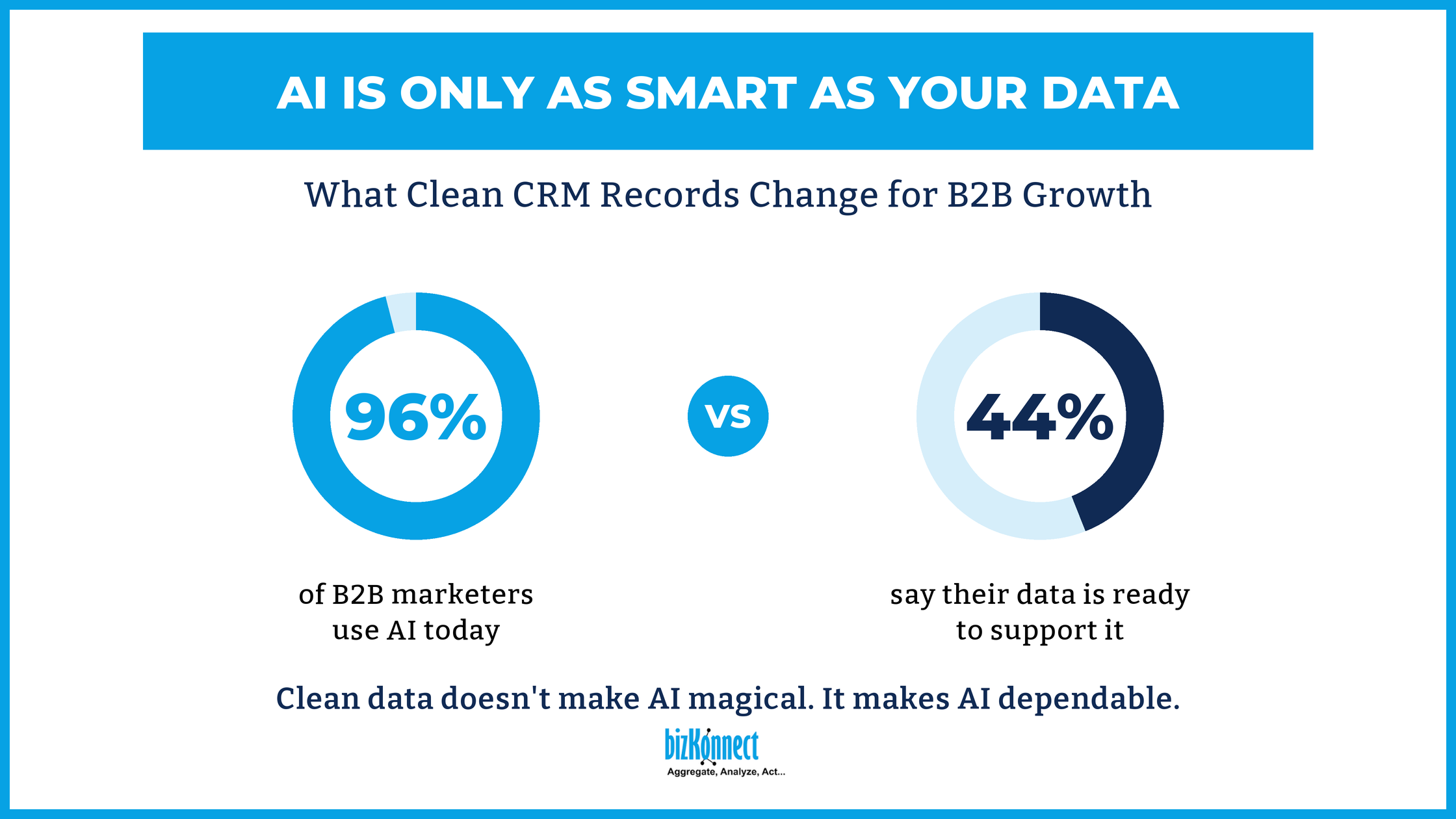
Walk into almost any B2B revenue meeting right now, and you will hear about new AI copilots, enrichment agents, or automated outbound sequences. Surveys show 96% of B2B marketers use AI in some capacity, while only 44% say their data infrastructure is ready to support it. Broader enterprise research points to a similar bottleneck: only 15% of enterprises report being ready for agentic AI in production despite heavy investment.
Explore CRM Managed Services by AI Native Analysts
Buying software feels like momentum. A new licence gets provisioned, a workflow gets turned on, and a dashboard lights up. Yet activity is not the same as readiness. When an AI model reads a CRM filled with duplicate leads, missing job titles, contacts who left six months ago, and unformatted company fields, speed simply multiplies error. Instead of sharper targeting, teams get generic outreach sent to the wrong people and pipeline forecasts built on guesswork.
Why Bad Data Silently Drains AI Spend
Most revenue leaders worry about falling behind competitors on AI. That fear often pushes teams to add another tool on top of a shaky foundation. Every extra layer a sequencer here, a prompt workflow there, an AI research agent somewhere else pulls from the same underlying records. If the source record is wrong, every downstream step inherits the flaw.
Consider what happens in daily go-to-market execution:
- Wasted rep hours: Sellers spend only around 40% of their week actually selling, losing hours to manual research and chasing dead contacts.
- Broken personalization: AI drafts look personalized on the surface, yet reference outdated roles, wrong company sizes, or departed decision-makers.
- Distrusted automation: When leaders see AI send awkward messages or misroute leads, they turn automation off leaving paid licences sitting idle.
The real loss is quiet. It shows up in bounced emails, low reply rates, stalled outbound programs, and budget spent on tools that cannot reach their potential because the input data lacks structure and freshness.
What Clean, Structured CRM Data Changes
Fixing data hygiene is rarely glamorous, which is why teams postpone it until campaigns stall. Once CRM records are standardized, deduplicated, and enriched with verified attributes, the math across go-to-market shifts noticeably:
- Segmentation becomes exact: Clean firmographics, clear buying roles, and standardized fields let teams group accounts by real fit rather than rough approximations.
- AI outputs become usable: Models work best when given clear context current titles, active accounts, recent signals, and clean history reducing hallucinations and manual rewrites.
- Routing and reporting hold up: Leads go to the right owner quickly, and leadership reviews rest on numbers people trust rather than manual spreadsheet fixes.
- Campaigns launch faster: Instead of spending weeks cleaning lists before every push, teams move straight from target account selection to relevant outreach.
Clean data does not make AI magical; it makes AI dependable. Paired with human review on key workflows and messaging, reliable data turns software spend into repeatable pipeline.
Closing the Gap With Weekly-Refreshed Data and CRM Operations
Closing the gap between AI ambition and data readiness takes steady, unglamorous execution: auditing existing records, merging duplicates, appending missing fields, tracking job changes, and keeping CRM workflows aligned with how the team sells.
That is where structured data services and hands-on CRM operations make a practical difference. Backed by a weekly-refreshed database of 20 million companies alongside continuous CRM refresh, append, and analyst-led data operations, revenue teams can replace stale records with verified contact and account intelligence before launching campaigns or scaling AI workflows. When the foundation stays current week after week, the tools built on top of it finally have accurate ground truth to work from.
Frequently Asked Questions
1. Why does AI underperform when CRM data is messy? AI tools rely on existing fields, histories, and attributes to score leads, segment accounts, and draft messages. Duplicates, blank fields, and outdated titles cause models to misclassify prospects or generate inaccurate context.
2. Should a team clean its CRM before or after adopting AI tools? Ideally before or alongside initial pilots. Starting with clean, structured records prevents early bad habits, avoids wasted outreach on invalid contacts, and gives teams a reliable baseline to judge whether an AI workflow actually helps.
3. How often does B2B contact and company data go stale? People change jobs, companies restructure, and buying roles shift throughout the year. Relying on a one-time list or static CRM import leads to decay quickly, which is why ongoing refreshes and job-change tracking matter.
4. What fields matter most for AI-assisted sales and marketing? Accurate company identifiers, standardized job titles and seniority, verified work emails and direct dials, clear lifecycle stages, and recent buying or organizational signals give both humans and AI clear context.
5. Does human review still matter once CRM data is clean? Yes. Clean data improves accuracy at scale, while human analysts and operators catch edge cases, verify nuanced account details, maintain workflow rules, and ensure outreach matches brand standards.
Book a quick discovery call or request a complimentary CRM Health Check to spot data gaps, fix broken automation, and build a cleaner foundation before your next campaign.
CLICK HERE to know more with BizKonnect.