


There is a moment in every marketing operations review when the numbers stop making sense. Rankings are holding, content investments are up, and yet organic traffic is quietly contracting.
Quarter after quarter, without a clear cause in the analytics dashboard.
The cause is structural, and it starts with a number most marketing teams haven't fully recalibrated around:
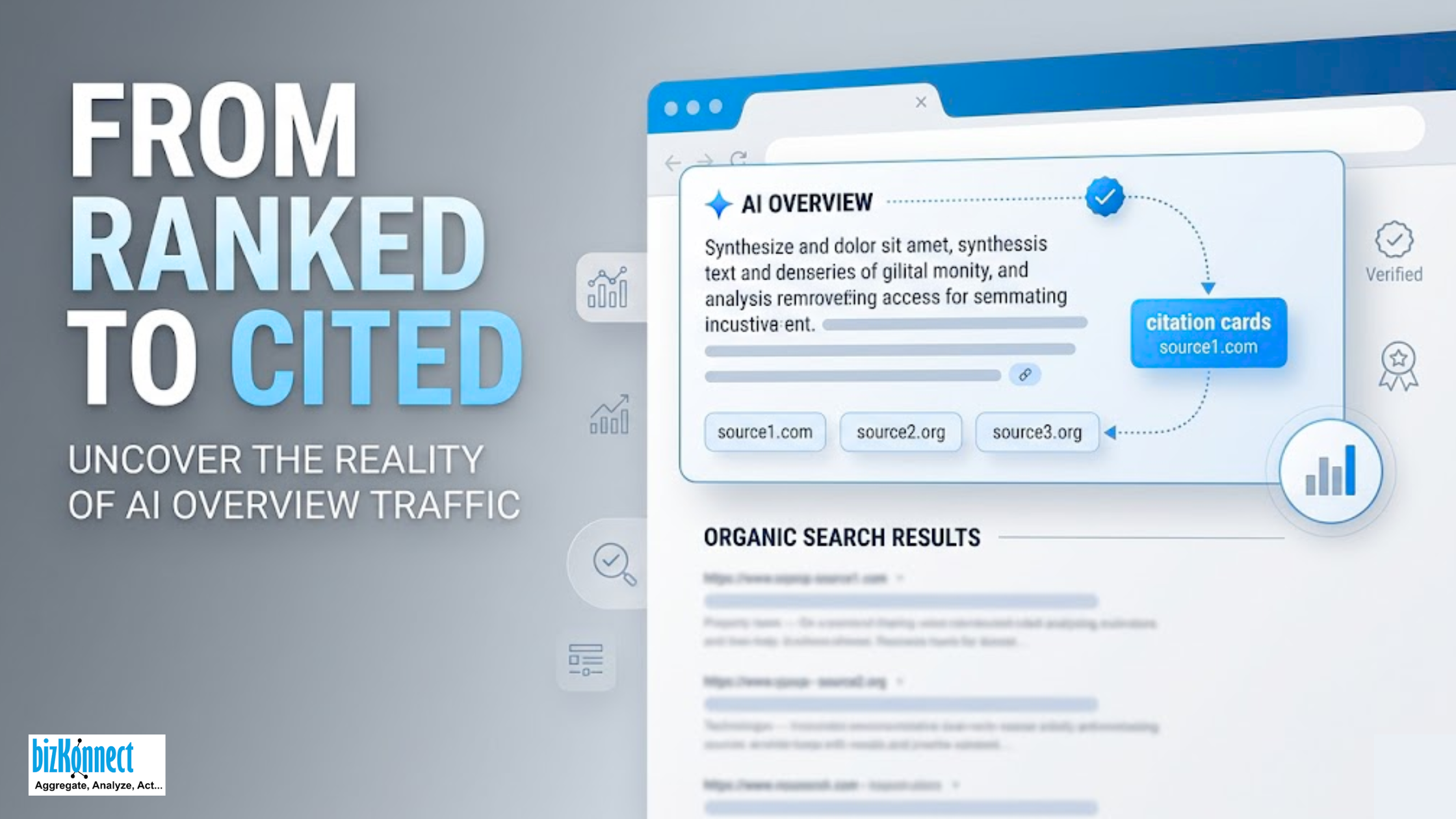
Over 60% of Google searches now end without a single click. Not because users aren't searching, but because Google's AI Overviews (AIO) answer the query instantly at the very top of the screen, before a user ever reaches the organic results below.
Traditional search engine optimization was built around one objective: rank a link in the top 10. That objective hasn't disappeared, but it no longer guarantees visibility.
Studies tracking AI Overview adoption show organic click-through rates dropping by as much as 61% on informational queries after AIOs became widespread. It is a permanent redistribution of attention toward cited sources inside the AI-generated answer.
The practical consequence is that even if a brand ranks #3 but isn't named inside the AIO summary, is functionally invisible for that query. Understanding what governs citations is what separates brands that maintain discoverability from those that lose it silently.
When the Goal Posts Moved and Most Teams Didn't Notice
For most of the past decade, B2B marketing teams optimized around one mental model:
- Produce authoritative content
- Rank in the top ten
- Capture organic traffic
The model worked because search architecture was stable and a ranked page was a visible page.
AI Overviews broke that assumption.
Powered by Google's Gemini models, they synthesize information from multiple web sources and deliver a comprehensive answer directly on the results page before the organic list begins.
Google's AIO uses a Retrieval-Augmented Generation (RAG) system.
It identifies candidate documents, extracts key facts, synthesizes a summary, and maps claims to source URLs as citation cards. Ranking in the top ten is now an entry condition. The AI then applies a second filter: extractability. Content that passes the first filter but not the second generates impressions with no citations and rapidly declining exposure.
Most content libraries were built to rank, only a very few were built to be cited.
What Is Generative Engine Optimization (GEO) and Why the Distinction from Answer Engine Optimization (AEO) Matters?
The search industry has developed two parallel disciplines to address this gap.
Answer Engine Optimization (AEO) focuses on structuring content so AI systems can extract direct answers to specific questions. How Answer Engine Optimization improves brand visibility comes down to one mechanic: making individual facts and definitions easy for an AI model to locate, extract, and attribute. FAQ schema, definition blocks, and Q&A structures are its primary tools.
Generative Engine Optimization (GEO) operates at a higher level, optimizing for the way large language models perceive and cite information through entity optimization, semantic enrichment, and E-E-A-T signals. Where AEO makes individual answers extractable, GEO makes the entire brand trustworthy enough that the AI consistently selects it as a preferred source.
A brand with strong AEO but weak GEO gets cited occasionally. A brand with strong GEO builds citation gravity, the AI returns to it repeatedly.
The unified formula: AIO Visibility = (Traditional Rank) + (Semantic Clarity) + (Entity Authority).
How GEO and AEO Improve Discoverability? The Mechanics Beneath the Surface
The common instinct when facing a traffic problem is to produce more content. In the context of AI Overviews, that instinct often backfires. The AI rewards specificity and extractability, instead of volume.
Ranking in the top 10–20 results is a prerequisite for citation consideration, but ranking #1 doesn't guarantee a citation. What makes content extractable:
- Answer-First Architecture: Sections should open with direct, factual statements. Preambles push the actual answer below the AI's extraction threshold.
- Entity Completeness: If the AIO for a target query consistently surfaces concepts like "automation" or "integrations," content omitting those entities is unlikely to be cited regardless of overall quality.
- Structural Clarity: Heading hierarchies, definition blocks, and comparison tables are extraction infrastructure. Gemini processes HTML structure as a signal.
- Grounding Density: Vague claims and unsubstantiated assertions reduce citation probability directly. Every sentence in an AIO must be traceable to a retrieved document.
Schema markup compounds these effects, acting as a translator that confirms entities and relationships in the text.
Article, FAQPage, HowTo, and Dataset schema all increase machine readability. Brands treating schema as a technical checkbox rather than a competitive signal carry a structural disadvantage.
Why Can Publishing More Can Make a Brand Less Visible?
Here is the consequence most content operations haven't absorbed: publishing broadly across many topics actively reduces citation probability for any individual topic.
Google is more likely to cite a specialized source than a generalist one. A brand with three definitive pieces on a narrow topic will outcompete one with thirty shallow pieces across adjacent topics because of semantic density within that niche.
B2B buyers who receive a complete AI-generated answer are filtering the web before they engage with it. The brands named in that answer become the default consideration set because of AI selection logic. Being absent from that initial synthesis means re-entering the buyer's awareness at a later, more competitive stage.
This is the core tension zero-click traffic optimization surface:
The old model optimized for click volume. The new model must optimize for citation frequency and those objectives require different content architectures and a fundamentally different definition of search performance.
Frequently Asked Questions (FAQs)
With these operational shifts in mind, several practical questions tend to surface during evaluation and execution.
Q. What is Generative Engine Optimization (GEO), and how does it differ from traditional SEO and AEO?
GEO focuses on making content trustworthy, semantically complete, and structurally extractable so AI language models select it as a cited source. Traditional SEO focuses on ranking a page. GEO operates one layer above, influencing which ranked pages an AI cites. Answer Engine Optimization (AEO) is the tactical layer beneath GEO: structuring individual facts, definition blocks, and FAQ schema so AI systems can extract and attribute direct answers to specific queries.
Q. Why does ranking on page one no longer guarantee visibility?
AI Overviews occupy the top of the search page for a growing share of queries. A brand can rank positions 1 through 10 and still appear below the fold, beneath a summary that already answers the user's question.
Q. Can a brand lose AIO citations it previously had?
Yes. AI Overviews are generated dynamically. A brand can lose citation status if a competitor publishes more authoritative content, if its content becomes outdated, or if query intent shifts. Citation monitoring and content refreshes are competitive requirements, not optional maintenance.
Q. Is being cited in an AIO drive value even without a click?
Yes. Repeated brand exposure inside AI-generated answers builds recognition that influences subsequent searches and direct navigation. In B2B, being named as an AI-cited authority during the research phase affects consideration and shortlisting in ways direct attribution rarely captures.
Want to understand how your brand currently performs inside AI-generated search answers and what it would take to get cited consistently? CLICK HERE to discover how BizKonnect’s solutions can help.
CLICK HERE to know more with BizKonnect.