


Enterprise sales reps who work Cisco as a target account know a simple truth: the moment your champion moves seats, your deal moves with them. Cisco has restructured its executive leadership team multiple times over the past year, and each round of changes has sent ripples through the vendor ecosystem that sells into the company. Understanding Cisco's organizational structure, and building a process for tracking it, has become a core part of account planning rather than a one-time research task.
This guide breaks down what a Cisco leadership shakeup actually does to a sales pipeline, what the current Cisco org chart looks like, and how account teams can build a repeatable process for staying current on leadership moves at any large technology company, not just Cisco.
Why Cisco's Organizational Structure Matters Beyond Cisco Itself
Cisco is one of the most closely watched org charts in enterprise technology. With roughly $56 billion in annual revenue and close to 90,000 employees across its business units, decisions made inside Cisco's executive leadership team affect thousands of partner and vendor relationships at once. When a senior vice president exits or a new executive vice president role is created, the reporting lines under that person shift too, and every deal that was sponsored through the old structure needs a new path forward.
This is not unique to Cisco. Every large technology company reorganizes on a similar cycle: new product priorities, M&A integration, board-level pressure, or a CEO wanting a leaner team around them. Cisco's corporate organizational structure just happens to be one of the most visible examples, because the company publishes leadership updates regularly and the changes tend to be significant.
What Cisco's Executive Leadership Structure Looks Like Right Now
Mark Patterson, previously Executive Vice President and Chief Strategy Officer, stepped into the Chief Financial Officer role at the start of Cisco's fiscal year 2026, succeeding Scott Herren. Around the same period, Jeetu Patel was promoted to President and Chief Product Officer, consolidating Networking, Security, and Collaboration under a single product organization.
Sales leadership shifted as well. Oliver Tuszik was named Executive Vice President of Global Sales and joined Cisco's Executive Leadership Team effective April 27. Communications leadership changed too: Steve Clayton joined Cisco as Chief Communications Officer effective January 5, 2026, arriving from Microsoft after more than 28 years in communications roles there. Elsewhere on the leadership team, Eyal Dagan moved into a new role as EVP of Strategic Projects, and Martin Lund joined Cisco to lead the Common Hardware Group as EVP.
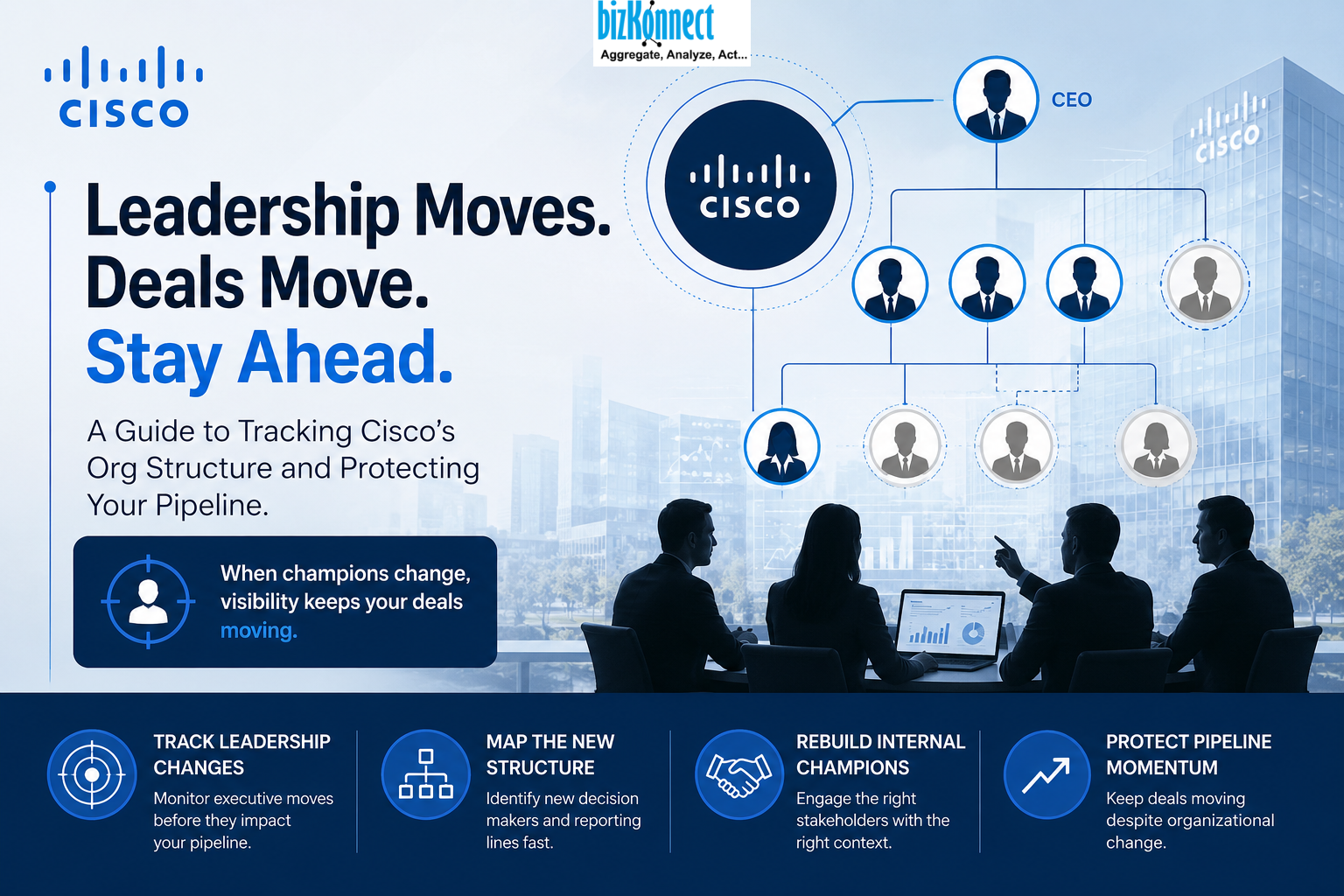
The board has changed too. Peter A. Shimer joined Cisco's board effective April 6, 2026, following Daniel Schulman's resignation as he took on the CEO role at Verizon. Other long-standing officers, including Chief Customer Experience Officer Liz Centoni, Chief People, Policy and Purpose Officer Francine Katsoudas, and Chief Legal Officer Dev Stahlkopf, remain in place under CEO Chuck Robbins, giving the structure a mix of continuity at the top and turnover just below it.
| Executive Leader | Core Title & Function | Pipeline Impact for B2B Sellers |
|---|---|---|
| Chuck Robbins | Chair & Chief Executive Officer | Sets top-level strategic direction, software subscription shifts, and overarching AI infrastructure goals. |
| Jeetu Patel | President & Chief Product Officer | Directs unified platform engineering across networking, cloud security, collaboration, and hardware units. |
| Liz Centoni | EVP & Chief Customer Experience Officer | Oversees post-sale adoption, success metrics, and platform telemetry across global accounts. |
| Oliver Tuszik | EVP & Chief Customer Experience Officer | Leads global field operations, direct enterprise execution, and channel partner ecosystems. |
| Mark Patterson | EVP & Chief Financial Officer | Governs fiscal allocation, subscription models, and corporate procurement approval thresholds. |
This kind of pattern, where the CEO stays put but the layer directly beneath them keeps rotating, is exactly what makes account mapping difficult. A rep's relationship with a director or VP can survive a reorg. A rep's relationship with the SVP two levels up, the one who actually signs off on budget, often does not.
What Happens to a Deal When the Sponsor Moves
Vendor teams who sell into large accounts have all seen the same sequence play out. An executive sponsor who championed a deal internally gets promoted, moves to a different business unit, or leaves the company. Emails sent to their old title bounce or go unanswered. The deal that was moving through procurement stalls, not because the business case weakened, but because nobody on the vendor side knows who inherited the budget line or the decision rights.
For a company the size of Cisco, this happens constantly and across dozens of business units at once. A partner manager who built a relationship with a services SVP now has to figure out who owns services strategy after a reorg. A security vendor whose champion sat under one product leader now needs to know whether that mandate moved to a different EVP entirely. Multiply that across an account list of even a few dozen enterprise accounts, and manual tracking through LinkedIn searches and press releases stops being sustainable.
A Practical Approach to Rebuilding Pipeline After a Reorg
When an executive sponsor changes roles or leaves, a few steps tend to separate reps who recover the deal from reps who lose it.
First, confirm who now owns the budget and the mandate, not just who has the title. Titles often lag the actual reporting change by weeks. Second, map the new reporting line before reaching out, so the first message references the correct scope of the new leader's role instead of the old one. Third, re-anchor the business case to whatever priority the new leader has been public about, since incoming executives usually want to be associated with their own wins rather than inherited ones. Fourth, keep a secondary contact inside the account who is unlikely to move, typically someone in a specialist or technical role rather than a rotating executive seat.
None of this is difficult in isolation. The challenge is doing it at scale, in real time, across every account in a territory, without waiting for a press release to confirm what already happened internally weeks earlier.
Where Leadership Intelligence Fits Into the Sales Process
This is the gap that account mapping tools TechKonnect, designed to close. Rather than relying on quarterly manual research, its account mapping continuously tracks executive movement inside target accounts and flags changes as they happen, whether that is a title change, a new reporting line, or a departure. The platform then rebuilds the visual org chart for that account automatically, so a rep can see the new hierarchy instead of piecing it together from old contact records.
The practical value shows up at the moment a deal would otherwise stall. Instead of a rep discovering a leadership change when an email bounces, it surfaces the move as it happens and points to the new decision-maker, the reporting line that connects them to the account's prior champion, and a suggested path back into the account. For teams managing dozens or hundreds of enterprise accounts, that turns a reactive scramble into a routine step in account planning.
Treating organizational hierarchy as living data, rather than a static chart pulled together once a year, is becoming a baseline expectation for enterprise sales and account-based marketing teams. Cisco's recent run of leadership changes is a clear example of why. Companies that build leadership intelligence into their sales motion recover pipeline faster after a reorg. Companies that do not spend weeks rebuilding relationships that were already close to closing.
FAQs
1. What does Cisco's org chart look like in 2026? Cisco's current structure is led by CEO Chuck Robbins, with Jeetu Patel serving as President and Chief Product Officer overseeing a combined Networking, Security, and Collaboration organization, Mark Patterson as Chief Financial Officer, and Oliver Tuszik leading Global Sales as Executive Vice President.
2. Who leads Cisco's technology strategy? Product and technology strategy sits primarily with Jeetu Patel in his role as President and Chief Product Officer, a role expanded after Cisco consolidated its core product organizations under a single leader.
3. How often does Cisco's organizational structure change? Cisco has adjusted its executive leadership team multiple times within the past two years, including changes to its CFO, sales leadership, communications leadership, and board composition, making it one of the more frequently updated org charts among large technology vendors.
4. Why does a Cisco leadership change affect vendor deals? Most enterprise deals are sponsored by a specific executive who owns budget and priority. When that executive changes roles or leaves, the deal loses its internal advocate until a vendor identifies and engages the person who now holds that mandate.
5. What should a sales rep do when their executive sponsor leaves a target account? Confirm who now holds the budget and decision rights, map the updated reporting line, tie the pitch to the new leader's stated priorities, and maintain a secondary contact who is less likely to be affected by future reorgs.
6. How is Cisco's corporate organizational structure different from other large tech companies? Cisco tends to keep its CEO in place for long stretches while rotating the layer of executive vice presidents beneath, a pattern common among established technology companies but one that makes tracking reporting lines below the top especially important.
7. What is account mapping, and why does it matter for enterprise sales? Account mapping is the practice of tracking the reporting structure, key stakeholders, and decision-making paths inside a target account. It matters because deals rarely stall due to product fit; they stall when the vendor loses visibility into who currently owns the decision.
8. Can org chart changes be tracked in real time? Yes. Tools designed for leadership intelligence and account mapping, such as ORGKonnect, monitor executive movement continuously and update the visualized hierarchy as changes occur, rather than relying on manual research cycles.
9. How does ORGKonnect help re-engage a stalled deal after a reorg? ORGKonnect detects the executive move, rebuilds the account's org chart to reflect the new reporting line, and surfaces the connection between the new decision-maker and the account's existing relationships, giving reps a starting point to re-engage without starting from scratch.
If your team is losing pipeline every time a target account reorganizes, see how TechKonnect keeps your account maps current and your outreach on target.
Book a DEMO with TechKonnect today.
CLICK HERE to know more with BizKonnect.