


A static corporate directory is the fastest path to wasted marketing spend.
For years, healthcare IT vendors relied on annual account reviews, assuming institutional inertia preserved stable buying committees. That assumption has broken.
Recent data tracking health plan C-suite exits in 2026 highlights a massive executive shakeup. High-profile departures like Susan Larkin leaving her post as EVP and Chief Commercial Officer at Independence Blue Cross, alongside Cigna finalizing plans for CEO David Cordani to transition to executive chair, have thrown established payer hierarchies into immediate flux. When these commercial strategy departures occur, the entire healthcare management structure alters overnight.
This article clarifies why traditional playbooks fail during macro shifts and how utilizing GenAI-driven health company org charts allows analytics vendors to identify new decision-makers before competitors realizes.
Why do traditional enterprise health plan sales strategies fail during executive transitions?
When an executive transitions to executive chair or when a market leader exits a dominant regional player, the consequences ripple far beyond isolated open positions.
Traditional business-to-business (B2B) marketing models treat an enterprise account as a fixed monolith. Sales teams track a single healthcare company organizational chart as if it were carved in stone, deploying automated sequences to historical titles.
This approach creates severe execution gaps.
A high-level commercial departure creates a vacuum that alters internal reporting lines, budget ownership, and strategic mandates within Cigna. A vendor pitching a legacy population health platform to a vacant office burns capital. When a commercial leader exits, active pilots stall, existing vendor relationships face mandatory re-evaluation, and strategic priorities pivot toward risk mitigation.
Marketers relying on quarterly data updates find themselves pitching solutions aligned with an administration that no longer exists. Static prospecting tools lack the operational speed required to navigate structural velocity.
How does high-profile C-suite churn trigger structural shifts in payer procurement?
The current volume of health plan C-suite exits in 2026 reflects a broader systemic realignment across the commercial payer landscape. Payers are grappling with intense margin compression, evolving employer demands, and the continuous pressure of value-based care optimization. Consequently, an executive departure is rarely a simple one-to-one replacement scenario.
When a chief commercial officer exits, the downstream effects follow a predictable, disruptive pattern:
- Strategic Freezes: Budgets are locked for 60 to 90 days while leadership stabilizes the department.
- Vendor Rationalization: Inbound solutions are cross-examined to see if they align with the incoming executive's vision, often leading to contract terminations for legacy software.
- Reporting Realignment: Direct reports are temporarily shifted to other executives, completely rewriting the internal power dynamics of the healthcare organizational structure.
For healthcare IT and analytics firms, these disruptions represent either an existential threat or a massive pipeline opportunity. The deciding factor is visibility. Real-time views of the evolving enterprise allow vendors to intercept the restructuring process while it unfolds.
What does a healthcare company org chart look like when powered by GenAI?
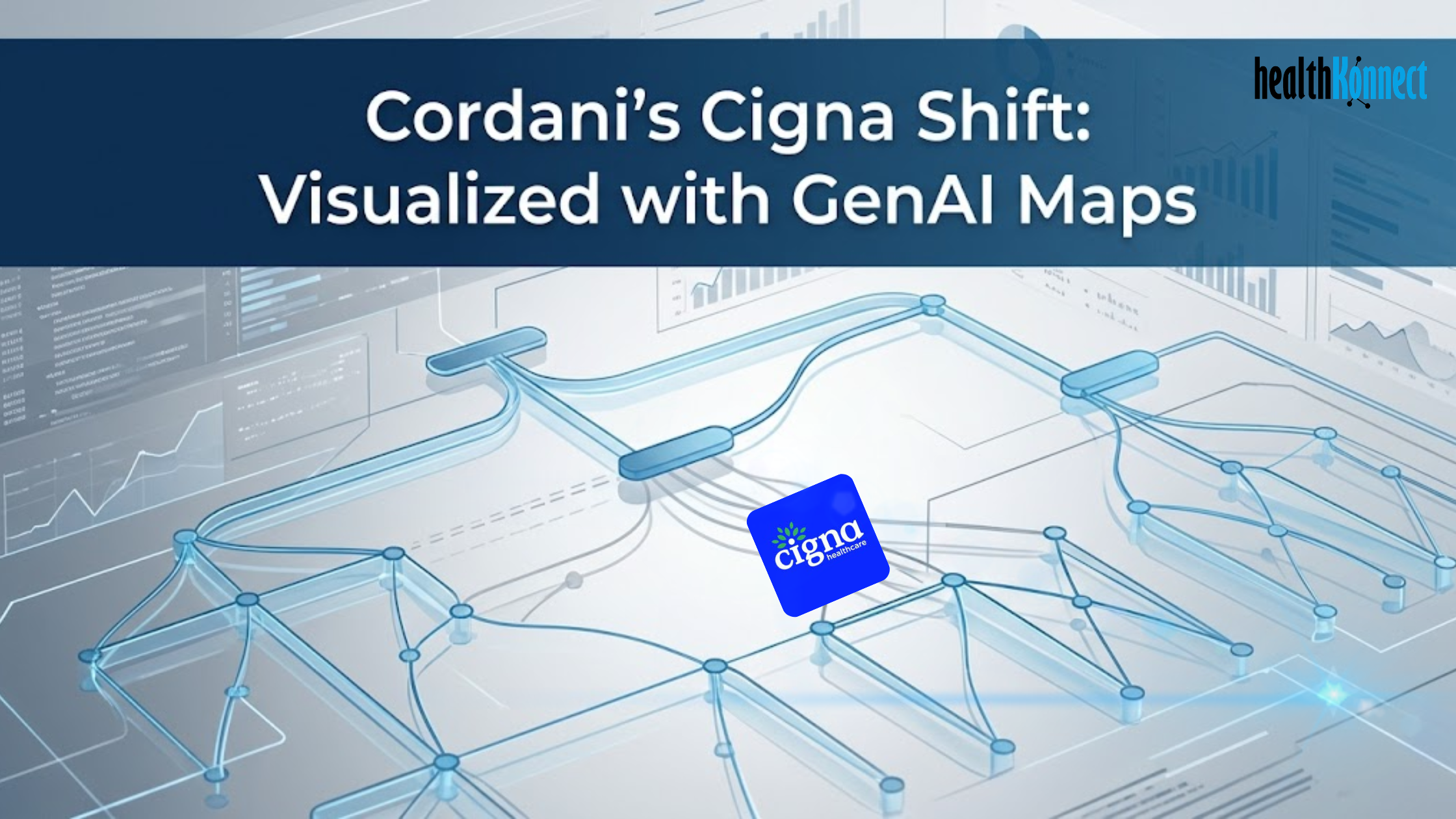
To intercept these opportunities, marketers must discard the simplistic question: What does a healthcare company org chart look like? The answer is no longer a static pyramid of boxes and lines. An actionable healthcare company org chart must operate as a live data model driven by generative artificial intelligence (GenAI).
GenAI engines ingest thousands of unstructured data feeds, including regulatory filings, press releases, public board announcements, and executive job boards. By synthesizing these signals, the technology constructs a predictive map of the organization.
| Data Attribute | Static Corporate Directories | GenAI-Driven Account Mapping |
|---|---|---|
| Update Frequency | Quarterly or annual manual reviews | Real-time continuous data ingestion |
| Data Scope | Standard contact details and titles | Contextual reporting lines and history |
| Vacancy Tracking | Relies on manual user reporting | Automated detection via public signals |
| Predictive Value | Zero historic backward-looking view | Maps secondary internal promotion pathways |
| Pipeline Impact | High bounce rates and cold outreach | Precision timing for executive onboarding |
When tracking a major payer entity, this intelligence engine maps how the vacancy of a commercial lead impacts regional vice presidents, director-level buyers, and procurement committees. It identifies the precise moment an interim leader takes the helm, signaling the optimal window to introduce operational analytics that support their transition strategy.
How do enterprise marketing teams turn structural flux into market dominance?
Capitalizing on major executive movements requires an immediate operational redesign of your go-to-market motion. Knowing that a transition is occurring at Cigna or Independence Blue Cross is only valuable if your sales and marketing workflows can ingest that intelligence at scale.
Enterprise marketing teams must shift from static, persona-based messaging to dynamic, trigger-based campaigns. The moment a GenAI-driven solution flags an executive vacancy or appointment within a target healthcare organizational structure, the account must be routed into a specialized workflow:
- Phase 1: The Vacancy Hold. Automatically pause all generic outbound sequences to the affected tier to protect brand reputation.
- Phase 2: Influence Mapping. Identify the temporary decision-makers who inherit budget authority during the interim period, routing targeted value propositions to those specific individuals.
- Phase 3: The First-100-Days Sequence. Deploy highly tailored content to the newly appointed executive on day one, positioning your solution as a tool to help them audit legacy systems.
By replacing broad, horizontal marketing with hyper-targeted, event-driven orchestration, healthcare analytics firms secure a definitive advantage. While competitors continue chasing ghosts in an outdated directory, agile firms utilize real-time structural visibility to guide new decision-makers through corporate transition.
Frequently Asked Questions (FAQs)
Q. How does tracking a healthcare company org chart improve sales velocity?
Tracking a live organizational chart reduces sales cycles by eliminating outreach to executives who have vacated their roles. It allows sales teams to engage the specific individuals who inherit budget authority during structural realignments.
Q. What breaks first in a B2B campaign when a payer executive exits?
The primary failure point is messaging relevance. Automated email sequences continue targeting an outdated strategy or an absent decision-maker, leading to dropped engagement and lost credibility within the account.
Q. Why is GenAI necessary to map a healthcare management structure?
Enterprise healthcare organizations are too complex for manual tracking. GenAI continuously processes unstructured text across regional announcements and regulatory filings, instantly updating reporting relationships far faster than human data teams can execute.
Q. How do C-suite exits in 2026 impact long-term healthcare IT procurement?
Every major executive exit triggers a review of existing software vendors. Incoming leaders validate their budgets, meaning legacy platforms face intense scrutiny while agile vendors offering clear cost-containment metrics find a window to replace incumbent solutions.
Q. Can an interim leader make major technology purchasing decisions?
Yes, but their risk tolerance differs. Interim leaders focus on stabilizing operations, mitigating compliance risks, and fixing systemic pipeline issues, making them highly receptive to fast-deploying analytics tools that offer instant operational clarity.
To gain access to real-time intelligence and map critical enterprise accounts today, CLICK HERE to leverage BizKonnect’s GenAI-driven health company org charts.
CLICK HERE to know more with BizKonnect.