


Say "fractional sales" to a B2B founder, and they usually picture a freelancer juggling six unrelated gigs- someone sending a few emails between contracts, forwarding lukewarm leads, and vanishing when deals get complex.
That mental model costs growing companies months of wasted US expansion.
Entering the US enterprise market from abroad is a classic two-way trap. If you rely purely on offshore outbound, US buyers ignore cold calls and unfamiliar time zones. Yet if you hire a full-time US VP of Sales before proving product-market fit, you burn $250,000+ in salary, benefits, and recruiting fees, often waiting six to nine months just to find out your messaging needs work.
The fix is neither a freelancer nor a premature full-time executive. It is an embedded US Country Manager: a seasoned sales leader with 15+ years of domain experience who plugs directly into your go-to-market engine, backed by an entire intelligence and outbound support system.
Why "Freelance" Is the Wrong Frame
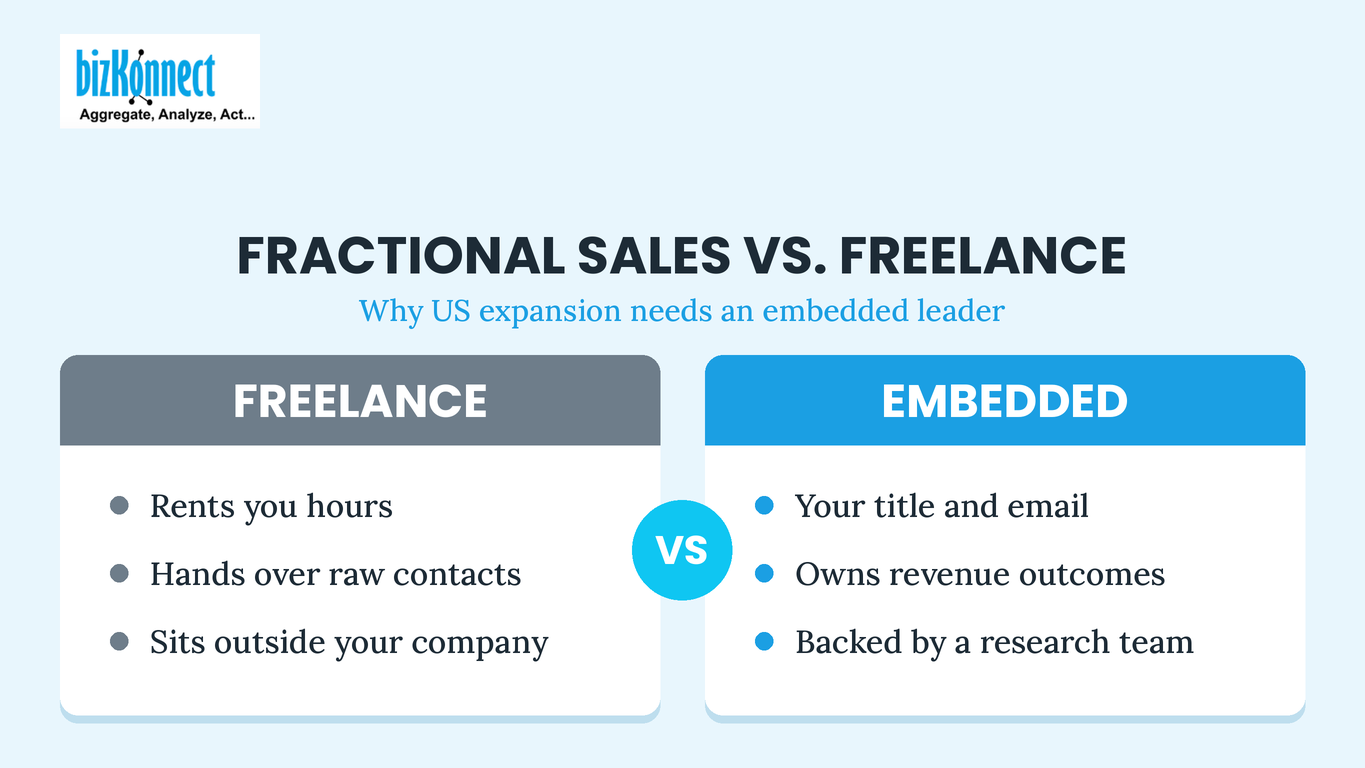
A freelancer operates outside your company. They rent you hours, work off your existing collateral without challenging it, and hand over raw contacts rather than owning revenue outcomes.
An embedded fractional Country Manager operates like an internal executive who simply works on a fractional allocation:
- Brand Identity: They carry your official title, company email address, and LinkedIn presence- not a third-party agency signature.
- Domain Authority: With 15+ years of experience in your vertical (such as SaaS, IT, Healthcare, or BFSI), they speak the buyer’s language from day one without six months of onboarding.
- Warm Network Access: Instead of relying strictly on cold lists, they activate their existing Rolodex of industry peers alongside ecosystem partner connections to open doors offshore teams cannot reach.
What "Embedded" Looks Like in Practice
Calling someone "embedded" means nothing without operational integration. In a true embedded setup, your local leader runs inside your daily revenue workflow rather than sitting in an external silo:
- Full CRM Integration: Every discovery call note, deal stage update, stakeholder map, and objection log goes directly into your Salesforce, HubSpot, or Pipedrive instance in real time.
- End-to-End Pipeline Ownership: They do not just book intro calls and toss them over the fence. They lead discovery, run product demos, represent you on the floor at US industry conferences, negotiate terms, and drive SQLs to close.
- Weekly Executive Cadence: You get structured pipeline reviews, deal-by-deal win/loss feedback, and clear activity reporting, giving headquarters direct visibility into how US buyers react to your pricing and positioning.
The Ideal Use Case: Proving US Market Fit Before Heavy Overhead
Consider a profitable B2B tech firm in India or Europe with strong domestic traction and a handful of inbound US logos. Leadership wants to scale in North America, but signing a year-long lease and committing to a full-time US sales director feels premature.
By starting with a 3-month pilot (with a two-week exit option), the company puts an experienced local executive in the US time zone immediately. Over 90 days, that leader tests ICP hypotheses in live buyer conversations, attends key trade shows, and builds early qualified pipeline. Once revenue becomes predictable, the company can scale its US footprint with hard market data instead of guesswork.
Not Just a Lone Wolf: A Supported GTM System
Even the sharpest senior seller fails if they spend half their week scraping contact lists, cleaning bounced emails, and manually updating spreadsheets. A solo fractional rep without back-office support quickly turns into an overpriced SDR.
The embedded Country Manager model works because the executive is backed by a dedicated remote intelligence and execution engine:
- Account Mapping & Verified Data: Analysts map up to 100 buying-committee stakeholders per target account using a continuously refreshed, human-verified B2B knowledge graph identifying decision-makers, influencers, and warm alumni or customer paths.
- Multi-Channel Campaign Execution: A remote team builds ICP lists, runs coordinated email, LinkedIn, and phone outreach, and books pre-scheduled 1-on-1 meetings around major US conferences.
- 100% Focus on Selling: Because research, list enrichment, and initial campaign sequences happen behind the scenes, your local Country Manager spends their hours doing what only a senior in-market executive can dobuilding trust and closing deals.
Frequently Asked Questions
1. How is a fractional Country Manager different from hiring an outsourced SDR agency? An SDR agency only books top-of-funnel meetings using junior reps, leaving your founders to wake up at midnight for US discovery calls, demos, and negotiations. A fractional Country Manager is a senior, US-based seller with 15+ years of experience who represents your brand locally and carries deals all the way to signature.
2. Will a fractional executive really represent our company directly to US enterprise buyers? Yes. Once shortlisted and approved by your leadership team, the executive uses your official email domain, title, and LinkedIn profile so prospects experience a seamless, local enterprise sales motion.
3. How does the executive avoid wasting time on prospecting and admin work? They do not work alone. A dedicated remote team handles ICP account research, org-chart mapping, warm-connection discovery, multi-channel outreach, and CRM hygiene, keeping the executive’s calendar focused on live buyer meetings and demos.
4. What happens if the US market fit or executive alignment isn't working? Unlike a full-time US hire that locks you into heavy severance, benefits, and recruiting costs, you can validate the motion through a structured 3-month pilot with a two-week notice exit option.
5. Can this model support US trade shows and industry events? Yes. Before the event, remote analysts identify high-value attendees and book confirmed booth or coffee meetings; during the conference, your local executive pitches on the floor; afterward, the team runs structured follow-up sequences until deals close.
Before you post a $250K job requisition for a US sales director: Look at your current US pipeline and ask yourself: do you actually need a permanent full-time payroll commitment this quarter, or do you need a seasoned local leader backed by a full research engine to prove repeatable revenue over the next 90 days?
Analyse it with BizKonnect
CLICK HERE to know more with BizKonnect.