


More automation and higher token bills: that is the contradiction quietly showing up in enrichment budgets across revenue operations teams. A workflow gets connected to an LLM, a spreadsheet of 10,000 contact or account rows gets queued for cleansing, and the invoice at the end of the month tells a different story than the one the pitch deck promised.
The assumption was simple: automate row-by-row enrichment, remove manual labor, and cut cost.
What actually happens is that a system prompt gets sent again, and again, and again, once for every single row, because raw API calls carry no memory between requests. Each row pays for context it already paid for a moment ago.
This blog traces where that cost actually comes from, why it compounds instead of flattening, and what an orchestration layer changes about the economics of CRM data enrichment.
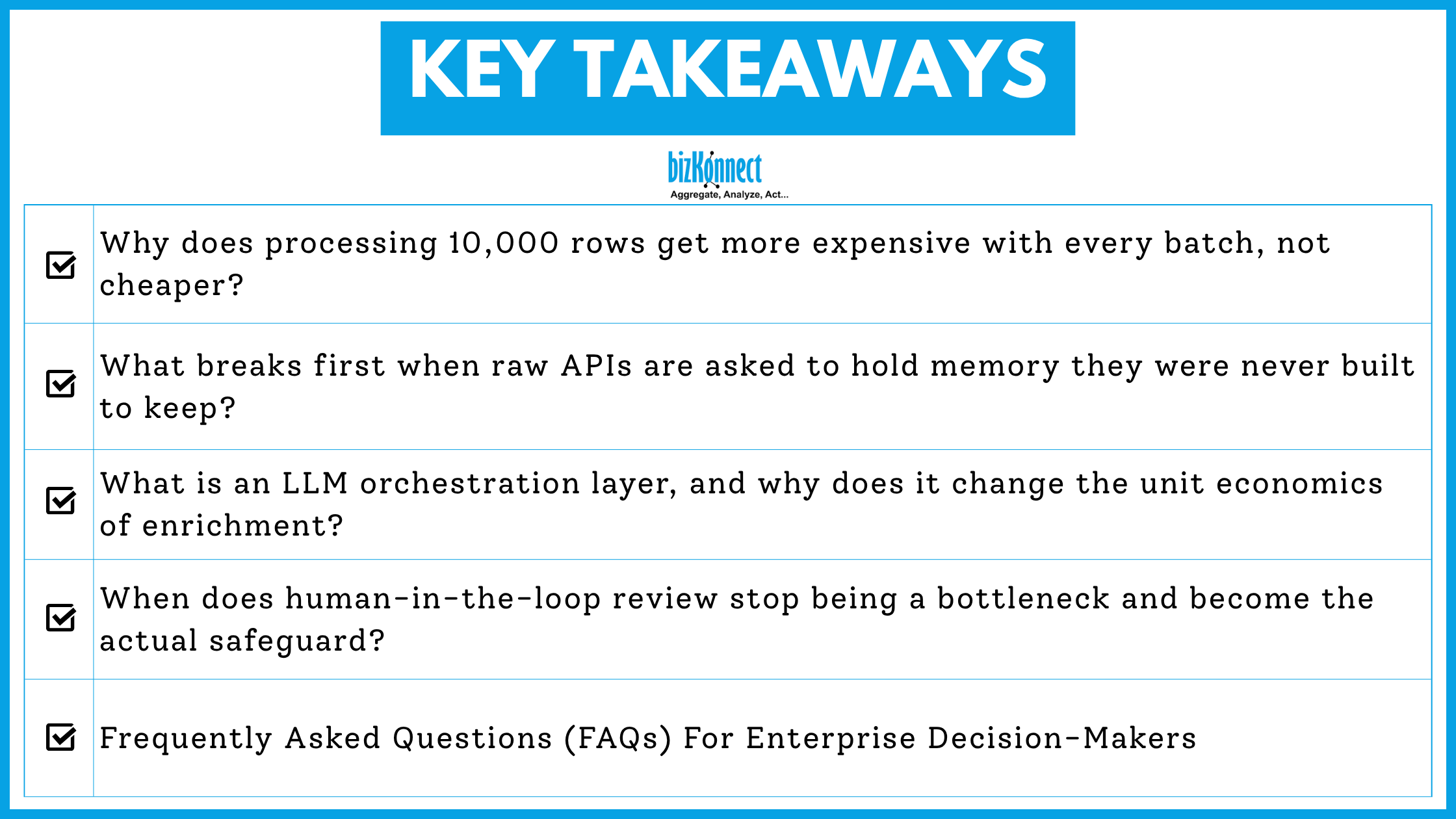
Why does processing 10,000 rows get more expensive with every batch, not cheaper?
Raw LLM calls are stateless by design. Every request to an API endpoint starts from zero. There is no working memory of the last row processed, no shared understanding carried forward, no accumulated context that reduces the next call's overhead.
That statelessness has a direct financial consequence for spreadsheet-scale work:
- The same system prompt, instructions, and formatting rules get re-transmitted with every row
- Token costs scale linearly with row count, but the fixed overhead per row never shrinks
- A 10,000-row file does not get 10,000 times more valuable output; it gets 10,000 times more repeated context
Most teams evaluating "AI Data Enrichment" tools benchmark against a demo of 50 or 100 rows, where repeated overhead is invisible. The economics only become visible at production volume, which is precisely when the invoice becomes a budget conversation instead of a technical detail.
What breaks first when raw APIs are asked to hold memory they were never built to keep?
Cost is the first symptom. Reliability is the second, and it tends to arrive without warning.
Enrichment pipelines built directly on raw API calls hit structural limits that have nothing to do with data quality:
- Rate limits throttle throughput once row volume crosses a threshold, forcing retries that add latency and cost
- Timeout crashes interrupt long-running batch jobs mid-file, especially when enrichment requires multi-field lookups per row
- Truncated rows leave a spreadsheet half-processed, with no clean signal of where the failure occurred or why
This is where the industry's engineering conversation has already moved. Recent architectural work on production LLM pipelines points to a consistent root cause: most failures in multi-source systems trace back to cramming too much into a single prompt, which causes evidence to get dropped or parts of the input to be silently ignored. Spreadsheet enrichment is a multi-source problem wearing a single-column disguise. Every row draws on prior context, formatting rules, and validation logic that a stateless call cannot retain.

What is an LLM orchestration layer, and why does it change the unit economics of enrichment?
An orchestration layer sits between the spreadsheet and the model. Instead of firing one isolated prompt per row, it batches related rows, caches repeated context, and templates the instructions that would otherwise be retransmitted every time.
The underlying logic mirrors a pattern now well established in production LLM design: separate the bounded, repeatable work from the reasoning that actually needs the model's attention. In practice, that means unstructured evidence is broken into small, independently processable pieces, while stable context is summarized a single time and reused across every downstream call instead of being retransmitted at full token cost with each request. Applied to CRM data, this means firmographic rules, formatting logic, and enrichment schemas are defined once and referenced, not rewritten into every row's prompt.
The practical shift:
- Batching groups similar rows so shared context is paid for once, not thousands of times
- Caching stores stable reference logic (industry taxonomies, title normalization, domain matching) instead of resending it
- Templating locks formatting and validation rules into a reusable structure, reducing drift between rows
This is the operational definition of an orchestration layer for anyone searching for a working CRM managed services guide: it is not a nicer prompt, it is a system that treats token overhead as an engineering problem rather than a pricing footnote.
When does human-in-the-loop review stop being a bottleneck and become the actual safeguard?
Even a well-orchestrated pipeline produces output that needs a check. This is where CRM managed services diverge from pure automation plays. A GenAI-trained analyst reviewing enriched output is not redundant labor bolted onto a finished process; it is the correction layer that catches what token-optimized batching alone cannot.
The failure pattern to watch for:
Teams that automate enrichment fully and skip review tend to discover errors only after they propagate into segmentation, scoring, or outbound targeting, at which point the cost of the mistake is far higher than the cost of catching it. Structured pipelines that separate evidence from context, cite every claim to its source, and flag conflicting signals rather than silently resolving them in the model's favor, produce output that is easier for a human reviewer to audit quickly rather than re-verify from scratch.
CRM managed services for enterprise buyers specifically need this layer, because enterprise CRM data carries higher blast radius per error, more downstream systems consuming the same record, and less tolerance for silent data drift across quarters.
Why does "clean data" stop being the finish line for CRM optimization?
A cleansed spreadsheet is not the same as an enriched, decision-ready CRM. Data enrichment that formats fields correctly but misses context, ownership signals, or freshness still produces a record that looks trustworthy and behaves unreliably. CRM optimization at scale depends on treating enrichment as a continuous operational discipline, not a one-time batch job that gets rerun whenever the data looks stale again.
Frequently Asked Questions (FAQs)
Q1. Does an orchestration layer replace the need for human review in CRM enrichment?
No. It reduces token waste and processing failures, but human-in-the-loop review remains the safeguard against subtle errors that automated batching cannot catch on its own.
Q2. How is CRM managed services different from a standard data enrichment API integration?
A managed service combines the orchestration layer (batching, caching, templating) with trained analysts who validate and correct output, rather than leaving raw model output to flow directly into the CRM.
Q3. What causes rows to get truncated during large-scale enrichment jobs?
Timeout limits and rate limits on raw API calls interrupt long batch jobs, especially when each row requires multiple lookups or enrichment steps without a caching layer to reduce repeated overhead.
Q4. Is CRM managed services for enterprise different from enrichment for smaller teams?
Yes. Enterprise volume amplifies both the token overhead problem and the cost of an undetected error, making orchestration and human review proportionally more important as row count and system count grow.
Q5. Does batching rows reduce enrichment accuracy?
Not when batching is paired with section-aware validation and citation rules. The goal is to reduce repeated context, not to reduce the model's attention on each individual row's content.
Q6. How often should enriched CRM data be reprocessed?
Enrichment is not a one-time job. Ownership, firmographic, and intent signals change continuously, so CRM optimization requires scheduled re-enrichment rather than a single cleansing pass.
Spreadsheet-scale enrichment breaks in predictable ways once volume rises, but the fix is architectural, not just budgetary. Teams evaluating how to close this gap can CLICK HERE to see how BizKonnect's CRM managed services combine orchestration with human-in-the-loop analysts to keep enrichment accurate at enterprise scale.
CLICK HERE to know more with BizKonnect.