


Market penetration metrics reveal a troubling contradiction. Organizations building go-to-market (GTM) strategies for complex risk management solutions face a hard reality:
Traditional data validation playbooks collapse under the weight of regional compliance shifts, fluctuating buyer behavior, and highly specialized corporate structures. B2B expansion strategy routinely miscalculates the sheer complexity of entering a new market. A recent research indicates that organizations frequently misjudge regulatory overhead and buyer entrenchment, turning high-conviction market expansions into capital-intensive experiments.
As a result, launching new risk management ecosystems often stalls from data fragmentation.
When go-to-market teams scale operations across borders or verticals, their underlying data pipelines fail to keep pace, leaving sales teams to navigate unverified accounts and mismatched buyer personas.
Why Do Traditional Data Playbooks Fail in New Risk Markets?
Expanding a risk management solutions ecosystem requires moving beyond broad industry classifications. Relying on basic firmographics to target decision-makers fails because risk ownership is highly decentralized. In one territory, compliance sits under general counsel; in another, it is embedded within operations, security, or finance.
When organizations rely on static third-party databases, several critical operational points break down.
- Decentralized Persona Disconnect: Standard filter mechanisms cannot isolate who owns vendor risk, operational risk, or financial compliance across varying corporate structures.
- Decay of Static Data: Corporate directories degrade rapidly during market shifts, forcing outbound teams to waste cycles on out-of-date or inaccurate contact records.
- Compliance Divergence: Emerging regional regulations render legacy targeting parameters obsolete, exposing organizations to go-to-market friction before a single pitch occurs.
According to a recent report, organizations that rely solely on passive inbound strategies during expansion struggle to capture market share because new markets demand aggressive, highly targeted outbound orchestration.
However, forcing an outbound motion through unverified, static databases creates substantial GTM risk management challenges. Sales cycles stretch, outbound reply quality drops, and CRM systems quickly fill with duplicate, fragmented data.
What is The Hidden Operational Drag of Fragmented CRM Systems?
An expansion strategy is only as fast as its data infrastructure.
When an enterprise introduces new risk products to an unfamiliar territory, sales and marketing systems inevitably drift apart. Regional teams stand up siloed databases, marketing automation platforms fire misaligned campaigns, and the core CRM becomes fragmented.
This infrastructure drag directly impacts the bottom line:
| Operational Failure Point | Second-Order Consequence | GTM Financial Impact |
|---|---|---|
| Siloed Regional Lead Lists | Fragmented workflows and duplicate accounts | Inflated customer acquisition costs |
| Unmapped Corporate Hierarchies | Reps multi-threading into wrong subsidiaries | Extended sales cycles, lost momentum |
| Outdated Lead Scoring Rules | Low-intent leads routed directly to account executives | Wasted sales capacity on unqualified pipelines |
To solve this, operations leaders are shifting toward comprehensive CRM managed services for market expansion and sales growth.
These services ensure that CRM workflow management keeps pace with evolving go-to-market strategies, avoiding the data decay that typically sabotages global expansions. Without continuous data entry, maintenance, and system customization, marketing automation investments underperform, and sales reps spend more time cleaning data than speaking with qualified prospects.
How GenAI-Trained Research Teams Reduce GTM Risk?
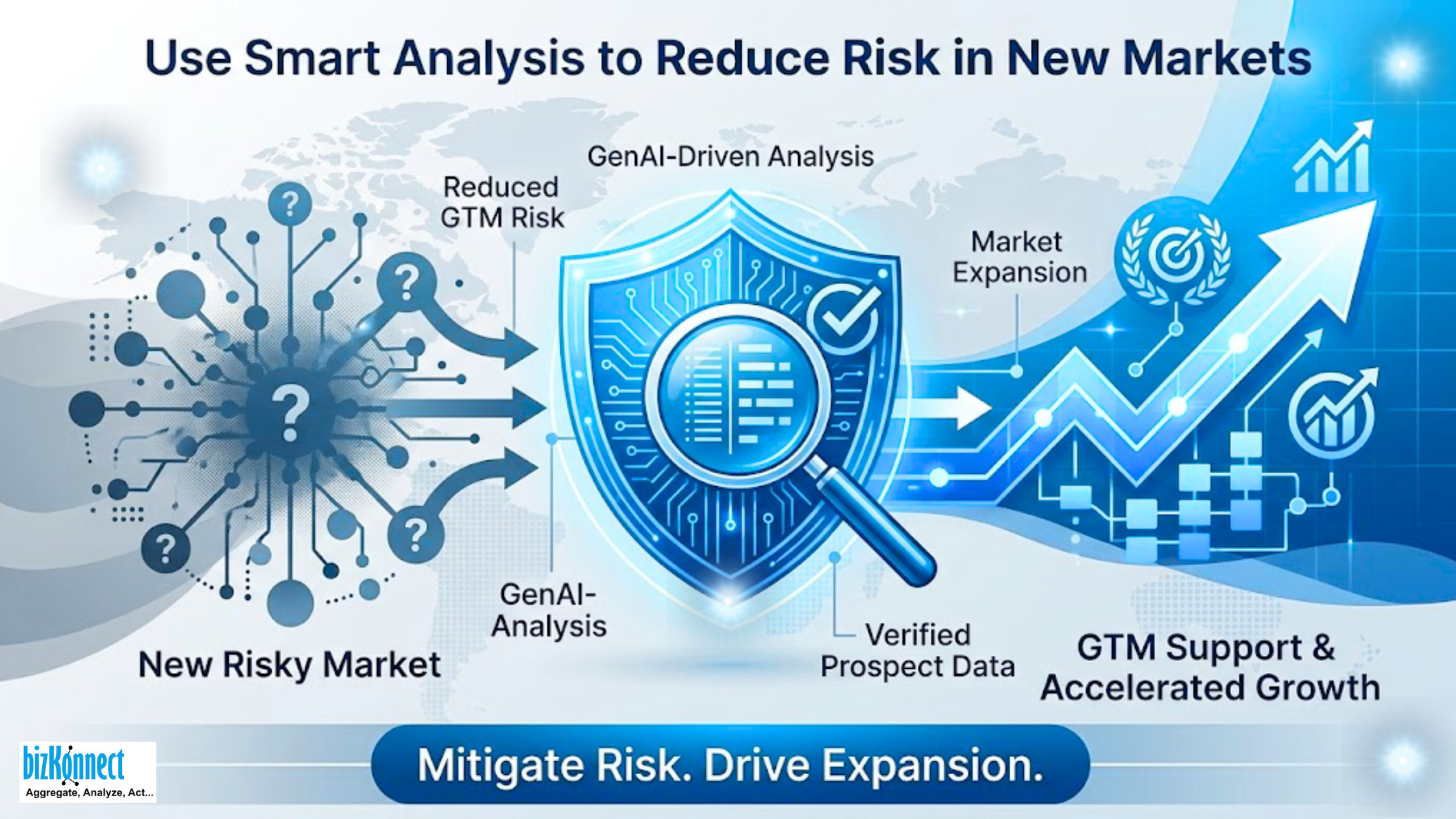
To eliminate the operational friction of market expansion, leading organizations are deploying specialized, virtual extended teams: dedicated expert analysts trained in GenAI solutions. This framework combines the speed of generative artificial intelligence with the precision of human validation to build highly accurate, customized data pipelines.
Standard AI tools often produce inaccurate results when analyzing complex corporate structures. However, when research analysts use GenAI specifically for deep data verification, they build an accurate, highly structured foundation for market entry.
Here’s how they do this in practice:
- Advanced System Configuration and Customization
GenAI-trained analysts align your CRM configuration with specialized workflows, terminology, and custom layouts. This structure ensures that fields specifically capture the nuanced risk parameters required for complex decision-making, deal monitoring, and relationship evaluation.
- Dynamic Data Validation and Enrichment
Instead of executing simple database scrubbing or database de-duplication, these teams perform deep data append and enhancement. They resolve inconsistencies and append missing context including precise job titles, Standard Industrial Classification (SIC) codes, company size, and complex corporate groupings, ensuring sales teams work with highly accurate data.
- Precise Lead Research and Predictive Scoring
Analysts conduct extensive market research, prospect identification, and lead profiling to isolate active risk management initiatives. They map out attendee contact details from industry events and build verified contact lists so outbound teams can execute targeted campaigns without delay.
- Automated Campaign Execution and Synchronization
By managing both CRM and marketing automation platforms, these analysts optimize list segmentation, campaign setup, and A/B testing across channels like email, WhatsApp, SMS, and major social platforms. This ensures data flow stays synchronized and eliminates operational silos.
Deploying GenAI-trained analysts changes how an organization approaches a new market.
Instead of relying on broad, automated campaigns that get ignored, go-to-market teams can execute highly personalized outreach based on accurate corporate data.
This approach allows research teams to map out entire corporate hierarchies, identify decision-makers, and uncover pre-scheduled meeting insights before outbound outreach begins. When CRM managed services for GTM operate with this level of accuracy, pipeline predictability improves, sales cycles shorten, and the financial risks of market expansion drop significantly.
Frequently Asked Questions (FAQs)
Several practical questions tend to surface during evaluation and execution of this approach. Here are some of them:
Q. How do CRM managed services support GTM strategy when entering a new risk management segment?
They align the CRM environment to the new segment's workflows, terminology, and relationship structures before outreach begins through field configuration, data migration, and continuous maintenance. So, sales teams operate on segment-accurate data rather than a legacy setup.
Q. What distinguishes GenAI-assisted lead research from standard database providers?
Standard database providers sell static, historical lists that degrade quickly. GenAI-assisted research combines automated data collection with human validation to find, clean, and verify contact data in real time, delivering accurate lists tailored to custom target profiles.
Q. Why is deep data enhancement critical for risk management products?
Risk management solutions cannot be sold using basic firmographics like company size or headcount. Enterprise buyers require deep data enrichment, including corporate parent-subsidiary hierarchies, specialized job titles, and specific technology configurations, to ensure outreach reaches the correct risk owners.
Entering a new market segment within the risk management solutions ecosystem is actually a data and workflow alignment problem that compounds with every week of delay. The firms that close the execution gap before the campaign launches build durable pipelines; those that wait for disappointing results to prompt action fund expensive proof-of-concept sprints instead.
CLICK HERE to explore how BizKonnect's GenAI-trained research analysts can configure your CRM, validate your prospect data, and build the execution infrastructure your next market entry actually needs.
CLICK HERE to know more with BizKonnect.