


This scenario plays out across B2B sales teams every quarter and this is where email marketing for B2B sales teams begins to show its limits if it is not structured for multi-threading. Reaching one contact is no longer enough because most B2B purchases involve a committee, each with different priorities and levels of influence.
This guide breaks down why single-contact selling breaks down, what multi-threading actually demands in practice, and how GenAI-driven org charts and B2B contact enrichment can create a more reliable path to closing.
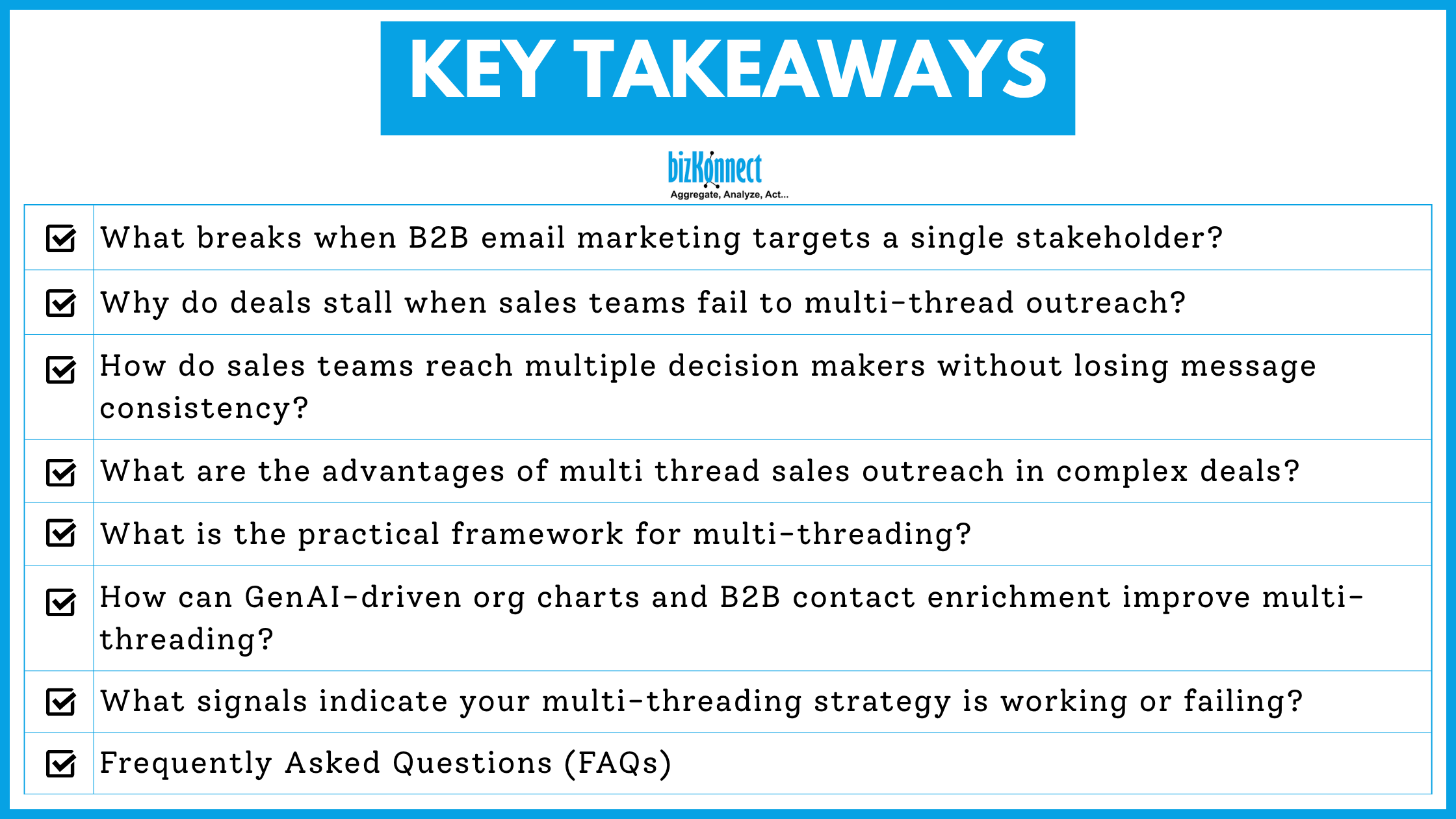
What breaks when B2B email marketing targets a single stakeholder?
Single-threaded outreach creates a fragile deal structure. It relies too heavily on one contact to advocate internally, translate value across departments, and carry the deal forward.
In practice, this rarely holds.
A recent report shows that a typical B2B buying group includes 6 to 10 decision makers, each contributing to evaluation and approval. When outreach focuses on only one or two individuals, the following issues emerge:
- Information distortion: Your message gets filtered through one person’s understanding
- Internal misalignment: Different stakeholders develop conflicting views of your solution
- Delayed objections: Concerns surface late, often when the deal is close to closure
- Deal vulnerability: If your primary contact leaves or disengages, progress resets
This is where traditional B2B email marketing campaigns fall short because they are often designed for scale, instead of stakeholder diversity.
However, a more resilient approach requires mapping the buying committee and engaging multiple roles in parallel. This is the foundation of multi-threading.
Why do deals stall when sales teams fail to multi-thread outreach?
Rather than just increasing the number of contacts, multi-threading is about building influence across the buying group in a structured way. It reduces reliance on a single champion and creates broader internal support.
When teams do not adopt this approach, several patterns appear:
- Late-stage surprises: Technical or financial objections arise after weeks of engagement. These could have been addressed earlier with the right stakeholders involved.
- Weak internal advocacy: Your primary contact may support your solution but lacks authority to drive consensus.
- Slow decision cycles: Without alignment across departments, approvals move sequentially instead of in parallel.
- Loss to “no decision”: A common outcome where the deal does not go to a competitor but simply stalls indefinitely.
These patterns arise a critical question:
How do sales teams reach multiple decision makers without losing message consistency?
Effective multi-threading requires three things working together:
- Stakeholder mapping before outreach begins. Who holds budget authority? Who drives technical validation? Who are the likely blockers, and who has internal credibility to champion the deal forward? Without this map, email sequences are generic.
- Role-specific messaging. The CFO needs ROI framing. The VP of Operations cares about process disruption and efficiency. The IT director needs security and integration clarity. Each email thread has to reflect those individual priorities.
- Coordinated sequencing. When your team is touching five stakeholders in the same account, the timing and content of each outreach needs to reinforce a single, coherent business case. Contradictory or inconsistent messaging across the committee is a fast way to lose trust and stall consensus.
B2B contact enrichment plays a critical role here.
Without accurate, current contact data including job titles, reporting structures, email addresses, and LinkedIn profiles, even the best-crafted sequence lands in the wrong inbox or misses the actual decision authority entirely.
What are the advantages of multi thread sales outreach in complex deals?
The advantages of multi-thread sales outreach go beyond deal protection, though that's the most immediate benefit.
- Higher deal stability
- Faster alignment
- Stronger objection handling
- Improved win rates
- Better insight into decision dynamics
What is the practical framework for multi-threading?
To apply this effectively and gain these advantages, sales teams can follow a simple structure:
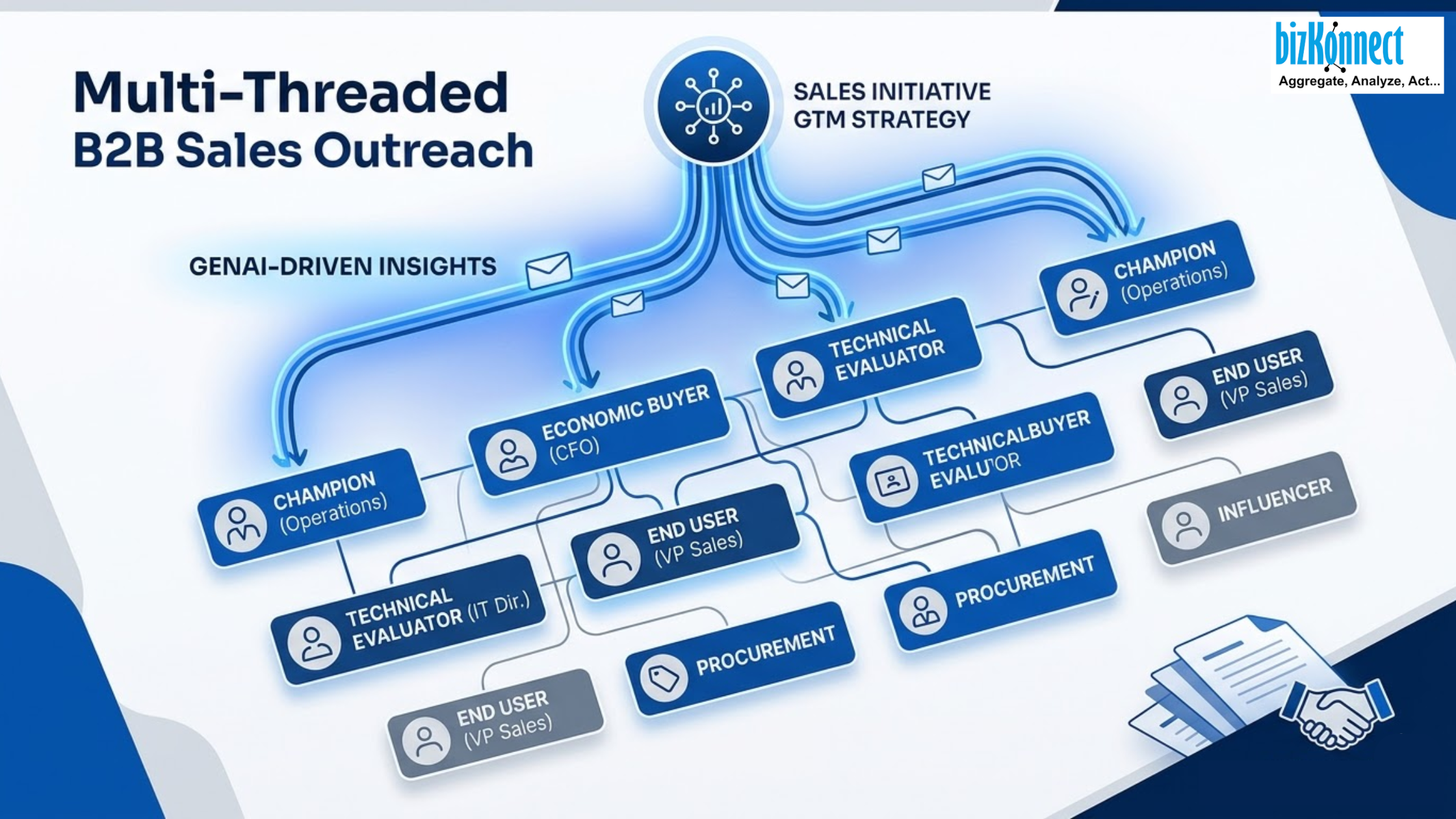
Step 1: Identify key roles: Economic buyer, Technical evaluator, End user, Procurement or finance
Step 2: Map messaging to each role: ROI and cost justification for finance, Integration and risk for technical teams, Usability and outcomes for end users
Step 3: Sequence outreach: Begin with your entry point, Expand laterally across roles within the same account, Maintain consistent but role-specific communication
Step 4: Track engagement patterns: Who responds, Who forwards emails internally, Where conversations slow down
This approach moves beyond basic email marketing for B2B sales teams and turns outreach into a coordinated engagement strategy.
How can GenAI-driven org charts and B2B contact enrichment improve multi-threading?
The main barrier to multi-threading is visibility. Sales teams often do not know who else is involved in the decision, how stakeholders are connected, or which roles carry the most influence. This is where B2B contact enrichment and GenAI-driven org charts play a critical role.
What GenAI-driven org charts solve:
They provide a dynamic view of the target account, including reporting structures, functional roles, likely buying committee members, and influence pathways within the organization. Instead of guessing, teams can prioritize outreach based on actual organizational context.
How this changes execution:
- Smarter account mapping: You can identify not just contacts, but relationships between them.
- Targeted expansion: Rather than broad prospecting, you expand within the account with purpose.
- Better timing: You engage stakeholders when their involvement is most relevant.
- Reduced research time: Manual account research is replaced with automated insights.
When combined with B2B email marketing, enriched data enables:
- Personalized messaging at scale
- Role-specific email sequences
- Coordinated outreach across stakeholders
- Better segmentation within a single account
What signals indicate your multi-threading strategy is working or failing?
Even with the right tools and intent, execution can vary. Monitoring key signals helps teams adjust early.
Positive Signals:
- Multiple stakeholders respond or engage with emails
- Internal referrals within the account increase
- Meetings include participants from different functions
- Objections are raised earlier and addressed constructively
Warning Signals:
- Only one contact engages consistently
- Email responses slow down after initial interest
- New stakeholders appear late in the process
- Deals extend without clear next steps
Quick Audit Checklist:
- Are you engaging at least 3 to 5 stakeholders per account?
- Does each stakeholder receive role-specific messaging?
- Are you tracking engagement across the buying group?
- Do you know who the final decision maker is?
If the answer to any of these is unclear, your multi-threading approach needs refinement.
However, navigating these dynamics raises a few important questions. With these challenges and solutions in mind, here are the most common ones we see:
Frequently Asked Questions (FAQs)
1. At what stage of the sales cycle should multi-threading begin?
Multi-threading should start as early as the discovery stage, not after your champion has already built a narrative internally, because by then you may be working against gaps you cannot see.
2. How do you approach a new stakeholder without making your existing champion feel bypassed?
Always loop in your champion when adding a new contact, framing it as bringing additional support to help move things forward.
3. What role does B2B contact enrichment play in multi-threaded outreach?
Enriched contact data ensures you have verified information on each stakeholder's role, seniority, and communication preferences. Without it, even a good multi-threading strategy will reach the wrong inboxes.
Multi-threading is no longer optional in complex B2B sales. It is a structural requirement for navigating modern buying committees. When supported by accurate data and clear account visibility, it transforms outreach from isolated conversations into coordinated influence.
CLICK HERE to explore how BizKonnect helps you execute multi-threaded sales with GenAI-driven org charts.
CLICK HERE to know more with BizKonnect.