


Every mid-to-late August, the consumer packaged goods (CPG) and retail technology sectors hit a predictable operational bottleneck. The industry calendar points firmly toward Denver for “Newtopia Now.” For brands aiming to capture the attention of decision makers from Target, Walmart, and independent grocers across the United States, the event represents a critical market gatekeeper. The potential upside of gaining regional or national shelf space, establishing pilot programs, or validating a new product line is undeniable.
The Cost of Being at “Newtopia Now 2026”? When Event ROI Competes with Core Operations
- Capital Allocation: The true cost of sending a core team overseas or cross-country means factoring in flights, lodging during peak convention dates, booth space, and material logistics. This frequently competes with essential product R&D or domestic marketing spend.
- Administrative Bottlenecks: For international brands looking to scale into the US market, visa processing queues and regulatory timelines frequently fail to align with hard summer deadlines.
- Opportunity Cost of Bandwidth: Taking two or three senior sales leaders or founders off their day-to-day operational tracks for a week creates a vacuum at headquarters. While they are walking the floor in Colorado, domestic pipeline management, product delivery, and existing client accounts inevitably slow down.
Sitting out “Newtopia Now” means conceding a competitive advantage and leaving a market vacancy that agile competitors are eager to fill. Conversely, forcing attendance under strained operational conditions risks internal disruption and low-yield execution. The flaw in this equation lies in a legacy assumption: that physical travel by home-office executives is the only mechanism available to capture market share at major retail events. In 2026, the brands achieving the highest return on objective are those realizing that market expansion is no longer an exercise in logging frequent flyer miles. It is an exercise in resource optimization and on-the-ground conversation control.
The 'Business Card Trap': Have You Analyzed Real Event ROI? Or, Just Betting on Random Chance at “Newtopia Now 2026”?
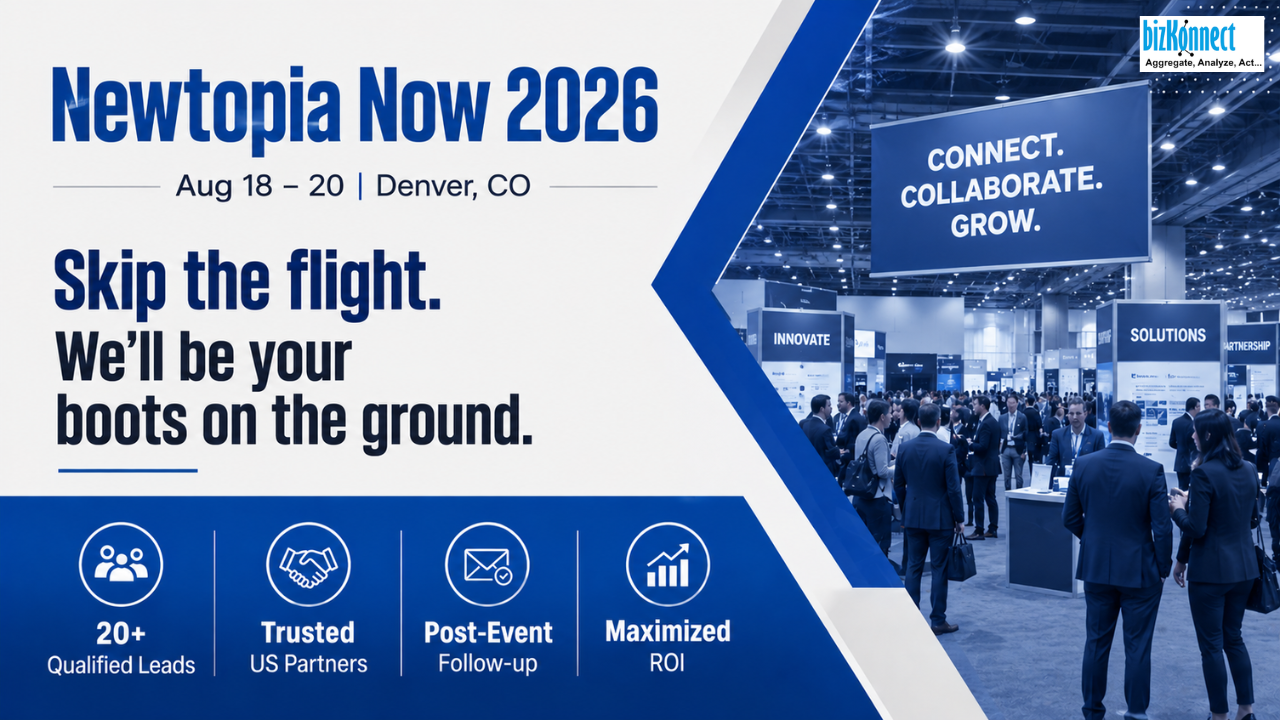
To understand why the traditional approach to events like “Newtopia Now” can take a backseat, one must analyze the mechanics of the standard trade show floor. For decades, the standard playbook for event marketing followed a linear path: book a space, ship marketing collateral, fly in the executive team, stand in a booth, and hope for high-intent foot traffic.
While this approach feels active, it subjects a brand’s growth to random chance. A corporate buyer walking the floor at “Newtopia Now” is bombarded by hundreds of exhibitors over a three-day window. Their attention span is fragmented; their schedules are tightly packed with pre-arranged commitments. The likelihood of a meaningful, deep-dive business conversation occurring via a spontaneous booth visit is statistically marginal.
The Outcome? Seamless US Expansion Without the Overhead
- High Volume, Low Intent: Teams return to the office with pockets full of business cards collected from peripheral attendees, service providers, or low-level managers without purchasing authority.
- The Follow-Up Decay: By the time the internal team returns home, catches up on the email backlog built up during their absence, and attempts to reach out to event contacts, weeks have passed. The momentum has cooled, the context of the conversation is forgotten, and response rates plummet.
- Maligned ROI Metrics: When the total capital expenditures (CapEx) and operational expenditures (OpEx) of the trip are weighed against actual signed distribution contracts six months later, the math rarely holds up.
High-growth brands treat major industry events not as a place to discover new opportunities spontaneously, but as the closing venue for opportunities that were identified, nurtured, and qualified weeks before the doors even open.
How About Re-Engineering the Trade Show Funnel for “Newtopia Now 2026”? Pre-Scheduled Pipeline vs. Foot Traffic…
When a brand shifts its perspective from 'being seen' to 'getting met,' the structural design of event attendance changes entirely. The floor plan of “Newtopia Now” should not be treated as a discovery zone; it should be treated as a highly localized corporate meeting room. Consider the operational divergence between a reactive event strategy and a proactive pipeline strategy:
| Operational Metric | The Reactive Approach (Traditional Booth) | The Proactive Approach (Pipeline First) |
|---|---|---|
| Primary Goal | Maximize total foot traffic and brand impressions | Secure pre-scheduled meetings with vetted buyers |
| Resource Focus | Booth design, logistics, sample shipping, travel booking | Target account mapping, personalized outreach, data validation |
| On-Site Activity | Waiting for passing buyers; pitch repetition to unqualified leads | Executing timed, high-intent executive briefings |
| Post-Event Cycle | Mass email blasts to collected badges with high decay rates | Immediate execution of tailored, pre-mapped next steps |
The math behind the proactive model is straightforward. If a brand identifies the top 50 retail buyers or distribution partners critical to their 2026–2027 growth strategy prior to August, the objective shifts from engaging 50,000 attendees to executing 15 flawless, high-value conversations with the right decision-makers. If those 15 decision-makers have confirmed time slots before the event starts, the necessity of having an expensive, multi-person internal team physically present at a booth begins to dissolve. The strategic value is entirely contained within the execution of the meeting itself, not the geography of the people holding the clipboard.
How to Anchor Yourself Within the High-Value Conversations Happening at “Newtopia Now”?
The answer lies in an operational model that has quietly revolutionized corporate development across other highly competitive sectors: deploying a Fractional Sales Executive.
This approach completely decouples the strategic intent of a business from its physical staff limitations. Instead of pulling core operators away from their primary responsibilities or overextending budgets on cross-border travel, organizations deploy a senior, US-based sales executive with decades of deep market experience to act as the direct, credible face of the company on the ground.
This is not the deployment of temporary promotional staff or generalist brand ambassadors. For an event as nuanced and relationship-driven as “Newtopia Now,” this representation requires individuals who possess deep domain expertise, professionals who navigate the specific jargon, vendor requirements, and relationship matrices of the US retail and CPG landscape with absolute authority.
They physically attend relevant sessions, network on your behalf, carry your visiting cards, and pitch your company directly to high-value decision-makers. Even if you are not present physically at the convention center, your business maintains an active, high-impact presence that engages prospects face-to-face.
This model functions through a highly coordinated four-stage synchronization framework, fully supported by an integrated lead generation team:
- Phase 1: Contextual Absorption & Brand AlignmentBefore a single foot is set in Denver, a rigorous knowledge-transfer process occurs. The internal brand leadership aligns with the US sales executive to build a deep understanding of your offerings, product differentiators, margin structures, supply chain capacities, and precise market positioning. The executive operates not as an outside vendor, but as an organic extension of your corporate roster.
- Phase 2: Target Mapping & Agenda SecuritySimultaneously, a dedicated backend research and lead-generation architecture goes to work. They scrub event registries, map target retail chains, identify the precise category managers attending “Newtopia Now,” and execute tailored outbound campaigns. The goal is simple: fill the executive’s calendar with confirmed, qualified briefings before they arrive at the Colorado Convention Center.
- Phase 3: High-Context Execution on the FloorDuring the three days of the event, the sales executive operates with maximum efficiency. They carry your positioning directly into pre-scheduled meetings, navigate spontaneous networking opportunities with the authority of an internal stakeholder, handle localized market objections fluidly, and filter out low-value interactions that typically drain an internal team's energy.
- Phase 4: Real-Time Data Processing and Immediate Follow-UpThe fatal flaw of most event execution is the post-event lag. Under this model, the data gathered during day one of the event is funneled directly back to the supporting lead-generation team in real-time. While the executive is moving to their next meeting, the backend infrastructure is already qualifying the contact, preparing customized follow-up assets, and executing immediate outreach to convert event contacts into real opportunities before the momentum cools.
Mitigating Risk and Maximizing Operational Agility
Beyond the immediate pipeline benefits, leveraging a localized fractional executive framework serves as a significant risk-mitigation tool for modern leadership teams.
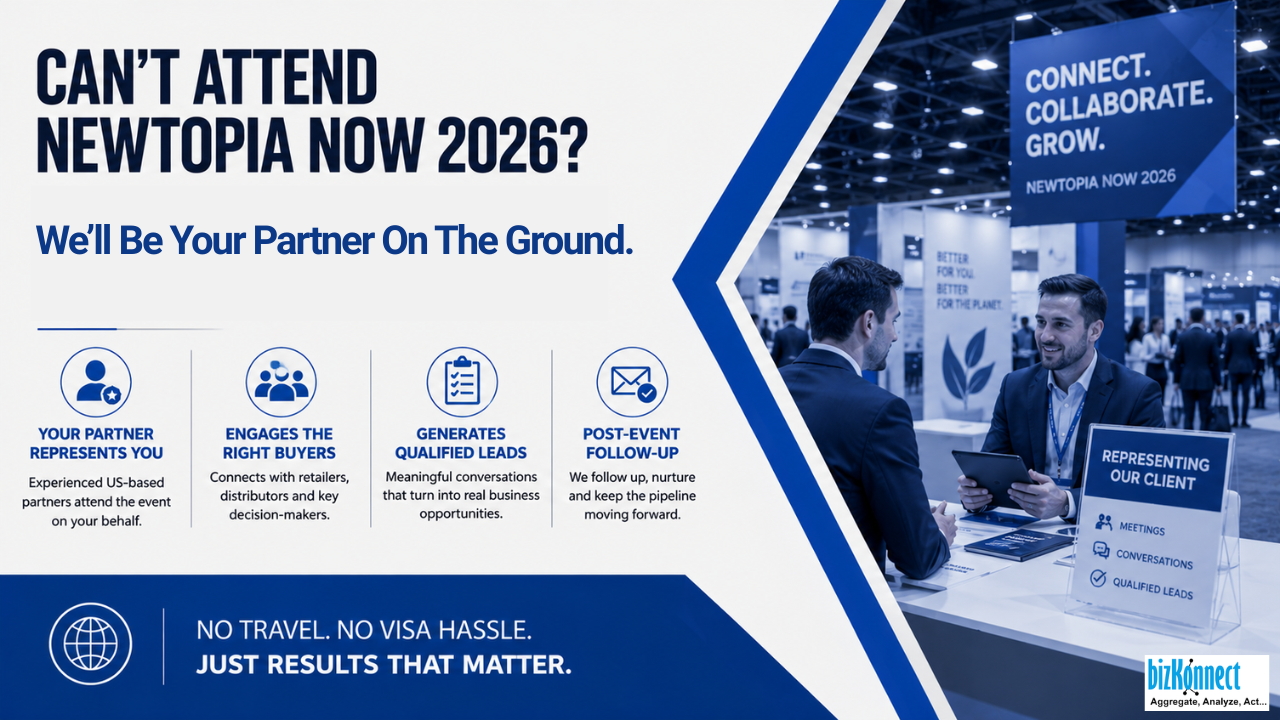
- Financial De-risking: Entering the US retail market requires capital efficiency. Committing five or six figures to a single event presence before validating buyer appetite is a high-risk gamble. A localized executive model allows brands to test the waters of a major event like “Newtopia Now” at a fraction of the cost of full-team deployment, transforming a major fixed CapEx risk into a highly controlled, variable operational expense.
- Continuous Internal Velocity: When a startup or mid-market enterprise sends its leadership team to an event, internal operations slow down. Product timelines slide, customer service response times stretch, and secondary pipeline opportunities stall. By keeping the core team anchored at headquarters, the company maintains its standard operating velocity. The business scales externally while remaining completely stable internally.
- Regulatory and Logistical Immunity: In an era where international travel can be disrupted by sudden visa delays, geopolitical shifts, or corporate travel freezes, relying entirely on a home-office team to execute global growth plans introduces a single point of failure. A decentralized network of local market experts ensures that no matter what administrative hurdles emerge at headquarters, the brand's footprint in the target US market remains completely uninterrupted and the sales momentum keeps moving forward.
The Evolution of Market Expansion Strategy
The paradigm of the enterprise trade show is undergoing a structural evolution. The metrics of success are moving away from vanity data such as booth square footage, the weight of distributed promotional materials, or the raw volume of badge scans and moving toward precise pipeline metrics: cost per qualified meeting, pipeline velocity, and contract conversion rates. As “Newtopia Now 2026” approaches, the decision facing forward-thinking leadership teams is no longer a binary choice between 'go' or 'stay.' The traditional constraints of budget, time, and team bandwidth are no longer valid justifications for sitting out the market conversations that define an industry's direction.
For businesses looking to evaluate their position in the upcoming US retail event matrix, the path forward requires a cold, analytical assessment of resources:
1. Audit the Current Architecture: Calculate the total operational cost of your historical event attendance, including the lost productivity hours of senior executives.
2. Define the Ideal Buyer Persona (ICP): Identify the exact individuals at events like “Newtopia Now,” Ai4, or TechCrunch Disrupt whose signatures actually move the revenue needle.
3. Evaluate the Proxy Architecture: Consider how a network of over 150 deeply experienced, US-based sales partners backed by a robust research engine (the precise framework managed by BizKonnect) can execute your growth objectives while your core team stays focused on what they do best.
The market waits for no one. The conversations at “Newtopia Now” will happen regardless of whether your team is stuck in a visa queue, managing a product launch at headquarters, or walking the floor in Denver. The structural choice is yours: operate by the old rules of logistical dependency, or deploy a smarter, localized model to capture the pipeline anyway.
A Strategic Choice: The question is whether you will let operational constraints keep you on the sidelines, or if you will deploy a smarter, local model to capture the opportunity anyway.
Want to see a sample engagement plan for event representation? It's HERE.
CLICK HERE to know more with BizKonnect.