


The era of volume-heavy outbound email is officially over. Enterprise buyers operate in an AI-first evaluation mode, they query generative AI models to validate solutions, research vendors, and synthesize market trends before replying to a cold outreach message.
To win in this landscape, B2B growth teams must shift from static email sequences to personalized, iterative, theme-based campaigns powered by a hybrid engine of generative AI, deep sales intelligence, and human context.
Using assisted-service frameworks as a reference model, here is how modern enterprises execute data-driven, theme-focused email campaigns that cut through inbox noise and drive qualified pipelines and faster GTM.
1. Deconstructing the Iterative Theme-Based Framework
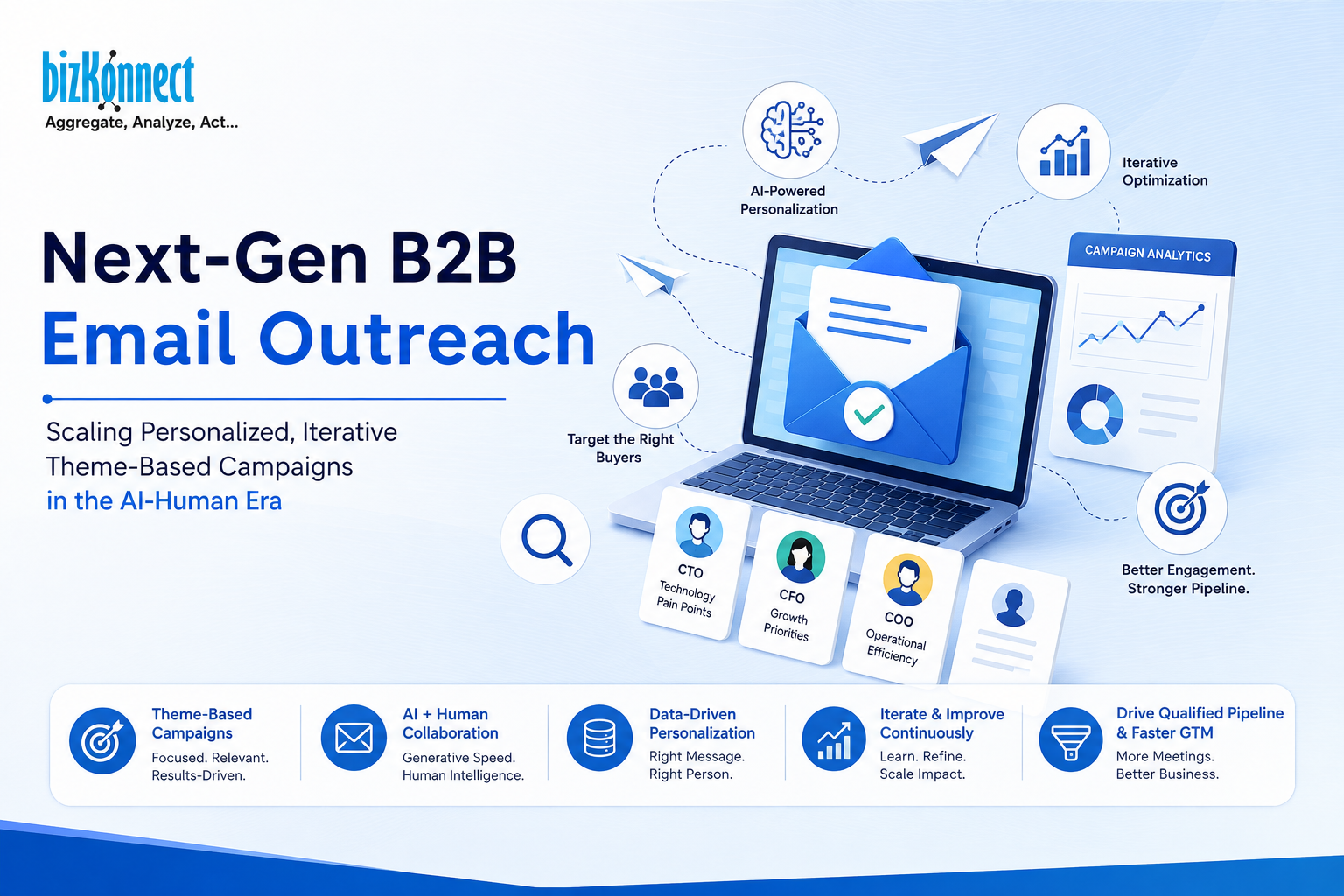
Rather than blasting a broad audience with generic sales pitches, a theme-based campaign centers all messaging around a single, highly relevant business narrative, such as a market shift, specific technology adoption, compliance update, or operational bottleneck.
The iterative execution process consists of four distinct operational phases:
- Ecosystem Configuration & Theme Discovery: The process begins by analyzing your business ecosystem, core solutions, and current client success stories. Generation AI models synthesize these inputs to extract resonant campaign themes and define explicit Ideal Customer Profiles (ICPs) covering geography, industry, revenue band, tech stack, and buyer personas.
- Intelligence-Led Contact Extraction: Target buyer lists are extracted directly from specialized sales intelligence repositories, such as BizKonnect’s BizKart database (20M+ contacts), or tailored via actionable organization maps (ORGKonnect) to identify multi-threaded buying committees.
- Hybrid Messaging Architecture: Message templates are established across industries and personas. Generative AI assists in personalizing contextual hooks (e.g., role-specific triggers, technology stack references), while human strategy ensures compliance with anti-spam standards, tone naturalness, and clear call-to-action (CTA) positioning.
- Analytics-Driven Iteration: Tracking response rates, click patterns, job titles, and departmental functions reveals what works. If a specific message angle resonates with CTOs but fails with CFOs, the next campaign iteration automatically refines both the targeting matrix and the messaging angle.
2. Bridging AI and Human Touchpoints in Outbound Marketing
The most successful 2026 outbound engines combine generative speed with human intelligence:
Generative AI Responsibilities
- Context Extraction: Scanning company news, job postings, and technology ecosystems to identify account triggers.
- Dynamic Copy Adaptation: Adjusting value propositions to match specific buyer personas (e.g., operational efficiency for COOs vs. risk mitigation for CISOs).
- Predictive Cohort Analysis: Analyzing campaign performance data to recommend content adjustments for underperforming segments.
Human Strategy & Execution
- Strategic Ecosystem Alignment: Mapping complex enterprise decision structures via human-verified Org Charts.
- Deliverability & Governance: Overseeing domain health, SPF/DKIM/DMARC configurations, one-click opt-out protocols, and strict inbox volume caps (~500 sends/day/inbox).
- Inside Sales Support: Human reps engage directly when high-intent signals occur, seamlessly managing phone, email, and LinkedIn interactions.
3. Optimizing Campaigns for AI Answer Engines (AEO & AI-SEO)
Modern B2B outreach does not end in the inbox. When prospective buyers receive an email highlighting a strategic issue, they often copy that challenge into AI research assistants like ChatGPT, Gemini, or Perplexity.
To capture this intent, your campaign themes must align with your public digital footprint:
- Information Symmetry: Align outbound email topics directly with published whitepapers, blog posts, and case studies.
- Structured Data: Use clear, entity-driven language across digital assets so conversational AI engines cite your brand when buyers research the problem.
- Zero-Friction Discovery: Ensure links embedded within email templates direct buyers to authoritative, high-value resources rather than generic landing pages.
4. The Assisted-Service Advantage
Managing data acquisition, tool stacks, domain warming, content generation, and sales follow-ups internally requires heavy capital and operational overhead.
An assisted-service model, such as BizKonnect’s fully managed approach, eliminates the need to procure separate tools or hire dedicated data teams:
- All-in-One Infrastructure: Includes data intelligence, campaign automation tools, and messaging frameworks out-of-the-box.
- Anti-Spam Best Practices: Keeps bounce rates low and complaint rates under 0.1% using domain-warming protocols and list hygiene.
- Full-Stack Execution: Combines data analytics, theme formulation, and inside sales follow-ups into a unified growth engine.
Frequently Asked Questions
What makes theme-based email campaigns more effective than traditional cold email?
Theme-based campaigns focus on a unified business solution or industry narrative rather than a generic product pitch. This enables deeper personalization, better engagement across multi-threaded buying committees, and clearer analytics regarding which themes resonate with specific job titles.
How do iterative campaigns improve conversion rates over time?
Iterative campaigns use response data such as open rates, link clicks, job titles, and buyer roles to continuously refine both the messaging and target profile. Each successive wave reaches a more refined audience with higher-converting content.
Why is an assisted-service model better than buying cold email software?
Buying standalone tools leaves your team responsible for sourcing accurate contact data, maintaining deliverability compliance, writing templates, and managing follow-ups. An assisted-service model provides the database, software, strategy, and human support in one turnkey service.
Ready to transform your B2B outbound engine with data-driven, theme-based campaigns? Connect with BizKonnect today to launch your next high-converting enterprise email strategy.
CLICK HERE to know more with BizKonnect.