


For years, the fastest way into a technology giant was predictable: find the VP, work toward the SVP, and wait for budget season. That path assumed the layered structure would hold still long enough to sell into it.
In June 2026, that assumption failed.
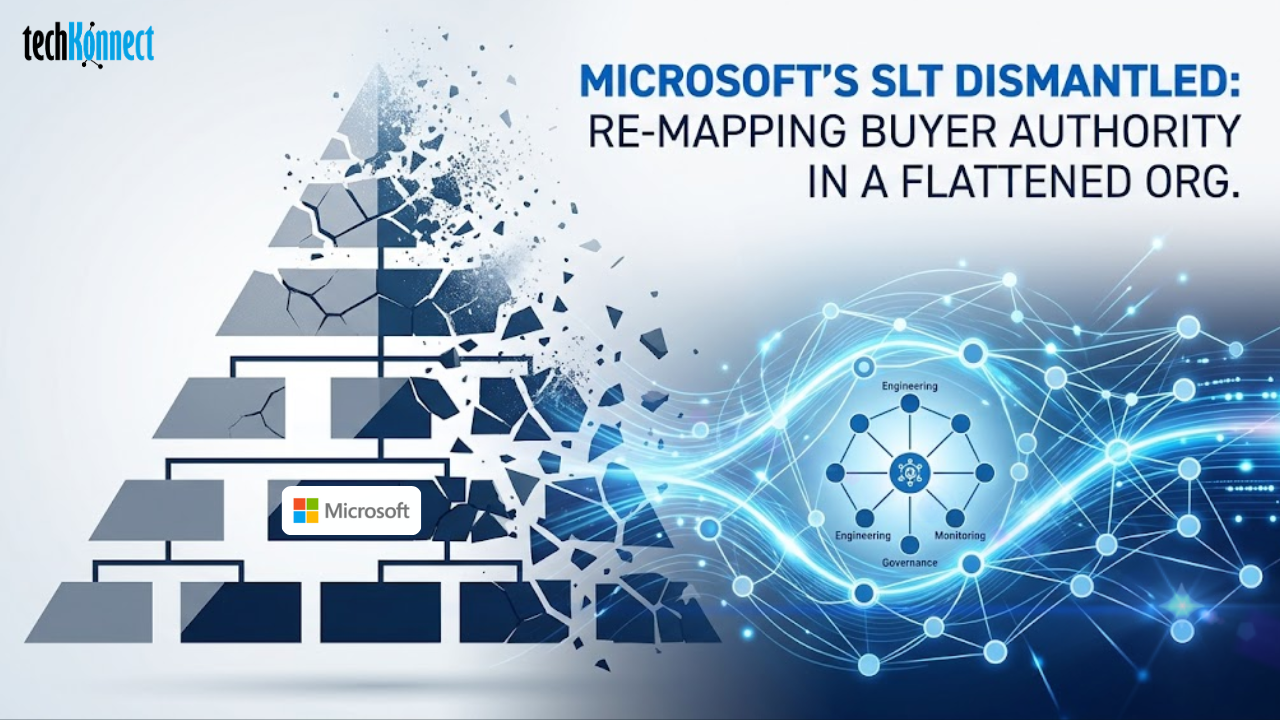
CEO Satya Nadella quietly retired Microsoft's Senior Leadership Team, the executive tier that had run the company's businesses for decades, replacing it with a compressed, engineering-led model. The layer that governed Microsoft's go-to-market gravity was simply gone, and the buyer marketers were trained to find no longer sits where they left them.
The problem is that it changed faster than any manually maintained contact list, CRM field, or quarterly research cycle could register. Understanding technology company org charts has stopped being a research nicety. It is now the precondition for reaching anyone with real budget authority inside a company like Microsoft, and increasingly, the only way to see it clearly is through GenAI-driven org chart intelligence that updates as fast as the structure itself.
What Actually Broke When the SLT Disappeared?
The SLT was the interpretive layer, translating engineering priorities into budget lines a rep could target. Its replacement is not one structure but three, running in parallel:
- A five-person corporate group meeting weekly for governance
- A 35-person engineering leadership group coordinating directly, without the managerial chains that once separated builders from budget
- A three-person Copilot team meeting with Nadella separately
None of these mirrors the old SLT's shape, and none is easy to map with research habits built for legacy hierarchies. Several long-tenured executives, including a 35-year veteran and a widely regarded security architect, have been repositioned or exited entirely. Budget authority has moved closer to engineering execution, not further from it.
A prospecting motion calibrated for stable VP layers was never built to detect that kind of movement, which is precisely the gap GenAI-driven Microsoft org charts are built to close: a continuously reconstructed map of where authority actually sits this week.
Why Selling to the Legacy VP Layer Stopped Working?
Enterprise sales strategy has long treated the VP layer as a proxy for authority, assuming title seniority tracked with proximity to the decision. Microsoft's restructuring severs that correlation at the center of one of the most closely watched companies in tech.
Charlie Bell, previously an AWS architect who joined Microsoft to lead 10,000 security staff, is now listed internally as an individual contributor with zero reports. Mustafa Suleyman, hired to build an entire AI division, now oversees a narrower scope as that division is absorbed into engineering. They prove title alone no longer indicates where budget conversations happen.
The consequences show up across the funnel:
- Contact data anchored to old titles decays faster than most CRMs assume
- Outbound sequences aimed at "VP of X" increasingly reach people with reassigned or reduced authority
- Meetings booked through legacy signals convert lower, not from weak messaging but because the recipient isn't the buyer anymore
- Forecasts built on stale hierarchy data look healthy on volume while quietly losing relevance
The pattern is sector-wide, not unique to Microsoft.
Salesforce lost roughly half its market value amid investor doubt over whether legacy SaaS structures can compete in the AI era. The old hierarchy stops producing its old outcomes, and the sales motion built on top of it fails quietly, in shrinking reply rates, long before anyone traces the cause back to an outdated chart. This is where a GenAI-driven approach to Microsoft org charts changes the math.
Instead of inferring authority from title, it can be trained to infer authority from cadence, activity, and reporting proximity signals that update in near real time.
Why Is a GenAI-Driven Tech Company Org Chart Matter Now?
A tech company org chart used to be a static reporting map. That definition undersells what a modern technology company hierarchy must capture: how close a role sits to weekly review cadence, regardless of title. Nadella personally reviews AI metrics every week and meets the Azure infrastructure team biweekly. Proximity to that cadence increasingly shapes investment decisions, which is why "who reports to the CTO in a tech company" no longer has a clean single answer.
Tech company org charts by department are shifting the same way. Departments that once ran through several managerial tiers, security, gaming, consumer products, are flattening into smaller groups closer to the center:
- Security now reports through a compressed EVP structure rather than a multi-layer chain
- Gaming's new CEO arrived from the Core AI group, not the traditional gaming leadership path
- AI, once a standalone division, has absorbed into the broader engineering structure
A GenAI-driven org chart model can trace these department-level shifts as they happen, flagging when a role's reporting distance to the CEO changes even if the title on a business card stays the same. Static databases cannot do this. They record what was true, not what is true.
Why Lead Enrichment Starts Failing at the Worst Possible Moment?
Enrichment tools solve a data completeness problem: fill in a title, a department. They were not built to detect structural discontinuity, the moment an authority map gets redrawn faster than public data can register it. Platforms pull from stale titles, outdated press mentions, and cached org data that predates the restructuring. At a company moving this fast, that lag is the difference between reaching someone with zero current authority and reaching the engineer who now reviews the budget weekly.
The downstream cost compounds in three specific ways:
- Sales teams invest cycles building relationships with contacts whose influence has already been reassigned
- Marketing attribution credits channels for reaching "the right title" while missing that the title lost its power
- Pipeline forecasts overstate quality because contact volume looks healthy while relevance quietly erodes underneath it
GenAI-driven Microsoft org charts address this differently. Rather than enriching a static field, the model continuously cross-references leadership announcements, reporting-line changes, and cadence signals, so the "title" a rep sees reflects proximity to actual budget conversations.
Evaluating a Chart That Moves Faster Than the Sales Motion
If reporting lines no longer proxy for authority, evaluation criteria should shift toward structural currency, how recently a signal reflects the company's actual decision shape. Three markers matter most:
- Cadence proximity: Does the contact sit inside recurring, high-frequency reviews, the kind Nadella now runs weekly, or are they several steps removed from that rhythm.
- Restructuring velocity: Companies flattening rapidly, as Microsoft and Salesforce both illustrate in different ways, need far more frequent org verification than companies with stable hierarchies.
- Title-to-influence gap: A widening gap between someone's formal title and their actual reporting proximity, as seen with several Microsoft executives repositioned into individual contributor roles, is itself a signal worth tracking rather than ignoring.
Georgetown professor Jason Schloetzer, commenting on this shift, said the velocity of change in technology now requires senior leaders to stay closely connected to what is happening at very local operational levels, and added he could not name a single large company, among dozens he studies routinely, that has fully solved this yet.
If companies themselves are still working out how to track internal authority in real time, outbound motions relying on stale org data carry an even larger blind spot, and a GenAI-driven layer becomes less of a convenience and more of a structural necessity.
Addressing a Few Frequently Asked Questions (FAQs)
Q. What is a tech company org chart in an AI-restructured company?
It is less a fixed diagram and more a live model of who sits closest to recurring product and metric review cycles. Formal titles increasingly lag actual decision proximity, which is why GenAI-driven reconstruction, rather than periodic manual research, has become the more reliable source.
Q. Who reports to the CTO in a tech company after a flattening restructure?
This varies more than static charts suggest. At Microsoft, engineering runs through a compressed group of roughly 35 people working in close coordination.
Q. What tech company org chart structure should marketers look for when prioritizing accounts?
Flatter structures with engineering leaders reporting close to the CEO or a small governance group, rather than through multiple VP tiers, generally indicate faster, less bureaucratic budget cycles worth prioritizing first.
Q. Why do SaaS company organizational chart patterns matter beyond Microsoft specifically?
The pattern is sector-wide. Legacy SaaS companies facing similar investor pressure around AI returns are compressing management layers in comparable ways, which means the evaluation logic built for Microsoft increasingly applies across the enterprise software category.
The SLT is gone and the reporting lines that once made enterprise prospecting predictable have been redrawn around weekly AI metrics and a 35-person engineering core, and the only way to keep pace is a GenAI-driven org chart that updates as often as the company does.
CLICK HERE to see how BizKonnect's GenAI-driven Microsoft org charts keep technology company hierarchies current as they shift.
CLICK HERE to know more with BizKonnect.