


Most enterprise ABM teams have spent years getting better at the wrong thing: building deeper relationships with the contacts they already know, while the stakeholders who will actually decide the deal remain invisible. Today,
- Targeting has sharpened.
- Messaging has grown more precise.
- Buying signals arrive faster.
And yet, late-stage deal collapse rates in complex B2B sales haven't moved the way investment in account-based marketing for B2B would suggest they should.
Somewhere between the first executive sponsor email and the final legal review, a stakeholder who never appeared in your CRM decides the deal's fate. Procurement raises a vendor consolidation concern, legal flags a data residency clause, and an IT director surfaces a security question that reframes the entire evaluation.
These are structural features of enterprise buying decisions and most B2B ABM strategies ignore them until it's too late.
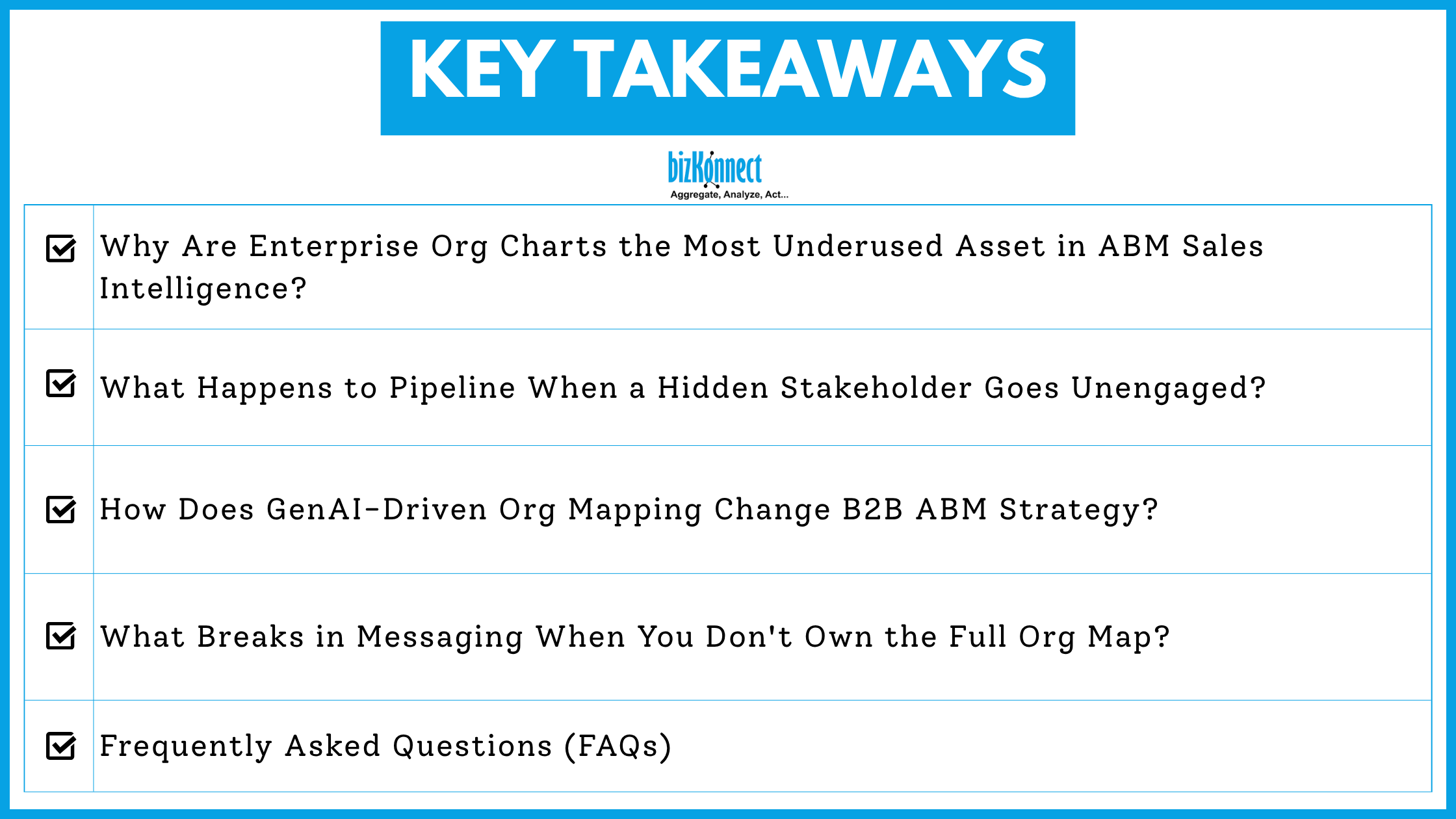
Why Are Enterprise Org Charts the Most Underused Asset in ABM Sales Intelligence?
The assumption ABM teams operate under: identify your champion, build a pipeline around them, and the deal will move. It worked when enterprise purchases involved three or four decision-makers. It no longer reflects how large organizations buy.
Research shows complex B2B purchases now involve six to ten stakeholders.
It is a committee with competing mandates and functional authority distributed across titles your CRM never captured. ABM sales intelligence teams build account profiles around contacts they can find:
- Buyers who respond to outreach
- Champions who attend demos
- Economic buyers who surface on LinkedIn
What they aren't capturing are stakeholders who influence the decision without ever engaging content.
How do org charts help enterprise sales teams?
Not as static reporting tools, but as dynamic intelligence layers. When a deal is at risk from a stakeholder who appeared "suddenly" late, that stakeholder was always there. The org map just wasn't built to surface them.
Traditional account-based marketing for SaaS and enterprise treats organizational intelligence as a setup task: accounts mapped once, records loaded into CRM, motion begins. But org structures shift. A compliance mandate can hand a procurement head veto power she didn't hold six months ago. The account mapped in Q1 is a different environment by Q3.
What Happens to Pipeline When a Hidden Stakeholder Goes Unengaged?
Late-stage collapse is the most visible consequence.
When a deal stalls on an unengaged stakeholder, it doesn't exit the pipeline, instead it ages. Cycles that should close in 90 days stretch to 180. Win rate reporting looks stable while deal velocity erodes.
Stalled deals that maintain CRM activity look healthy because marketing keeps investing in known contacts, sales keeps working the champion, but the unengaged stakeholder who will determine the outcome has received no messaging, no relationship investment.
Enterprise B2B deals rarely fail because the champion went cold. They failed because the champion's internal coalition was narrower than the GTM team realized and nobody surfaced that gap in time.

How Does GenAI-Driven Org Mapping Change B2B ABM Strategy?
The operational problem with traditional org mapping is signal coverage. Human research can only surface what's visible: LinkedIn profiles, org announcements, publicly disclosed reporting structures. GenAI-driven org mapping works from a fundamentally different signal set:
- Corporate filings and procurement history
- Internal job posting patterns and organizational change signals
- Professional network adjacencies and intent data
The output is who holds influence for a specific purchase type. A procurement director irrelevant to a renewal may be critical in a first-time enterprise evaluation. A legal counsel three levels removed from the sponsor may hold blocking authority above a certain contract value.
AI in account-based marketing is most consequentially applied to organizational intelligence, instead of content personalization. The practical shift for ABM teams:
- Org maps treated as living intelligence
- Stakeholder relevance evaluated by deal structure
- Buying committee gaps surfaced as execution risks
- CRM completeness measured against the full influence map
What Breaks in Messaging When You Don't Own the Full Org Map?
Hidden stakeholders create a consequence that operates upstream of deal risk: messaging inefficiency across the campaign. When the committee is wider than the known contact set, messaging is coherent to CRM contacts and invisible to those who aren't, while the account looks healthy on the dashboard.
The procurement head who appears late carries concerns distinct from the technical buyer's:
- Vendor stability and contract structure
- Renewal terms and exit provisions
- Compliance and data governance requirements
If those concerns go unaddressed earlier, they surface as friction rather than managed objections.
Effective B2B ABM strategy treats messaging architecture and stakeholder mapping as interdependent. Knowing who hasn't been reached enables multi-threaded engagement before the deal exposes those gaps.
Frequently Asked Questions (FAQs)
With these operational shifts in mind, several practical questions tend to surface during evaluation and execution.
Q. How do org charts help enterprise sales teams beyond basic contact mapping?
Dynamic org maps reveal who holds influence for a specific purchase type. A procurement head irrelevant to a renewal may be critical in a first-time evaluation, a distinction static org charts can't make.
Q. Why do hidden stakeholders tend to appear late in the enterprise deal cycle?
Procurement and legal enter close to contract, not during technical evaluation. ABM teams built around early-stage buyers meet these stakeholders for the first time when the deal is already under pressure.
Q. Can AI in account-based marketing surface stakeholders who have never engaged with content?
Yes. AI-driven org mapping starts from the account's organizational architecture like using filings, job posting patterns, and network adjacencies to surface decision-relevant roles regardless of engagement history.
Q. What metrics signal a hidden stakeholder problem in a B2B ABM strategy?
Late-stage stalls are the clearest indicator, alongside extended cycles with no objection on record, high champion engagement paired with stalled internal advocacy, and pipeline aging without closing.
Want to surface hidden stakeholders in your target accounts before they become late-stage blockers? CLICK HERE to see how BizKonnect builds account intelligence that goes deeper than your CRM.
CLICK HERE to know more with BizKonnect.