


The traditional cybersecurity sales play, i.e., sending a technical whitepaper to a CISO and hoping for a signature, is officially broken. Today, the "CISO-only" strategy doesn't just result in slow deals, rather it results in no deals.
As cybersecurity matures from a back-office IT function to a cornerstone of enterprise risk management, the buying power has shifted. The Chief Financial Officer (CFO) and the Board of Directors hold the keys to the budget now, viewing security through the lens of liability, ROI, and regulatory compliance.
This evolution requires an effective account based marketing (ABM) approach.
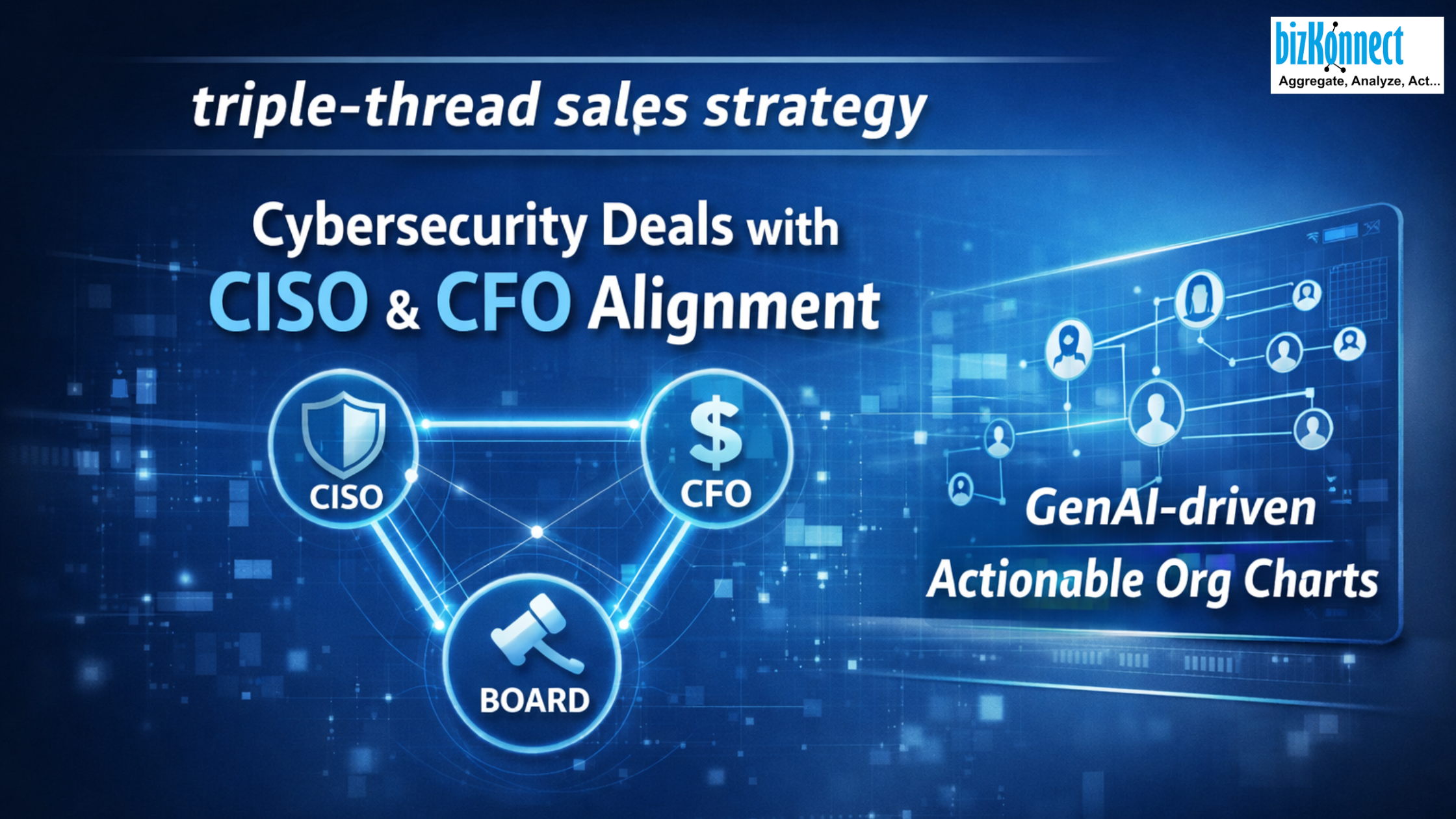
Navigating these complex buying structures demands more than a generic pitch, it needs GenAI-driven actionable org charts that map the hidden influence between the technical guardian (CISO) and the economic buyer (CFO). To win, vendors must orchestrate a "triple-thread" campaign:
- Validating the tech for the CISO
- Proving the fiscal resilience for the CFO
- Ensuring the Board sees a direct link between cyber-hygiene and shareholder value.
This guide explores how to navigate this new power dynamic using cybersecurity enterprise ABM strategy to close high-value deals.
Why is Cybersecurity Leadership Moving to the C-Suite and Board Tables?
The era of the CISO reporting to the CIO in a basement office is over. According to recent insights, the CISO has evolved from a "technical guardian" to an "accountable strategic risk leader." This shift is driven by two primary factors:
- The skyrocketing cost of data breaches
- The personal liability now attached to executive roles
Today, the SEC and international regulators are focusing on "materiality" reporting where security is a business continuity essential. Statistics indicate that organizations where the CISO has a direct line to the CEO or Board see a 20% faster response time to threats and significantly more aligned budget allocations. So, security leaders are joining the executive suite because the "blast radius" of a cyber event now impacts stock prices and brand equity instantly.
For those executing a cybersecurity sales strategy, this means your primary contact is under more pressure than ever to justify spending in "business terms."
If you cannot help the CISO explain to the CFO how your risk scoring software reduces insurance premiums or prevents a dip in quarterly revenue, the deal will stall at the final hurdle.
How Can GenAI-Driven Org Charts Map the "Triple-Thread" Buying Committee?
The biggest barrier to a successful cybersecurity account based marketing campaign is the "Invisible Committee." You might have the CISO’s buy-in, but who is the General Counsel who cares about data privacy? Who is the Head of Procurement who is tightening vendor consolidation?
GenAI-driven actionable org charts go beyond static boxes and lines. They analyze social signals, past career trajectories, and public financial statements to identify "Influence Clusters."
The Triple-Thread Structure:
- The Technical Validator (CISO/Security Architects): They need to know if the software integrates with their existing stack (e.g., SIEM/SOAR) and if it creates alert fatigue.
- The Economic Buyer (CFO/Finance VP): They are looking for the "Cost of Inaction." They want to see risk-scoring models that translate into tangible ROI or "Risk Reduction per Dollar Spent."
- The Compliance/Legal Gatekeeper: They focus on whether the solution meets the latest regulatory frameworks and reduces the personal liability of the board.
By using GenAI to map these connections, sales teams can identify warm paths into an account.
For instance, if a CFO previously worked at a company that suffered a high-profile breach, their sensitivity to risk scoring is higher. An actionable org chart highlights these triggers, allowing for a personalized ABM strategy targeting CISO and CFO decision makers that feels consultative rather than intrusive.
What is Account Based Marketing in Cybersecurity When Targeting Risk-Averse CFOs?
When we define what is account based marketing in cybersecurity, we must move past the idea of "targeted ads." In the context of risk scoring software, ABM is the process of delivering "Decision Intelligence" to each stakeholder simultaneously.
The CFO doesn't care about zero-day exploits or lateral movement, they care about how those technical risks manifest on the balance sheet. An effective cybersecurity enterprise ABM strategy involves creating dual-track content:
- For the CISO: Deep-dive technical audits and API documentation.
- For the CFO: A "Cyber Risk Executive Summary" that uses the software’s scoring to project potential savings in cyber insurance and incident response costs.
The Decision Framework for CFO Alignment:
- Predictability: Does this software make our risk posture more predictable for the next quarterly report?
- Consolidation: Can this tool replace two or three legacy "point solutions"?
- Accountability: Does it provide the "defensible data" needed for Board-level reporting?
This dual-pathing ensures that when the CISO goes to the CFO to request the budget, the CFO has already been warmed by high-level insights that align with their specific fiscal goals.
How Does ABM Help Cybersecurity Companies Win Deals Against Legacy Competitors?
Legacy vendors often rely on "land and expand" strategies that focus solely on IT managers. However, modern cybersecurity account based marketing wins by identifying "Trigger Events" before the competition does.
A Trigger Event might be a company’s expansion into a new geographic region with strict data laws, or a recent M&A where the parent company needs to audit the risk of the acquired entity. How ABM helps cybersecurity companies win deals is by positioning the software as the solution to these specific, high-stakes business transitions.
A Checklist for Navigating the Cyber Risk Buying Structure:
- Identify the "Power Pair": Use GenAI to find the specific CISO-CFO duo and their historical working relationship.
- Custom Risk Reports: Send a "Snapshot Risk Score" of the target’s public-facing infrastructure (where legally permissible), instead of generic demo.
- Bridge the Language Gap: Translate technical vulnerabilities into business impact levels (High/Medium/Low fiscal risk).
- Multi-Channel Orchestration: Ensure the CISO sees technical validation on LinkedIn and industry forums, while the CFO receives "Thought Leadership" pieces in finance-centric publications.
Now Let’s Address Some Frequently Asked Questions (FAQs)
Q1. What are the early warning signs of a breakdown in the CISO-CFO buying alignment?
The most common sign is a technical win followed by a budgetary freeze. If the CISO stops asking about features and starts asking for "one-pagers for the finance team," your campaign has failed to engage the CFO early enough.
Q2. How can I identify inefficiencies in my current cybersecurity ABM strategy?
Look at your "CISO-to-CFO transition rate." If you are getting technical meetings but failing to get finance-level meetings, your content is likely too "feature-heavy" and lacks the ROI-driven language required for the executive suite.
Q3. How do I handle a "No" from the CFO when the CISO says "Yes"?
Shift the conversation to "Risk Transfer." Ask the CFO how they currently quantify the liability of the risks the CISO has identified. Use your software’s data to show that the cost of the residual risk is higher than the cost of the subscription.
If you want to map a full buying committee of your target accounts with GenAI-driven actionable org charts and run a coordinated ABM strategy across CISO, CFO, and board, CLICK HERE to see how BizKonnect helps cybersecurity teams close multi-stakeholder deals faster.
CLICK HERE to know more with BizKonnect.