


The modern B2B buying cycle is no longer a linear path; it is a multi-threaded web of interactions.
Sales teams often find themselves in a state of "coordinated chaos" where the VP of Sales is engaging on LinkedIn, the IT Manager is opening a technical whitepaper via email, and the Head of Procurement is discussing budget constraints with a channel partner, all at the same time.
When these touchpoints are disconnected, the outreach feels like spam, damaging brand reputation and stalling deals. The core problem here is none other than lack of structural visibility. Without a qualified and personalised email campaign backed by GenAI insights acting as the narrative anchor, revenue teams are unable to map the internal influence loops that dictate whether a deal moves forward or dies in committee.
This guide explores how to move beyond fragmented communication across email, LinkedIn, and calls by using AI-powered mapping to build a sophisticated, multichannel strategy that resonates with every stakeholder in the buying group.
Why Does Traditional B2B Lead Generation Outreach Often Feel Like Spam?
Most outreach sequences fail because of a "relevance gap."
When a prospect receives a LinkedIn message that ignores a conversation they just had with a colleague, or an email that addresses a pain point they’ve already solved, the automation becomes visible and rather, irritating.
Research shows that companies with extremely strong omnichannel customer engagement retain an average of 89% of their customers, compared to a 33% retention rate for companies with weak omnichannel engagement. In the prospecting phase, this disparity is even more pronounced. If your outreach isn't synchronized, you aren't "omnichannel"; you are simply "multi-channel," which often translates to "multi-annoying."
The friction usually stems from three specific triggers:
- Data Silos: Marketing sees the email clicks, but Sales doesn't see the LinkedIn engagement.
- Static Intelligence: Using outdated organizational insights that don't account for recent promotions or departmental shifts.
- Linear Sequences: Treating the "Economic Buyer" and the "Technical User" with the same cadence, despite their vastly different involvement stages.
To solve this, firms are shifting toward the best multichannel outreach strategy for B2B sales, where each touchpoint informs the next, ensuring the buyer feels understood rather than targeted.
How Do Sales Teams Track Deals Across Multiple Channels Without Losing Context?
In modern enterprise, the average B2B deal now involves 6 to 10 stakeholders. Identifying the "Champion" is no longer enough; you must identify the "Blocker," the "Influencer," and the "Legal Gatekeeper."
So, how do sales teams track deals across multiple channels effectively?
Leading teams use sales engagement platforms to aggregate disparate signals such as social media activity, intent data, and historical CRM interactions to visualize the "path to power." Unlike a static PDF, GenAI-driven charts identify "Lookalike Stakeholders."
For example, if the IT Manager at Account A was the primary driver for a deal, the AI flags the IT Manager at Account B as a high-priority node, even if they haven't engaged yet.
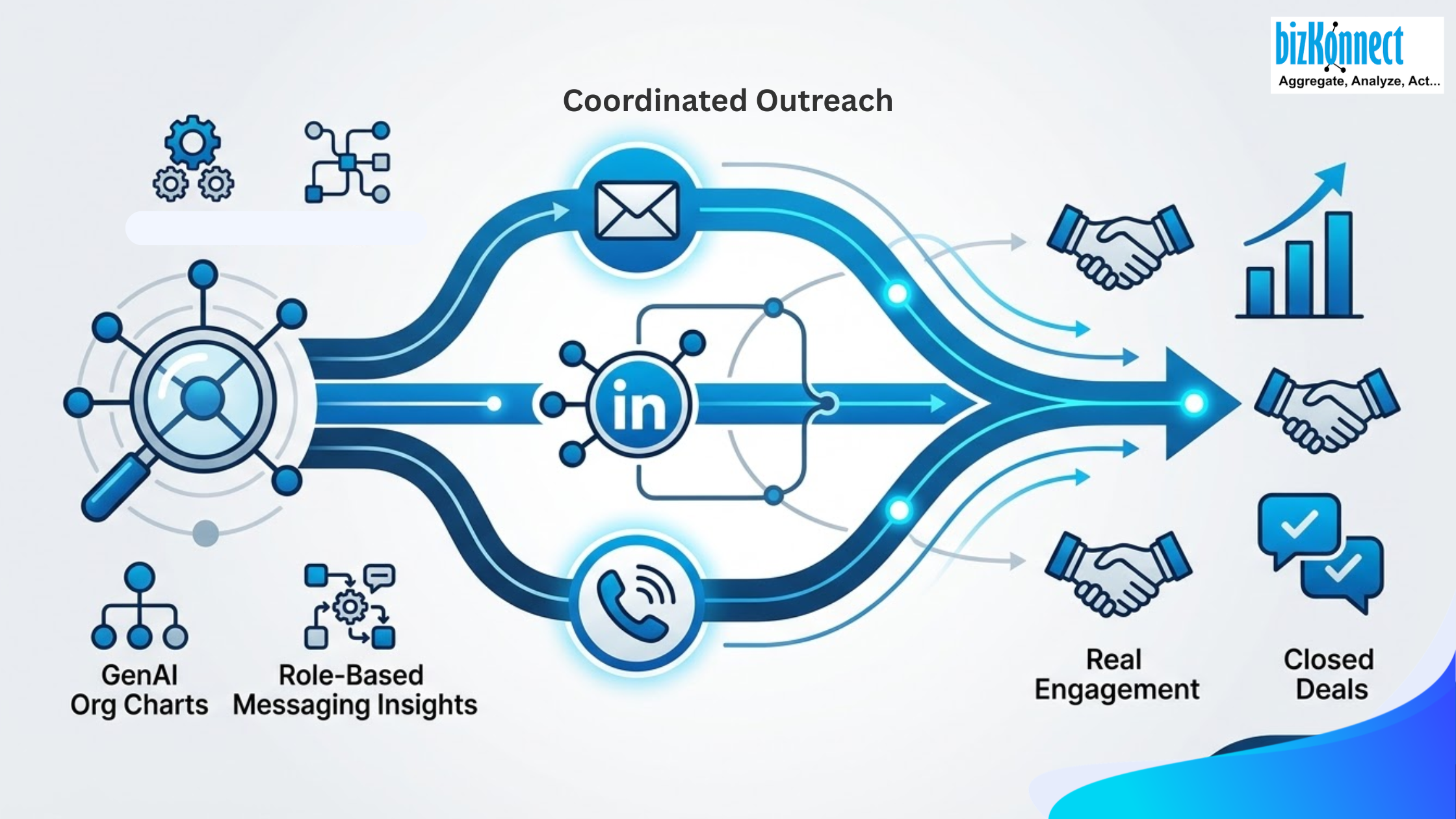
To track effectively, teams use a three-tier framework:
- The Formal Hierarchy: The standard reporting lines found in traditional org charts.
- The Influence Network: Who does the VP of Sales actually listen to? AI analyzes social proximity to find these "hidden" connections.
- The Engagement Layer: Overlaying current activity like who is reading the emails versus who is talking to partners.
By integrating deep account intelligence, marketers can see that while the VP signs the check, the IT Director does the "silent" research.
This insight dictates the sequence:
Send the technical case study to IT first, then reference the "team's interest" in the executive's LinkedIn message.
What Does an Ideal B2B Outreach Cadence Look Like in a Multi-Stakeholder Environment?
A coordinated sequence requires a "Command Center" approach.
If the VP of Sales is talking on LinkedIn, the next email to the IT Manager should acknowledge that "leadership is exploring solutions for [X]." This creates a sense of organizational alignment rather than a series of cold interruptions.
Statistical data suggests that 15% of customers are comfortable with a brand contacting them on multiple channels, but this number jumps significantly when the content is part of a qualified and personalised email campaign. This is where AI-powered enterprise insights become the core of the strategy.
The Ideal Cadence Framework:
The LinkedIn Hook (Day 1-3):
Focus on "Point of View" (POV) sharing. If the VP is active, engage with their content rather than DMing. This builds familiarity without the "spam" trigger.
The Educational Email (Day 4-6):
Use data from your GenAI org chart to send a role-specific email to middle management. Mention that you’ve noticed the company’s focus on a specific initiative.
The "Alignment" Call (Day 8):
When calling, the script isn't "Do you want to buy?" but rather, "I’ve been sharing some insights with [VP Name] on LinkedIn regarding [Topic], and I wanted to see if your team has the technical bandwidth to support such a shift."
This transition from "selling" to "consulting" is only possible when you have a B2B lead generation outreach plan that tells you exactly who is talking to whom.
However, with these challenges and solutions in mind, a few important questions naturally arise for teams navigating similar situations. Addressing a few of them.
Frequently Asked Questions (FAQs)
Q1. What is the right number of touches per stakeholder in a B2B sequence?
Research consistently shows that deals require 6 to 8 meaningful touches before a response, but most reps stop after two. The key word is "meaningful" where each touch should advance the conversation.
Q2. When should LinkedIn be used before email in a sequence?
When the prospect has recent public activity like posts, comments, or article shares, LinkedIn is an effective first touch because you can reference something specific.
Q3. How often should B2B contact data be refreshed for outreach accuracy?
Role changes, org restructures, and hiring activity in target accounts can invalidate contact data within three to six months. For high-velocity outbound teams, monthly enrichment against active sequences is a reasonable standard. For ABM programs targeting a defined account list, quarterly verification with intent signal overlays is the minimum.
Coordinated outreach across email, LinkedIn, and call is no longer optional in B2B sales. As buying committees grow and channels multiply, disconnected efforts create friction instead of momentum. The shift lies in:
- Moving from lead-level to account-level tracking
- Using GenAI-driven org intelligence
- Building adaptive, signal-based outreach sequences
This is how teams maintain relevance without increasing noise.
CLICK HERE to see how BizKonnect can help you map stakeholders accurately and run coordinated outreach sequences that drive real engagement.
CLICK HERE to know more with BizKonnect.