


Event firms operate on a peculiar tension, which is, revenue is seasonal by design, but costs are not.
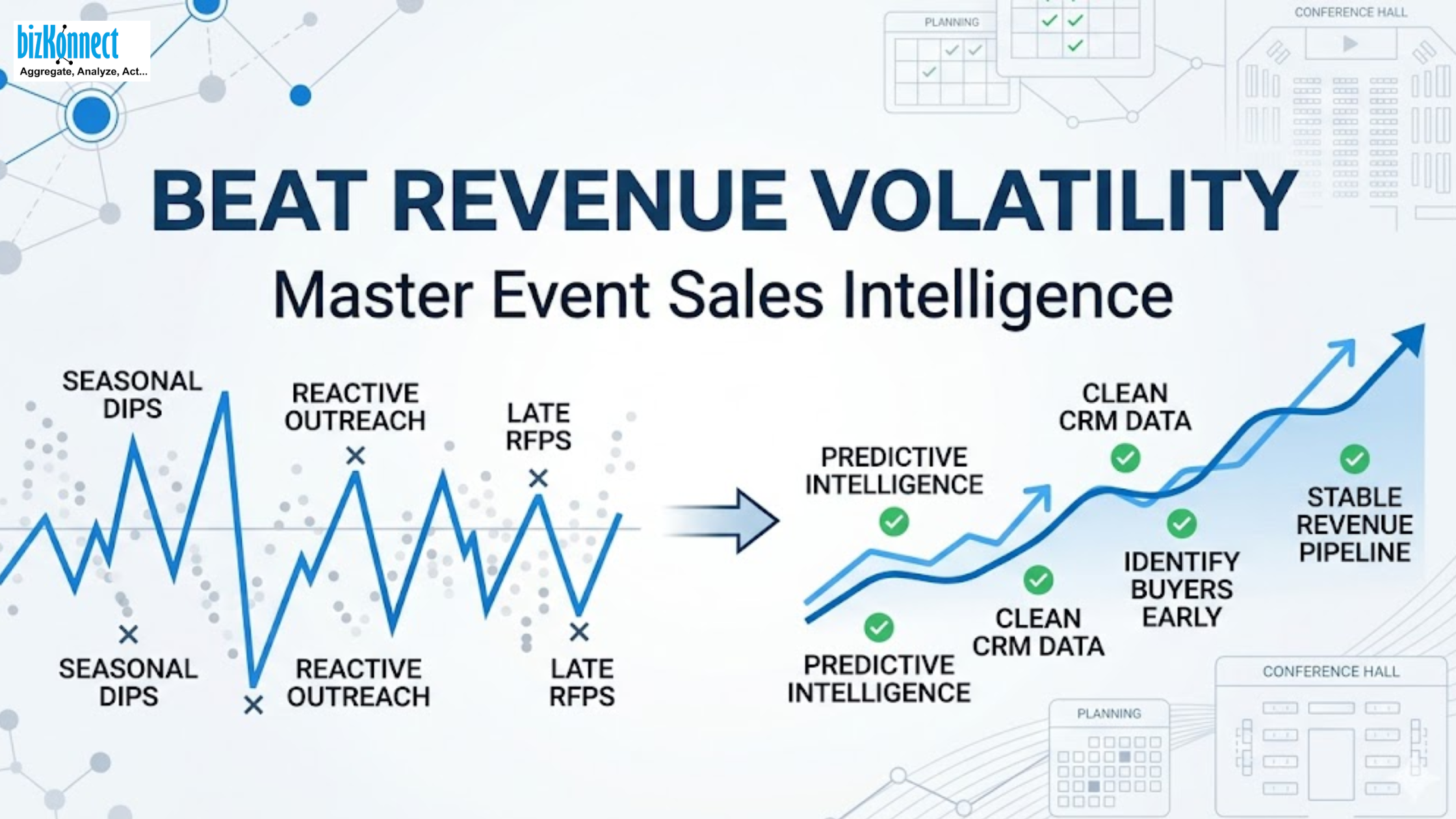
The planning cycle for a mid-size trade show typically spans 9 to 14 months, yet most event business growth strategies are still built around reactive outreach:
- Reaching prospects after a conference is announced
- Chasing sponsors when registration pages go live
- Scrambling to fill exhibitor slots in the final 90-day window
This worked when buyer timelines were predictable, but unfortunately, neither holds anymore.
Conference budgets are approved in cycles that begin well before any public announcement. Sponsors commit to event slates 6 to 12 months in advance, often locking in exclusivity windows before competing firms know the opportunity exists.
The result: high outbound volume producing weak conversion, because outreach reaches buyers after decisions have already been made.
Often, the fix here is earlier visibility, powered by cleaner data through GenAI-driven CRM managed services.
Before diving into “why”, let’s understand:
What Is Event Demand Generation and Why the Old Model Fails?
Event demand generation is the process of identifying and converting organizations actively planning conferences, trade shows, or live experiences before they issue an RFP or go public with their plans.
Traditional demand generation in the event services ecosystem relies on two inputs:
- A CRM populated with past clients
- Known conferences from industry calendars
….both are backward-looking.
Past clients are re-engaged only when it's time to sell. Calendars publish intentions already finalized, so any outreach triggered by a listing chases a decision already in motion.
The pipeline stays reactive and thin on the left side of the funnel. Seasonality takes the blame, but the underlying cause is a data and intelligence problem. What changes the model is integrating intent signals such as behavioral indicators that an organization is beginning to plan an event, long before procurement announces it publicly.
What is The Hidden Cost of Poor Attendee and Sponsor Data?
Corrupted data doesn't announce itself. Deliverability rates drop without explanation, outreach reaches people who changed roles two years ago, and CRM records show the same organization under four different spellings with conflicting engagement histories.
For event firms, attendee data and sponsor data are not just marketing assets, rather they are operational infrastructure. Running CRM workflow management on stale records means misreading which accounts are warm and which sponsors have already committed elsewhere.
The downstream effects compound:
- A lead scoring model trained on outdated firmographic data surfaces contacts at organizations that have since been acquired or restructured.
- Duplicate records create phantom engagement: an account looks active, but no single stakeholder has been meaningfully reached.
- Missing role data makes segmentation guesswork, and reaching the wrong organizational level in sponsorship sales damages credibility needed to access the right level later.
Data-driven event strategy begins before targeting, with knowing the records being acted on are accurate and current, not just at setup, but continuously.
How Event Firms Can Identify Companies Planning Conferences and Trade Shows?
Through event sales intelligence.
It is the capability to identify organizations in an active planning cycle using behavioral, firmographic, and contextual signals, rather than waiting for public signals that arrive too late to matter.
The signals that surface buying intent are rarely obvious:
- Job postings for event coordinators or venue sourcing roles indicate an internal events function being built.
- Budget cycle timing creates predictable windows when event spend gets approved.
- Content consumption around venue platforms and hybrid event infrastructure suggests active evaluation.
- Hiring in brand experience or corporate communications often precedes large-scale event investments by months.
By the time a company issues an RFP, the early engagement window has closed.
This is where GenAI-trained analyst support changes the calculus for event firms operating without enterprise-scale research infrastructure.
GenAI-Trained Analysts: The Operational Layer Between Data and Pipeline
The gap between accessing intent data and operationalizing it is where most firms lose momentum. Research tasks, data validation, record enrichment, and CRM hygiene require consistent human judgment at scale, capacity most event firms don't have internally.
GenAI-trained analysts function as a virtual extended team, closing the distance between raw data and actionable pipeline:
- CRM configuration and workflow alignment: Fields structured around event-specific data: planning horizon, sponsor tier interest, decision-maker seniority. Without this, even clean data gets filed in ways that make segmentation unreliable.
- Data import, merging, and deduplication: When data arrives from conference directories, attendee lists, and enrichment providers simultaneously, analysts reconcile sources and resolve conflicts before they become structural CRM problems.
- Ongoing data maintenance: B2B contact data decays at roughly 25 to 30 percent annually; event industry bases move faster. Regular maintenance keeps a data-driven event strategy functional rather than drifting.
- Attendee and participant data research: Capturing and cataloging contact data from visiting cards, badge scans, and participant registries is logistically intensive. Analysts handle formatting and CRM import so sales teams act immediately.
- Lead research and qualification: Prospect identification, profiling, and scoring require firmographic accuracy and role-level validation that keeps pace with intent signals being surfaced.
- Campaign execution support: For event lead generation for B2B firms, CRM managed services for GTM means segmentation, data append, and reporting are maintained continuously, not configured once and abandoned.
This is an extended operational function that makes the intelligence layer usable at the speed the pipeline requires.
What Does It Take to Build a Continuous Event Pipeline Beyond Seasonal Cycles?
Overcoming the cycle of seasonal revenue dips requires moving away from intermittent, high-volume sales pushes. True operational resilience is achieved by establishing a continuous pipeline powered by precise data and predictive intelligence. When an organization treats data quality not as an occasional cleanup project but as a foundational business strategy, market volatility becomes manageable.
By aligning advanced CRM and marketing automation managed services with the deep analytical capabilities of GenAI-trained professionals, event services firms can maintain visibility into buyer intent all year long.
This methodology protects the go-to-market engine from data decay, optimizes valuable sales capacity, and ensures that outreach is driven by clear intent signals rather than calendar pressures.
Ultimately, sustainable growth belongs to the firms that replace seasonal guesswork with an institutionalized, data-driven event strategy.
Frequently Asked Questions (FAQs)
Q. What is event demand generation?
The systematic process of identifying organizations actively planning events, uses intent signals and behavioral triggers before they issue an RFP or make public announcements.
Q. How does CRM managed services for GTM apply to event firms?
It ensures sponsor records, attendee histories, and prospect data are continuously accurate and properly segmented, so targeting decisions rest on reliable data, not approximate records.
Q. Can GenAI-trained analysts replace internal research teams?
They function as an extended operational layer. Analysts handle data maintenance, enrichment, lead research, and CRM workflow management so internal teams focus on relationships and deal execution.
To build a pipeline that doesn't reset every season, the intelligence layer and data infrastructure have to run together. If your event firm is ready to operationalize predictive intent and clean CRM workflows, CLICK HERE to explore how BizKonnect structures this for firms inside the event services ecosystem.
CLICK HERE to know more with BizKonnect.