


Outbound engine metrics are masking a structural decay across revenue organizations. Campaign delivery rates hold steady, automated cadences execute flawlessly, and prospect lists appear fully populated with target accounts. Yet, pipeline velocity stalls, response rates plummet, and closed-won conversions continue to contract.
The friction is not a delivery failure, rather it is an intelligence failure.
Most go-to-market (GTM) teams build target account lists relying entirely on static firmographics such as fleet size, company headcounts, or generic revenue brackets. In field operations, these high-level metrics hide critical operational realities. Two field organizations with identical technician headcounts frequently operate on entirely different technology maturity levels, regulatory pressures, and operational workflows. When outbound motions rely on broad quantitative criteria rather than deep, qualitative operational context, sales teams end up pitching legacy dispatching tools to enterprises that just signed three-year contracts with specialized field management suites.
Relying on static data converts targeted outreach into a high-cost numbers game. To reverse declining conversion rates, revenue teams must shift from basic contact collection to actionable field service sales intelligence.
What Does an Operational ICP in Field Service Actually Mean?
An Ideal Customer Profile (ICP) in field operations goes beyond firmographic descriptors. It is a precise framework defining the exact operational environments, tech stacks, and organizational friction points where a solution delivers maximum quantifiable value.
Without this depth, GTM teams run into severe targeting friction, scattering resources across accounts that will never convert. A true operational ICP isolates the subtle indicators that signal an enterprise's immediate readiness to buy:
- Operational Architecture: Dispatch models (centralized routing vs. regional depots), contractor-to-employee technician ratios, and service-level agreement (SLA) commitment structures.
- Technological Maturity: Legacy ERP dependencies, mobile field access limitations, offline sync capabilities, and real-time inventory tracking integration.
- Regulatory & Safety Pressures: Compliance mandates, safety auditing workflows, and regional environmental certification burdens.
Understanding this operational context changes how revenue teams source B2B contacts in field service companies. An account is not viable simply because it manages remote technicians. It becomes viable when its current operational architecture reaches a point of friction that makes status-quo software unsustainable.
How Do You Build an ICP List of Field Service Decision-Makers in 5 Steps?
Transitioning from a generic email database to a high-converting target account list requires moving away from static assumptions. How do you find field service industry contacts who possess both the budget and the immediate operational necessity to buy?
Step 1: Isolate Operational Commonalities Across Top-Performing Accounts
Begin by analyzing the highest-value accounts within your CRM. Look beyond standard metrics like revenue and employee count. Track operational signals such as:
- Average dispatch density per technician.
- Integration complexity across existing field platforms.
- First-time fix rate bottlenecks.
- Actual number of technicians on the field
Isolate the exact operational thresholds where your product consistently delivers high ROI.
Step 2: Map the Decentralized Buying Committee Across Operations
Field service purchasing decisions are rarely made in isolation by a single executive. Buying authority spans multiple operational layers:
| Role Level | Key Focus Areas | Operational Priorities |
|---|---|---|
| Vice President of Field Operations | Margin protection, SLA compliance, workforce retention | Fleet efficiency, labor optimization |
| Director of Service Delivery | Daily execution, first-time fix rates, scheduling accuracy | Dispatch workflows, route density |
| IT & Enterprise Systems Directors | Integration stability, offline mobile synchronization | Data security, stack scalability |
When building your field service email list, capture contact records across the entire committee rather than relying on a single contact point.
Step 3: Layer Actionable Sales Intelligence Over Static Lists
Static contact databases decay quickly due to high turnover rates among field supervisors and operations managers. Enrich static data using dynamic field service sales intelligence. Verify:
- Active hiring trends for field technicians and dispatchers.
- Recent regional expansion or infrastructure acquisitions.
- Triggers such as fleet management system replacements or upgrades.
- Funding information for an account and where it will get utilised.
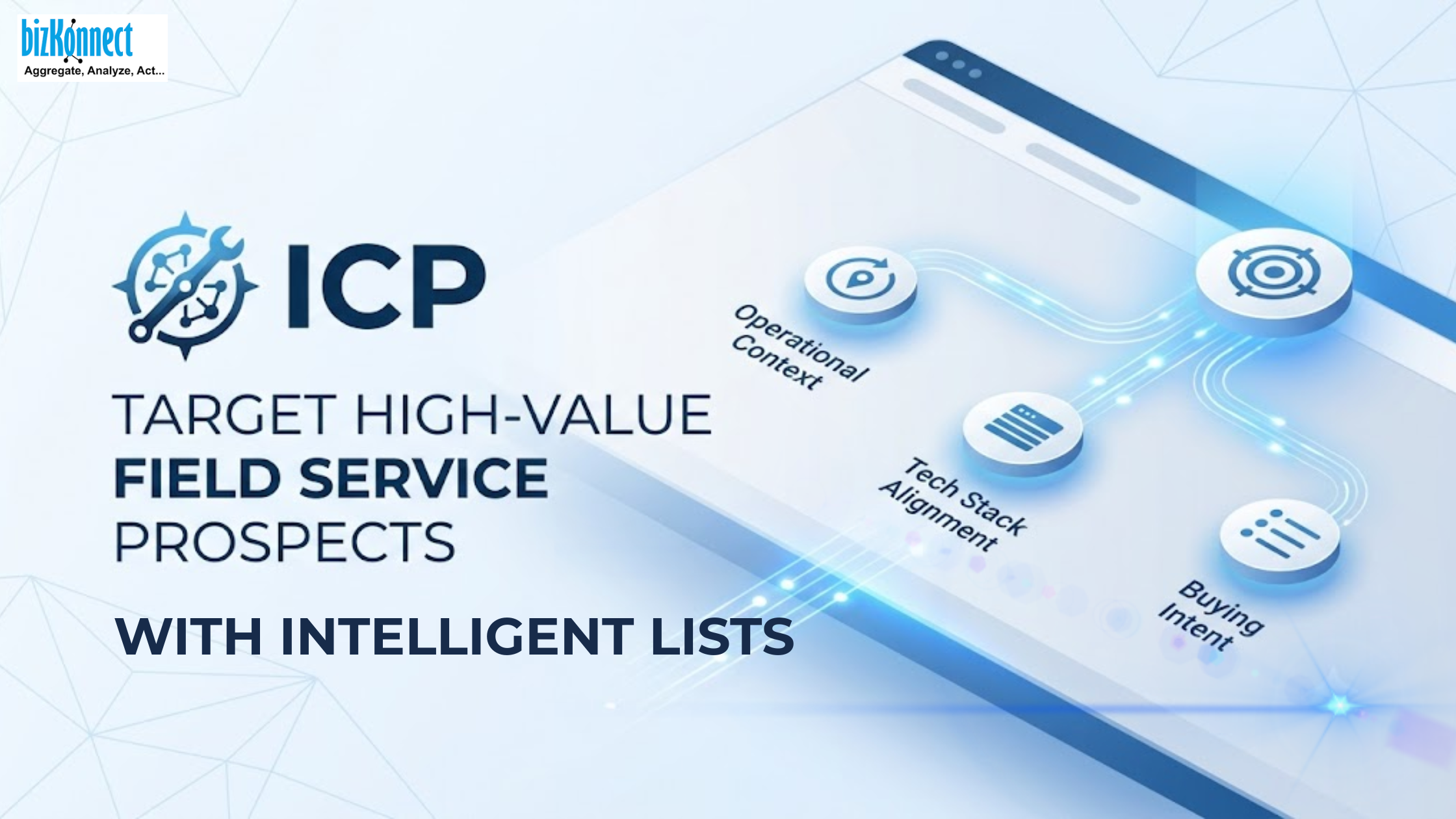
Step 4: Segment Account Lists by Urgency and Readiness
Group target accounts into distinct tiers based on fit and demonstrated buying intent:
- TIER 1: HIGH FIT + ACTIVE INTENT
- Full Buying Committee Mapped
- Active Tech Stack Migration / Hiring Surge
- Multi-Channel Personalized Account-Based Motion
- TIER 2: HIGH FIT + DORMANT INTENT
- Matches Operational Criteria
- No Immediate Technology Shift Detected
- Value-Led Educational Nurture Campaigns
This tiering prevents reps from burning high-value enterprise accounts with premature outbound efforts.
Step 5: Establish a Continuous Validation and Refresh Loop
Market shifts, fleet expansions, and software renewals alter account eligibility continuously.
Establish structured review cycles across sales, marketing, and customer success teams to refine target criteria. Validate account data routinely against live operational signals to clear out obsolete field service business contacts before launching outbound campaigns.
What Are the Strategic Benefits of an Operational ICP List?
Replacing broad contact sourcing with a validated target list changes outbound efficiency and pipeline health across the entire organization:
- Shorter Enterprise Sales Cycles: Reaching field service executives during active operational friction removes months of initial problem-awareness education.
- Eliminated Outbound Waste: Filtering out incompatible tech stacks and non-responsive accounts prevents reps from chasing dead leads, maximizing team productivity.
- Higher Customer Lifetime Value (LTV): Accounts acquired through precise operational alignment onboard faster, see higher platform adoption, and renew at significantly higher rates.
- Sales and Marketing Alignment: Jointly defining target criteria unifies GTM messaging and ensures marketing spend directly supports active sales pursuits.
None of this happens from a single list-building sprint. It happens from treating the ICP as infrastructure, something that gets referenced, tested, and adjusted continuously as field service buying committees keep evolving.
Frequently Asked Questions (FAQs)
Q1. What is the difference between an ICP and a buyer persona in field service?
An Ideal Customer Profile (ICP) defines the account-level organization (e.g., fleet size, dispatch structure, software dependencies). A buyer persona profiles the specific decision-maker within that organization, detailing individual responsibilities, KPI pressures, and personal buying motivations.
Q2. How often should a field service ICP list be updated?
Account lists should be updated continuously via live intelligence layers, with full strategic reviews conducted quarterly. Operational changes such as company acquisitions, system migrations, and executive turnover can alter account readiness in weeks.
Q3. Why do standard B2B contact lists underperform in field service?
Standard databases rely heavily on generic job titles and static corporate firmographics. They lack field-specific operational context, such as depot structures, contractor models, and real-time tech stack dependencies.
Q4. Which decision-makers should be prioritized in a field service target account list?
Prioritize operational leadership (VP of Field Operations, Director of Service Delivery), IT leadership (CIO, Director of Enterprise Systems), and regional operations managers who directly oversee service-level agreement (SLA) execution.
Q5. How does intent data enhance an ICP list for field service?
Intent data identifies accounts actively researching specific operational challenges such as dispatch bottlenecks, mobile sync failures, or fleet tracking integration, allowing revenue teams to engage prospects right when buying urgency is highest.
To streamline your target account list build with verified, operational sales intelligence, Reach out to Us to explore how BizKonnect can accelerate your outbound strategy.
CLICK HERE to know more with BizKonnect.