


Wholesale building material suppliers have added SDR capacity, more sequences, more CRM fields, yet fewer conversations reach an actual project decision-maker.
This is the quiet failure point in construction go-to-market today: contact volume scaled, contact relevance did not.
The reason?
- Procurement departments restructured.
- Project authority fragmented across estimators, regional buyers, and site supervisors.
- Distributor lists kept the old org chart while the buying committee moved on.
Actionable sales intelligence closes this gap by clarifying which names matter, why, and when. What follows is a working map of where construction buying authority sits now, and the sequence required to reach it before a competitor's quote does.
Why Does a Bigger Contact List Often Produce Fewer Qualified Conversations?
When the pipeline weakens, the instinct is to expand the top of the funnel. But for building material distributors, this backfires.
Construction procurement is not centralized the way enterprise SaaS buying is.
A single project routes decisions through an estimator who shortlists suppliers before bid submission, a project manager who controls specification changes mid-build, a procurement lead who negotiates pricing across sites, and a superintendent who approves substitutions under deadline pressure.
Generic contact intelligence collapses all four into "purchasing contact" and emails the title most likely to ignore them.
Actionable sales intelligence corrects this by mapping authority to project phase, not job title alone. An estimator has influence at bid stage but disappears once the contract is awarded. Knowing which role is active at which moment separates a cold email from a well-timed one, but only once the underlying project is worth that effort.
What Actually Separates a High-Value Construction Buyer from a Busy One?
Reaching the right contact still fails if the underlying project was never worth chasing. Activity is not valuable, and most outbound motions confuse the two. In reality, a high-value buyer is the one with funding behind the build, repeat purchasing behavior, and growth that outlasts a single project.
Five signals separate a worthwhile target from a busy one:
- Funded projects: a signed construction loan moves a project to procurement on a predictable timeline; speculative projects stall and waste outreach
- Backlog size: contractors carrying a large backlog have steadier material needs across sites rather than a single transaction
- Permit volume: a rising count of filed permits within a region signals near-term demand before any RFP is issued
- Repeat-build contractors: builders running similar project types repeatedly create recurring order patterns
- Regional expansion signals: new branch openings or multi-site rollouts indicate a buyer scaling demand rather than completing an isolated job
Prospecting starts at the project level, instead of the contact level. A perfectly timed email to the right person on a low-value, single-site project still produces a low-value deal. Customer data intelligence makes this filtering possible by surfacing funding status, backlog, and permit trends before a rep drafts a sequence.
Who Are the 7 Decision-Makers Every Building Material Supplier Should Be Targeting?
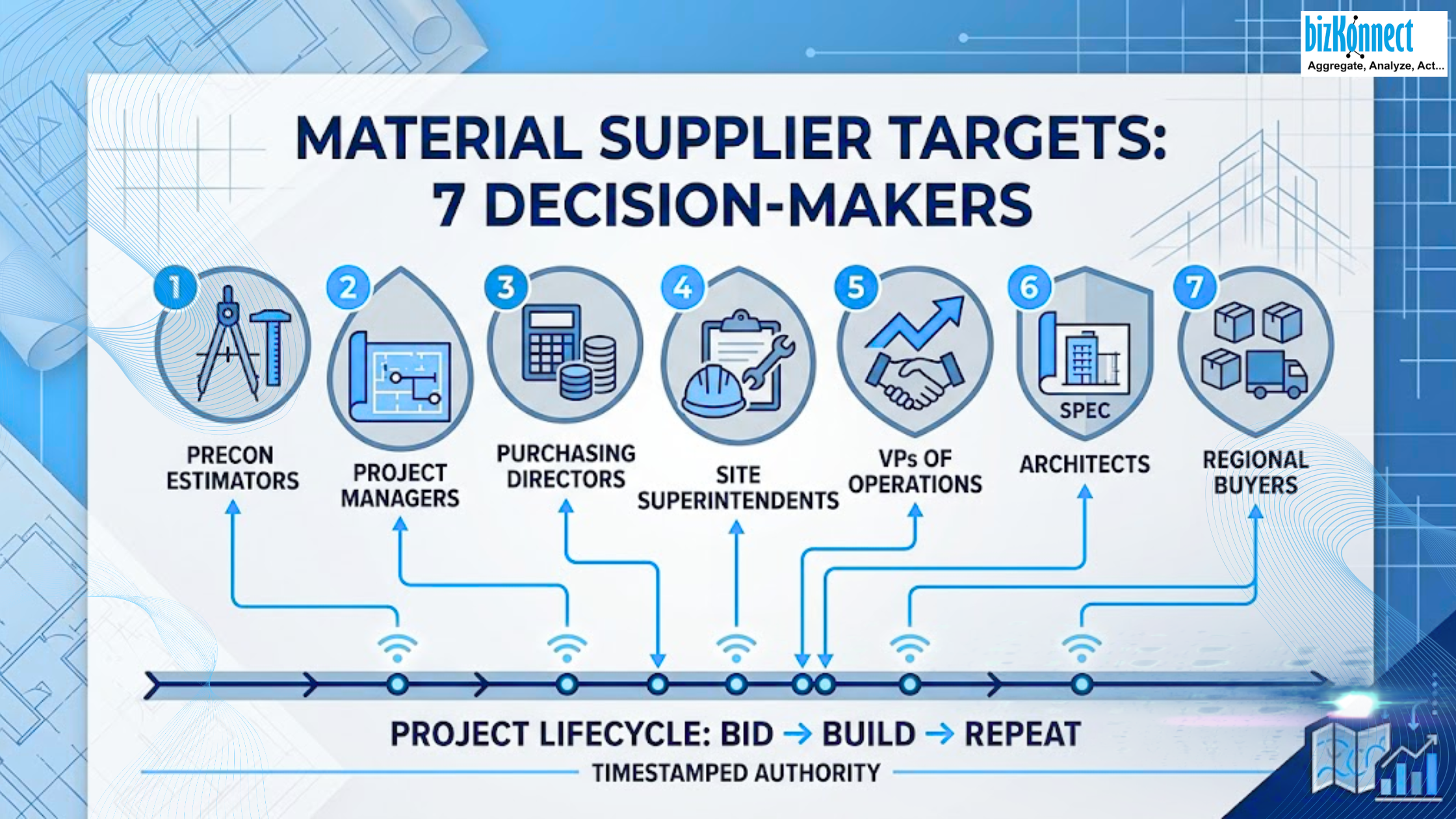
Once a project clears the value threshold, the buying committee is wider than most supplier CRMs reflect. Seven roles consistently shape outcomes, each behaving differently by project stage:
- Preconstruction Estimators: evaluate pricing and lead times before a bid is finalized; early-stage, price-sensitive
- Project Managers: control specification and substitution decisions once construction begins; mid-stage, schedule-driven
- Procurement or Purchasing Directors: own vendor contracts and supplier consolidation; cross-project, margin-driven
- Site Superintendents: approve last-minute substitutions and reorders under deadline pressure; ground-level, availability-driven
- VPs of Construction or Operations: set preferred-vendor policy across projects; strategic, relationship-driven
- Architects and Specification Consultants: influence which materials are named in the original spec; upstream, credibility-driven
- Regional or Branch Purchasing Managers: execute repeat ordering for distributed projects; recurring, reliability-driven
Treating this as a flat list rather than a sequence is the common error. Targeting a procurement director before the estimator has shortlisted the supplier wastes the outreach. Targeting a superintendent after the spec is locked is too late to matter.
Customer data intelligence identifies which role is active on a given project, using the same permit, bid, and procurement signals that qualified the project in the first place.
When Does Lead Enrichment Start Working Against Targeting Accuracy?
Enrichment tools solve a narrow problem well: filling in missing fields, email, phone, LinkedIn, company size. But enrichment without context creates complete-looking records that are operationally stale.
A purchasing director who changed roles eight months ago still shows up as "active," because enrichment refreshes fields, not relevance. Outreach lands, gets no response, and the rep concludes the lead was never good rather than that the data was stale.
Enrichment answers who this person is. Sales intelligence answers whether this person currently has buying authority on a live, high-value project, and whether now is the right moment to reach them. That requires signals enrichment tools do not track: active project timelines, recent procurement activity, shifts in regional buying responsibility. The result: sequencing aligns to project phase, rep time shifts toward live windows, and win-rate per qualified conversation rises even if total volume stays flat.
This is how sales intelligence improves B2B sales prospecting for distributors: not more names, but timestamped authority against project reality.
What Is the GTM Process for Reaching These Decision-Makers, Powered by Contact Intelligence?
Reaching the right person at the wrong moment produces the same outcome as reaching the wrong person. A workable process for wholesale suppliers follows five stages:
- Qualify projects before mapping accounts: Filter for funded projects, rising backlog, permit volume, and expansion signals before a single contact gets added to a sequence.
- Identify the currently active decision-maker for that phase: Cross-reference the seven roles against project signals to determine who holds influence now.
- Sequence outreach to match authority windows: Estimators get pricing messaging before bid submission; project managers get specification messaging once construction starts.
- Trigger re-engagement on signal change: A procurement update, a new hire, or a project delay should reopen outreach automatically, rather than waiting for a follow-up that arrives too late.
- Feed outcomes back into targeting logic: Which project profiles and roles converted should refine future qualification, not just get logged as closed-won.
What is sales intelligence in B2B sales, applied here, is the connective layer running through all five stages: what tells a sales team which project is worth pursuing, who controls it now, and when that control shifts.
Sales intelligence strategies for B2B growth in this sector succeed less on any single tactic and more on how tightly qualification, targeting, and timing stay synchronized as projects move through their lifecycle.
Answering Some Frequently Asked Questions (FAQs) by Suppliers
Q. How is contact intelligence different from a standard construction contact database?
A standard database lists titles and companies. Contact intelligence adds project-stage activity, so suppliers know not just who holds a role but whether that role currently has live buying authority.
Q. How often does construction buying authority change within a single project?
Frequently. Authority shifts at bid submission, contract award, groundbreaking, and any point material substitutions are needed.
Q. What signals indicate a project has entered an active buying window?
Permit filings, public bid postings, procurement system updates, and changes in project staffing are the most reliable early indicators.
Q. How does this reduce wasted outreach without reducing outreach volume?
By aligning message and timing to the currently active role instead of contacting every title on an account at once, concentrating effort on conversations more likely to convert.
The shift from broad contact lists to project-stage-aware contact intelligence is already separating suppliers who win bids consistently from those who simply send more emails. CLICK HERE to see how BizKonnect helps wholesale building material suppliers identify and sequence outreach to the right construction decision-makers at the right project stage.
CLICK HERE to know more with BizKonnect.