


For years, go-to-market (GTM) teams have been told that outbound success is an execution problem. It solves for speed, scale, and personalization, ultimately the pipeline follows. That belief drove the widespread adoption of AI SDR tools: platforms that automate sequences, trigger follow-ups, and reach thousands of prospects without adding headcount.
So teams invested, they automated, and they scaled.
But here's what that framing missed: execution is only as effective as the inputs behind it.
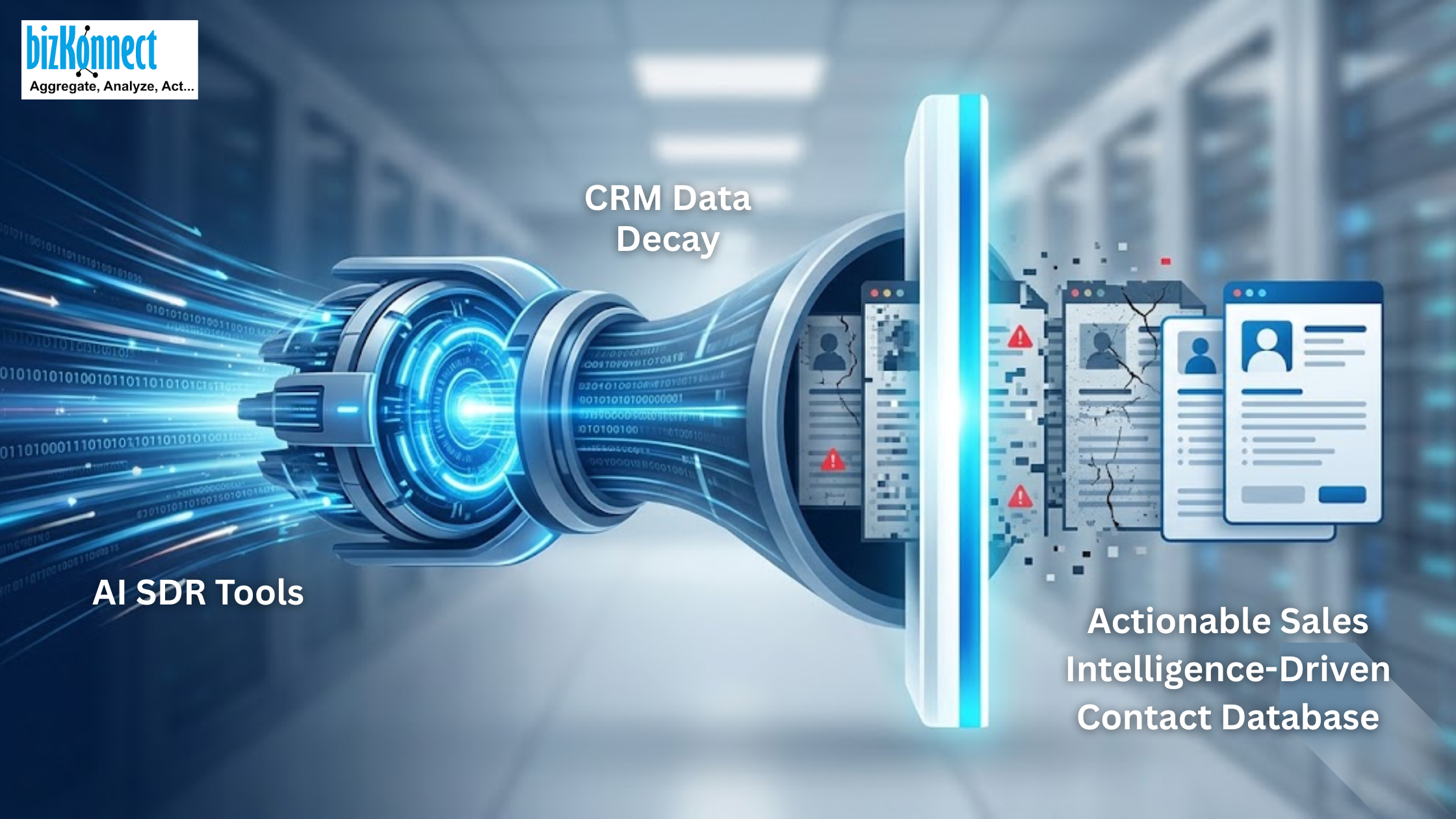
An AI SDR tool is a delivery mechanism and what it delivers depends entirely on the quality of the contact data it operates from. When that data is outdated, duplicated, or unverified, the automation accelerates in the wrong direction.
That's why the most forward-thinking sales teams are anchoring their entire GTM motion in actionable sales intelligence because it is verified, current, and specific enough to make every automated touchpoint count.
But, before we dive deep into this:
What Happens When Your AI SDR Moves Faster Than Your Contact Data Can Keep Up?
- B2B contact data decays at approximately 22.5% per year and 2.1% every month. If a sales team enriched its CRM in January, nearly a quarter of that data is unreliable by December.
- Work emails cycle out at 20–30% annually as people change employers.
- Job titles shift at 15–25% due to promotions, reorgs, and eliminations.
By the time an AI SDR pulls a contact from a segment, that person may no longer hold the title or email address that made them a viable prospect.
The automation fires anyway, it just fires at irrelevant contacts, resulting in:
- Emails bounce against deactivated inboxes
- Personalization tokens pull outdated titles
- Sequences target contacts who've moved to competitors
- Follow-up logic triggers on accounts that have gone inactive or been acquired
None of these surfaces immediately. It shows up three months later in pipeline reviews, when leadership is trying to understand why high-volume outbound produced almost no qualified opportunities.
Why CRM Contact Data Quality Collapses Under Outbound Scale?
The decay problem isn't new. What's new is how fast automation amplifies its consequences. A team sending 200 emails a week can absorb some data quality loss but a team running AI-assisted sequences at 2,000 a week cannot.
According to a recent research, 76% of organizations report that less than half their CRM data is accurate and complete. Companies lose an average of 64 sales deals per year directly attributable to poor-quality data. Teams rarely discover how bad things have gotten until they push volume through where automation reveals data decay through failure at scale.
Structural patterns that accelerate deterioration:
- Duplicate contacts from multiple reps prospecting the same accounts through different sources
- Unverified imports from third-party lists not validated before entering the CRM
- Manual entry errors baked in at creation and left to propagate
- No enrichment cadence, leaving records from two or three years ago treated as current
An AI SDR pointed at that database becomes a fast machine for sending the wrong messages to the wrong people at scale.
What Revenue Is Bad Data Quietly Costing Your Outbound Team?
This problem shows up wearing different masks such as deliverability issues, messaging failures, and targeting gaps and usually all three at once. They get diagnosed separately, and the root cause goes untreated.
Sales reps spend an average of 13 hours per week searching for accurate CRM information, 32.5% of a 40-hour workweek. Across a 10-person outbound team, that's 3.25 full-time roles spent on data archaeology rather than selling.
The compensating instinct is to increase volume. If 30% of contacts are unreachable, send to more people. But this degrades sender reputation, inflates unsubscribes, and signals to the AI SDR's optimization layer that segments aren't performing. The system adjusts on flawed inputs and becomes more confidently wrong over time.
Why Actionable Sales Intelligence Changes the Outbound Equation?
A contact list with unverified records and 18-month-old titles is data. A human-verified list of decision-makers with confirmed direct lines and current roles is actionable sales intelligence. The difference isn't volume, rather it's utility at the moment of outreach.
Actionable sales intelligence is what makes an AI SDR tool a force multiplier rather than a source of sustained operational drag. It closes the gap between automation firing and automation landing, ensuring the right message reaches a real person with the right authority, at the right company, right now.
The verticals where this distinction matters most are precisely the ones where human-verified, 100% quality-guaranteed email lists are built to operate:
- Aerospace and defense email lists: verified contacts for long procurement cycles where one bounced sequence can close an account for months
- Agriculture and farm contractors email lists: current business status across seasonal operations, ownership changes, and regional consolidation
- Government services mailing lists: accurate role and department data in organizations where titles shift frequently and procurement authority is distributed
- Telecom executives mailing lists: decision-maker level contacts in a sector where buying influence spans multiple functions and changes with organizational restructuring
- Logistics email lists: verified contacts across a high-turnover industry where operational roles and company structures evolve rapidly
- Fiber optic manufacturing industry lists: title-accurate contacts aligned to infrastructure investment cycles and technology purchasing decisions
- Law firms email lists: verified partner and decision-maker contacts in a vertical where hierarchy and role specificity determine outreach relevance
- Shopify customer lists: current contacts in a fast-moving e-commerce segment where business status and ownership change at pace
- Manufacturing email lists: enriched, verified contacts across a broad vertical where procurement roles and plant-level decision-making vary by company size
- Marinas email lists: niche, high-precision contacts where small pool size makes every invalid record a proportionally larger loss
- Saving institutions federally chartered lists: verified contacts within a compliance-sensitive segment requiring accurate role and institutional data
- Manufacturing technology companies lists: decision-maker contacts in a sector at the intersection of industrial operations and technology adoption
- Denmark business email lists: GDPR-compliant, human-verified contacts for the Danish market where regulatory and cultural specificity matters
- European business email lists: verified, compliance-ready contacts across European markets where GDPR mandates legitimate sourcing
Each list is maintained with verified sourcing, current role data, and a refresh cadence that keeps pace with how fast B2B contact information actually changes.
What Data-Disciplined Outbound Teams Do Differently?
The correction is a process redesign, built around four structural commitments:
- Quarterly re-enrichment as a baseline: A quarterly cycle across any active segment prevents decay from compounding past operational usefulness.
- Human-verified sourcing for high-stakes segments: For outreach sequences where a single contact's accuracy affects a high-value deal, human-verified data outperforms automated enrichment. Organizations applying this approach reduced bounce rates from 35–40% to under 5%.
- Explicit ownership of data quality: When no one is responsible, no one fixes it. A governance framework assigning accountability for enrichment cadence, duplicate resolution, and import standards converts data quality into a tracked operational metric.
- Stage-gated required fields: Requiring full qualification data at first contact forces fabrication. Research shows 37% of staff regularly input false CRM data to satisfy required fields because the system leaves no alternative. Fewer required fields at appropriate deal stages produce cleaner records.
Let’s Address Few Frequently Asked Questions (FAQs)
Q. How frequently should B2B contact data be re-enriched?
Quarterly at minimum. High-turnover industries warrant monthly enrichment given the 22.5% annual decay rate.
Q. How does bad data degrade AI SDR performance?
The system misattributes low engagement to messaging rather than data quality, optimizes on a flawed premise, and narrows targeting further with each adjustment.
Q. What separates actionable sales intelligence from standard contact data?
Standard data gives a name and email. Actionable sales intelligence adds verified current role, company context, and trigger events indicating buying readiness, closing the gap between receiving a contact and acting on it.
Q. Is human-verified data worth the cost premium?
For long-cycle, compliance-sensitive, or niche verticals, one failed outreach sequence typically costs more than the verification itself.
Building a predictable, scalable outbound engine requires recognizing that automation capabilities are only as powerful as the data infrastructure supporting them. Organizations must look beyond the speed of their delivery systems and anchor their go-to-market architecture on an accurate, verified information foundation.
To discover how human-verified database solutions can empower your automation stack with true actionable sales intelligence, CLICK HERE to explore the advanced B2B intelligence solutions engineered by BizKonnect.
CLICK HERE to know more with BizKonnect.