


For the last three years, risk and compliance solution providers have invested heavily in outbound infrastructure.
- More sequences.
- More contact databases.
- More automation layers.
Yet somewhere between higher send volumes and the expectation of proportional returns, a quiet contradiction took hold: pipeline coverage increased while qualified opportunity rates declined and the revenue did not materialize.
It is a data and targeting problem rooted in how most risk and compliance firms approach CRM data management for compliance and risk consulting firms. Specifically, the assumption that volume-driven prospecting can substitute for research-led precision. As buyers in this space become more defensively selective, that assumption is beginning to cost firms measurable growth.
What follows now is an examination of why that gap widens, what breaks when it does, and how GenAI-trained analyst support is fundamentally restructuring the prospecting model for firms that sell into governance, risk, and compliance markets.
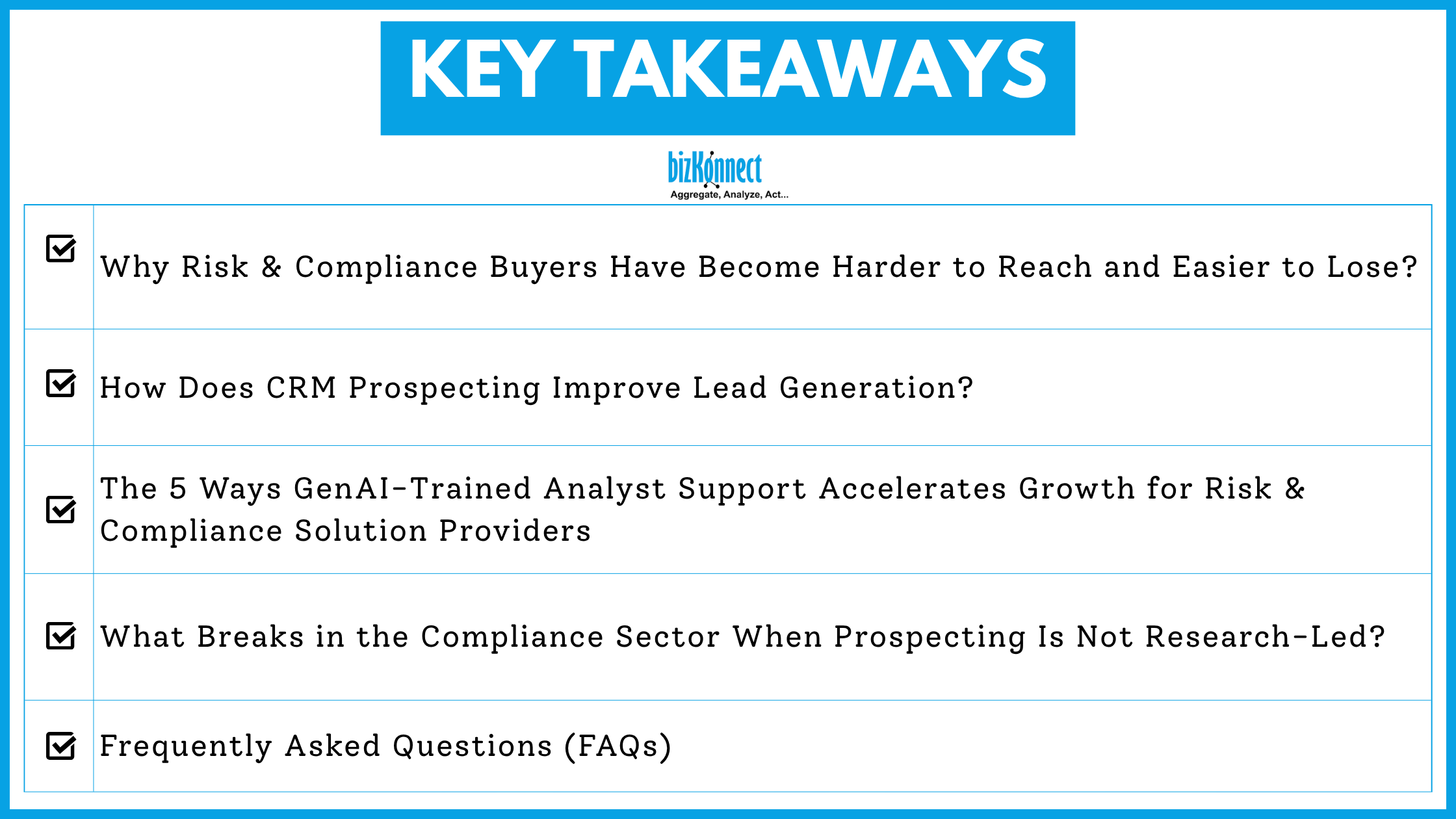
Why Risk & Compliance Buyers Have Become Harder to Reach and Easier to Lose?
The compliance and risk buyer was never easy.
They operate under regulatory scrutiny, procurement controls, and institutional risk aversion that extends to vendor evaluation itself. A cold email that misidentifies their regulatory environment, their company size bracket, or their current solution stack signals disqualification before the conversation begins.
What has changed is the signal-to-noise ratio they now face.
As noted in a recent research, “we are operating in a VUCA environment: volatile, uncertain, complex, and ambiguous, where information overload has made buyers more skilled at filtering, not less. The firms that break through are those that demonstrate pre-call knowledge density, instead of the highest contact frequency.”
The implication for risk solution providers is direct. Generic prospecting sequences actively erode brand credibility with the very buyers who carry the longest contract values. An account-based sales strategy built on researched, validated, and enriched CRM data starts to look less like a competitive advantage and more like a baseline requirement.
How Does CRM Prospecting Improve Lead Generation?
CRM prospecting improves lead generation by ensuring those contacts map precisely to the decision-making structure of accounts that have a demonstrated likelihood to buy. That requires three things working simultaneously:
- Clean data
- Enriched data
- Actionable intelligence layered onto both
Most risk and compliance firms have exactly one of those three.
Their CRM contains contacts but the contacts are outdated, duplicated, incompletely titled, or unlinked to the correct account hierarchy. A compliance director who moved firms eight months ago is still receiving orders. A mid-market GRC prospect is being targeted with enterprise-tier messaging. An account that acquired a competing solution last quarter is still flagged as an open opportunity.
The consequence is biased pipeline reporting, skewed lead scoring, and sales cycles that open with misaligned expectations and close at lower rates.
CRM data management, when executed with discipline, corrects all of this before a campaign runs. It restructures the foundation on which every outreach decision sits.

The 5 Ways GenAI-Trained Analyst Support Accelerates Growth for Risk & Compliance Solution Providers
This is where the model shifts. GenAI-trained analyst support does not replace human judgment in prospecting, rather it removes the research drag that prevents human judgment from operating at scale. Here is what that looks like operationally:
1. Precision Data Validation Replaces Assumption-Based Targeting
Before any outreach touches a risk or compliance buyer, the underlying contact record must be verifiable. GenAI-trained analysts executing systematic data validation such as database cleansing, de-duplication, verification, and formatting eliminate the compounding inaccuracy that undermines campaign performance over time.
The result is the elimination of false confidence: the assumption that because a record exists in the CRM, it reflects a real, reachable, accurately characterized prospect. In a market where buyer trust is already compressed, reaching the wrong person at the wrong firm at the wrong moment is a more expensive failure than reaching no one.
2. Data Append and Enhancement Enables Tiered Targeting Across Buyer Segments
Risk and compliance solution providers operate across heterogeneous buyer segments, from regional financial institutions managing Basel compliance to multinational manufacturers navigating ESG disclosure mandates. A flat contact list treats these as equivalent, but in reality, they are not.
Data append capabilities including adding job titles, SIC codes, employee counts, company size, phone numbers, and decision-maker email addresses to existing records make differentiated campaign architecture possible. When the data reflects the actual structure of a prospect organization, messaging can be calibrated to role-specific pain points rather than category-level generalizations.
3. Structured Lead Research Surfaces Accounts Before They Signal Readiness
Most compliance-sector buyers do not signal purchase intent through typical behavioral markers. Their readiness is embedded in organizational triggers:
- Leadership changes
- M&A activity
- Regulatory fines
- Audit failures
- Geographic expansion into new compliance jurisdictions
GenAI-trained analyst support structures lead research to capture exactly these triggers through market research, prospect identification, lead profiling, lead scoring, and verification before an account is ever pushed into a sales sequence.
The effect is a compressed qualification cycle.
Sales teams are not opening conversations with cold contacts; they are initiating outreach at moments of demonstrated organizational receptivity.
4. CRM Managed Services Remove the Operational Drag That Kills Pipeline Velocity
CRM data services are most valuable when they are continuous.
A one-time data cleanse followed by six months of unmanaged growth produces the same degraded data quality problem on a delayed timeline. What changes the underlying trajectory is ongoing CRM managed services:
- Platform management
- Campaign setup
- Data segmentation
- Analytics and reporting
- A/B testing
- Lead scoring
- Integration with external data providers
For risk and compliance solution providers, this matters for a specific reason: their buyer relationships are long-cycle and relationship-dependent. Tracking communication history, interaction patterns, and stakeholder preferences across a CRM that is actively maintained is what enables relationship management to scale without losing the personalization that compliance buyers expect.
5. Campaign Execution Capability Closes the Gap Between Research and Revenue
Research that never converts into executed outreach is overhead. The final acceleration point is where GenAI-trained analyst support extends from data management into campaign execution itself. providing verified, actionable contact lists, managing multi-channel campaigns across email, WhatsApp, and SMS, processing event attendee data for targeted follow-up, and handling CRM imports of refreshed data ahead of every campaign cycle.
For growth-stage risk solution providers without dedicated RevOps infrastructure, this functions as a virtual extended team. For established providers scaling into new verticals or geographies, it absorbs the execution load without the hiring timeline.
In both cases, it compresses the time between market insight and market contact.
What Breaks in the Compliance Sector When Prospecting Is Not Research-Led?
The compliance sector has a tolerance profile that magnifies the cost of undisciplined prospecting. Buyers in this space are risk-averse by professional orientation. A cold outreach that demonstrates poor research such as wrong title, wrong regulatory context, or wrong company stage does not produce a neutral non-response. It produces a negative signal that travels where procurement teams talk and compliance officers share vendor impressions within professional networks.
A recent research characterizes the modern sales environment as one where "information is the way to manage uncertainty" where organizations that develop the capacity to understand patterns and derive buyer insights gain a structural advantage over those operating on volume assumptions alone.
In the compliance sector, that characterization is especially acute.
The firms winning new revenue in this market are outresearching them on account selection, data quality, and contact precision and they are doing it systematically.
Let’s Address a Few Frequently Asked Questions (FAQs)
Q: How does CRM prospecting improve lead generation for niche compliance verticals?
By anchoring outreach to accurately researched, role-specific contact data and organizational trigger signals, CRM prospecting filters out structurally unqualified accounts before they enter the pipeline, reducing wasted cycles and improving the conversion rate on the accounts that do advance.
Q: What distinguishes CRM data management for compliance and risk consulting firms from standard B2B data hygiene?
The buyer set is more complex: decisions involve legal, procurement, operations, and executive stakeholders with divergent priorities. Accurate data management must capture role hierarchy, decision authority, and organizational structure, not just contact information to enable effective multi-threaded outreach.
Q: At what stage should a risk solution provider invest in CRM managed services?
Before the GTM motion scales. The common mistake is treating CRM data management as a remediation task following pipeline underperformance. By that point, campaign costs, sales cycle distortion, and brand credibility loss have already accumulated. Investing in managed CRM data services at the point of growth planning prevents the downstream failure modes.
Q: Can GenAI-trained analysts support both data management and campaign execution simultaneously?
Yes. The most effective deployments run data validation, enrichment, and CRM maintenance in parallel with campaign preparation and execution. This eliminates the sequential bottleneck where clean data is available too late to inform the current campaign cycle.
Ready to build a research-led prospecting system that turns CRM data services into a consistent pipeline for your risk and compliance firm? CLICK HERE to connect with BizKonnect and see how GenAI-trained analyst support can work as your extended growth team.
CLICK HERE to know more with BizKonnect.