


The traditional B2B sales motion is breaking under the weight of external unpredictability.
Most go-to-market (GTM) teams realize too late that their deals haven't died, they have simply entered a state of suspended animation. When a prospect stops responding, the instinct is often to increase volume, yet this rarely solves the underlying cause of the silence. In the current climate, a staggering 44% of executives have postponed key parts of their business strategies due to policy uncertainty, market volatility, and geopolitical issues.
This hesitation directly lengthens B2B sales cycles, making a consistent B2B multi-channel outreach strategy the primary factor in determining whether a deal eventually closes or permanently stalls.
The gap in execution today is not a lack of effort, but a lack of persistence across the right nodes of influence.
When geopolitical chaos causes a budget freeze, a single-channel approach fails because it cannot maintain the "warmth" required over an eighteen-month cycle. To keep prospects engaged across email, LinkedIn, and partner networks, teams are turning to an iterative, multi-channel campaign model powered by GenAI insights.
This guide examines how to bridge the gap between initial interest and final signature during long, unpredictable decision cycles.
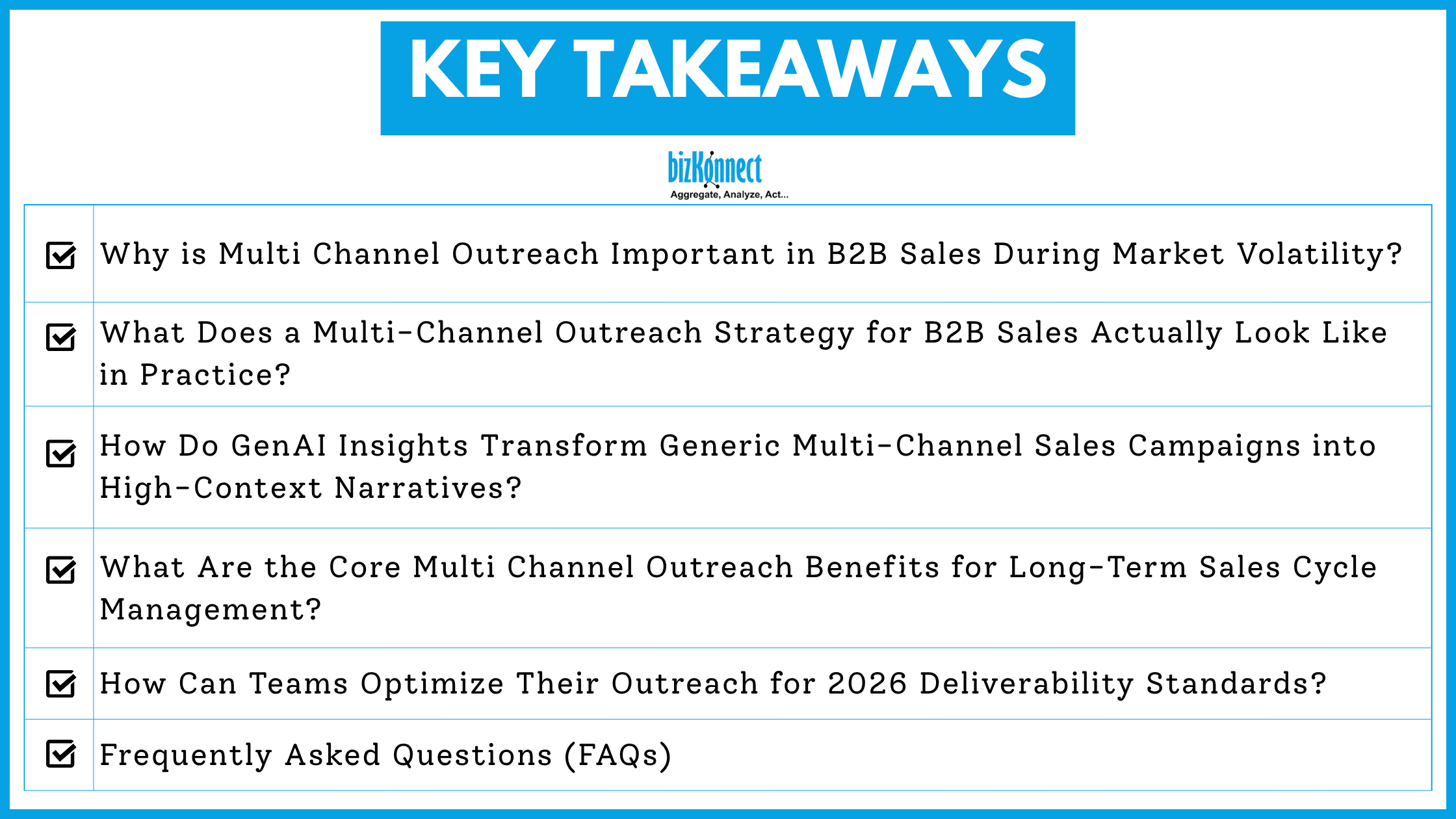
Why is Multi Channel Outreach Important in B2B Sales During Market Volatility?
During periods of stability, a linear sales process is effective. However, when macro-economic shifts occur, the "buying committee" often expands to include risk officers and CFOs who were not part of the initial discovery. A multi channel outreach strategy for B2B sales is essential because it accounts for the fact that your champion may no longer have the unilateral power to move the needle.
Common approaches fail here because they treat outreach as a series of "check-ins" rather than value-adds.
If your outreach is limited to a single channel, you risk being filtered out by automated systems or human fatigue. Recent data indicates that deliverability is no longer just about records, rather it is about engagement signals.
In 2026, email visibility is heavily influenced by "reputation clusters." If a prospect doesn't engage with your email but sees your insightful commentary on a LinkedIn thread or encounters your brand through a partner network, the next email you send is more likely to land in the primary inbox rather than the "Promotions" or "Other" tab.
The non-obvious insight here is that multi-channel is all about creating a "surround sound" effect that validates your stability.
In a volatile market, buyers gravitate toward vendors who appear omnipresent and composed. By diversifying touchpoints, you mitigate the risk of a single point of failure in your communication chain.
What Does a Multi-Channel Outreach Strategy for B2B Sales Actually Look Like in Practice?
In most execution, "multi-channel" means sending the same message through email, LinkedIn, and occasionally a phone call. That's actually repetition with more logistics.
A real multi-channel outreach strategy maps touchpoints to where a buyer is in their thinking, not where they sit in your CRM. Over 80% of enterprise tech buyers are now segmenting their buying process into phased steps, and 87% report tightening purchasing criteria to focus only on mission-critical products. Your outreach needs to match their internal risk calculus at each stage.
What that looks like in practice:
- Email for context-heavy content such as case studies, ROI summaries, comparisons a buying committee can forward internally.
- LinkedIn for ambient credibility, commenting on buyer content, sustaining presence without pressure.
- Partner and community channels for third-party validation where sources buyers trust more than vendors.
How Do GenAI Insights Transform Generic Multi-Channel Sales Campaigns into High-Context Narratives?
The primary reason multi channel sales campaigns fail is the "copy-paste" trap. Sending the same generic message across three platforms doesn't build trust, it creates noise. Generative AI has moved beyond simple draft generation to become a diagnostic tool that identifies "buyer triggers" buried in earnings calls, policy shifts, and news cycles. Effective teams use GenAI to synthesize how specific geopolitical events like a new trade tariff or a shift in energy policy specifically impact a prospect's vertical.
Instead of asking "Are we still on for Tuesday?", the outreach becomes: "Given the recent shift in [Regulation X], many of our partners in [Industry Y] are pivoting their supply chain strategy. I’ve attached a framework on how we support that transition."
This level of insight density is what keeps a deal alive during a six-month silence.
While your competitors are sending "following up" emails, you are providing market intelligence that helps the prospect navigate the very chaos that caused the delay. This shifts your role from a vendor to a consultant, which is the only way to remain relevant when budgets are being scrutinized.

What Are the Core Multi Channel Outreach Benefits for Long-Term Sales Cycle Management?
The most significant benefit of a multi-channel approach is the accumulation of "micro-conversions." In a stretched sales cycle, you cannot expect a "macro-conversion" (a signed contract) every month. You need a system that rewards smaller engagements.
- Pattern Recognition: By monitoring engagement across LinkedIn, email, and webinars, you can identify when a "stalled" lead is heating up again before they ever reply to an email.
- Deliverability Resilience: As deliverability algorithms become more sophisticated, having a high LinkedIn engagement rate actually improves your domain’s email reputation. Interconnected engagement signals are the new SEO for the inbox.
- Reduced Friction: Different stakeholders prefer different channels. A Technical Lead might engage with a GitHub repository or a technical whitepaper, while a CXO prefers a concise LinkedIn Voice Note or a peer-referral through a partner network.
Where many teams fail is in the "hand-off" between channels. They treat LinkedIn and email as separate silos.
A high-authority approach requires a unified thread where the conversation on one platform naturally informs the next. This creates a cohesive narrative that survives even when the internal team at the prospect’s company undergoes turnover which is a common occurrence during market volatility.
How Can Teams Optimize Their Outreach for 2026 Deliverability Standards?
The technical landscape of 2026 has moved toward "signal-based" filtering. For B2B marketers, this means that your B2B multi-channel outreach is now being judged by the quality of the recipient's response as well as the volume of sends.
To maintain visibility, teams must focus on:
- Engagement-Led Warmth: Before launching a heavy email sequence, engage with the prospect’s public-facing content. This creates a "familiarity signal" in the digital ecosystem.
- Contextual Pivoting: If a deal stalls due to a geopolitical event, the outreach should immediately pivot from "product-centric" to "resilience-centric."
- Frequency Calibration: In a long cycle, the goal is not high frequency, but high relevance. One well-timed, GenAI-informed insight sent via a partner network is worth ten automated follow-ups.
Frequently Asked Questions (FAQs)
With these challenges and solutions in mind, a few important questions naturally arise for teams navigating similar situations. Addressing some of them:
Q1. Why is my email deliverability dropping even though my technical setup is correct?
In 2026, mailbox providers prioritize "reputation clusters." If your prospects don't interact with your brand across other digital touchpoints, your emails are increasingly likely to be flagged as low-priority.
Q2. Does GenAI-generated content hurt or help deliverability?
It helps if used for insights, but hurts if used for automation. Using GenAI to find a specific business pain point increases engagement, which is the strongest positive signal for deliverability.
Q3. How do I justify a longer sales cycle to leadership?
Shift the metric from "time to close" to "pipeline velocity and health." Use engagement data from your multi-channel touchpoints to prove that while the deal is taking longer, the relationship is deepening.
Navigating B2B sales in times of geopolitical instability requires more than just persistence, it requires a strategic, multi-channel presence that offers genuine value. By integrating GenAI insights into a structured outreach framework, you can turn a stretched sales cycle into an opportunity to build unbreakable trust.
CLICK HERE to explore how BizKonnect helps teams execute account-level multi-channel campaigns that stay relevant across every stage of an extended cycle.
CLICK HERE to know more with BizKonnect.