


AI can process enormous amounts of information in seconds. That does not automatically make the information useful to a sales or revenue team.
In B2B sales, the real value comes when raw output is checked, interpreted and turned into intelligence that a team can actually use. A company record may look complete while missing a recent leadership change. A contact may appear relevant while no longer holding the role. An account may fit an ICP on paper but have little commercial relevance at the time of outreach. This is where human validation still matters.
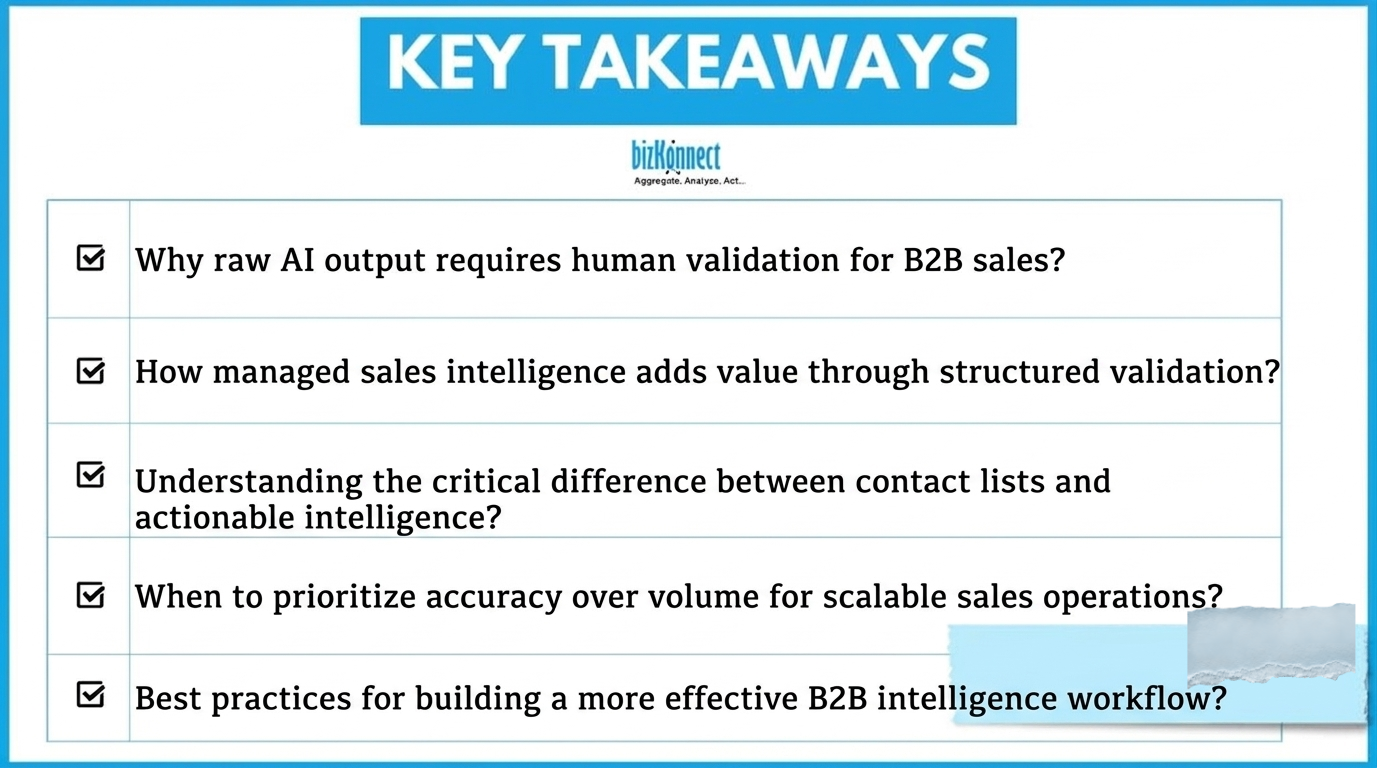
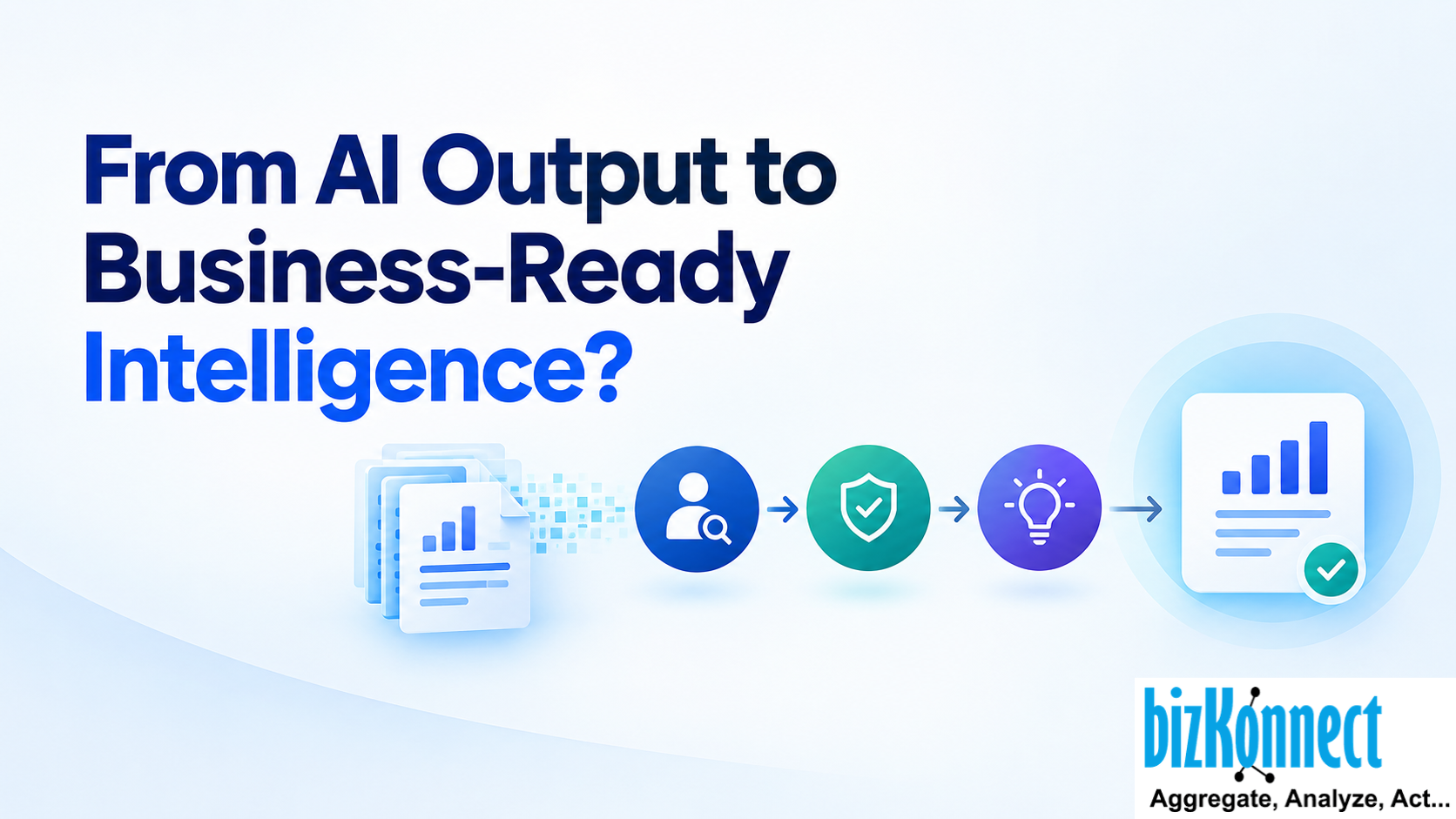
Business-ready intelligence sits between automated processing and business action. It combines technology's ability to handle large volumes of information with analyst judgment around accuracy, relevance and context.
Why Raw AI Output Needs a Business Context (EXPLORE HERE)
Automated systems are good at finding patterns, extracting information and processing large datasets. The difficulty begins when that information needs to support a specific business decision.
Consider an enterprise account that has recently undergone a leadership change. An automated system may identify the new executive, their title and the company. But a sales team may need more:
- Is the person actually responsible for the relevant function?
- Is the role newly created or part of an internal move?
- Who previously held the position?
- Has the reporting structure changed?
- Does the change create a meaningful sales opportunity?
- Which other stakeholders should be considered?
These questions require more than extraction. They require verification and interpretation.
For sales teams, a small error can have an outsized impact. An incorrect title can send outreach to the wrong person. An outdated company structure can distort an account map. An unverified trigger can become the basis for an entire campaign.
Business-ready intelligence reduces that gap between information and action.
The Human Layer Behind Reliable Intelligence (RELEVANT RESOURCE)
Human analysts play an important role when information is being prepared for commercial use.
Their role is not simply to check whether a field is populated. It is to examine whether the information makes sense in context.
A strong validation process can involve:
Verifying critical informationNames, roles, company details, leadership positions and other high-value fields are checked against available sources.
Resolving inconsistenciesConflicting company information, duplicate records, outdated titles or mismatched firmographic details need to be investigated rather than passed directly into a sales workflow.
Reviewing exceptionsSome accounts will not fit neatly into predefined rules. Analysts can identify unusual cases and determine whether they require further review.
Adding business contextThe difference between a contact record and useful sales intelligence often comes down to context. A decision-maker's role, organisational position, business function and relevance to an ICP can change how that record should be used.
Correcting errorsAutomated systems can accelerate research, but their output still needs quality control before it becomes part of a prospecting or account strategy.
The objective is simple: give revenue teams information they can work with confidently.
Where Managed Services Add Value (RELEVANT RESOURCE)
Many organisations already have CRM systems, data platforms and automated research tools. The challenge is often less about having another source of information and more about keeping information usable.
This becomes particularly difficult when sales teams are working across large account universes, multiple markets or complex enterprise buying groups.
A managed sales intelligence model can bring together automated research, structured processes and analyst validation.
The workflow can look like this:
Data Collection → Analyst Validation → Quality Review → Business Context → Sales-Ready Intelligence
Each stage serves a different purpose.
Data collection creates scale. Analyst validation checks whether important information is accurate. Quality review identifies inconsistencies and exceptions. Business context connects the information to the commercial objective. The final output can then be used for account research, ICP development, account mapping, prospecting and outbound campaigns.
(RELEVANT RESOURCE)
This approach also gives revenue teams a way to manage work that would otherwise consume significant internal research time.
From Contact Lists to Actionable Sales Intelligence
A database can tell a sales team who works at a company.
Business-ready intelligence can help answer a more useful question: why does this account or contact matter for the sales motion?
That distinction becomes important when building an ICP.
Suppose a technology provider is targeting large enterprises with a specific operational challenge. Simply generating a list of companies in the right industry may produce thousands of possible accounts.
The sales team still needs to understand:
- Which accounts match the ICP?
- Which business units are relevant?
- Who influences the purchase?
- Which leadership changes or business events may matter?
- What does the account structure look like?
- Which contacts should be prioritised?
- What information should inform the first conversation?
That is where validated intelligence becomes more valuable than volume.
The same principle applies to account mapping. Enterprise deals rarely involve one contact. Understanding the people connected to a buying decision, their functions and their organisational relationships can give sales teams a clearer picture of the opportunity.
Why Accuracy Matters More as Sales Operations Scale
At a small scale, a salesperson may notice an incorrect record before acting on it.
At scale, errors can move through an entire workflow.
An inaccurate contact can enter a CRM. That record can feed an outbound campaign. The campaign can generate poor engagement. Sales may then conclude that the account, message or market is weak when the underlying problem was data quality.
This is why data quality should be treated as part of the sales process rather than as a separate database concern.
The larger the account universe and the more automated the workflow, the more important validation becomes.
Business-ready intelligence creates a stronger foundation for the activities that follow: segmentation, account prioritisation, account mapping, personalised outreach and pipeline development.
Building a Better Intelligence Workflow
The goal is not to remove technology from the research process. It is to use technology where it creates scale while retaining human judgment where context matters.
For B2B revenue teams, that means designing the workflow around the final business decision rather than the volume of records produced.
A practical approach is to begin with the ICP, define the information required for each account and contact, establish validation rules, review exceptions and continuously improve the dataset based on sales feedback.
Over time, this creates an intelligence process that becomes more useful to sales and marketing teams.
The result is not simply more data.
It is information that has been checked, contextualised and prepared for a specific commercial purpose.
Frequently Asked Questions
What is business-ready intelligence?
Business-ready intelligence is information that has been validated, reviewed for quality and placed in the context required for a specific business decision. In B2B sales, this can include verified company information, decision-makers, organisational relationships, ICP fit and relevant business signals.
Why is human validation important in sales intelligence?
Automated systems can process information quickly, but they may not understand whether a record is commercially relevant or whether conflicting information needs investigation. Human validation helps identify errors, exceptions and contextual issues before information enters a sales workflow.
How does business-ready intelligence help B2B sales teams?
It can help sales teams build more accurate target account lists, identify relevant decision-makers, improve account mapping and prioritise outreach based on better-quality information.
Can managed services improve sales intelligence quality?
Yes. A managed service can combine research processes, technology and analyst review to maintain sales intelligence at scale. This can be useful when internal teams need large volumes of validated account or contact intelligence without adding a significant research workload.
What should companies validate before using sales data?
The required checks depend on the use case, but commonly include company identity, industry, location, employee information, job titles, organisational relationships, contact relevance and other data points used to determine ICP fit or sales priority.
Turn Data Into Business-Ready Sales Intelligence
Reliable sales intelligence needs more than scale. It needs a process that connects research, validation and business context.
BizKonnect combines sales intelligence, data research and managed services to help revenue teams build more usable account and contact intelligence for their GTM programs.
If your sales team is spending too much time correcting lists, verifying contacts or researching accounts before outreach can begin, it may be time to examine the intelligence process behind your pipeline.
Talk to BizKonnect about building a business-ready sales intelligence workflow for your ICP.
CLICK HERE to know more with BizKonnect.