


A company enters a new market with one target industry, one messaging framework, and one sales motion built around a set of assumptions that made sense on a whiteboard. Six months later, the pipeline is thin, the win rate is worse than projected, and the budget that was supposed to fund a full go-to-market cycle has been spent proving that a single guess was wrong. Nothing about the process failed operationally because the demos happened, the outreach went out, and the CRM was updated on schedule.
What failed was the premise: that one vertical, chosen early and defended late, would reveal product-market fit before the runway ran out.
It is a structural problem in how companies expand into competitive, expensive markets like the US, where a single sales bet consumes resources that could have tested three. Sales-as-a-Service exists specifically to break that constraint, not by making one bet cheaper, but by making three simultaneous bets financially possible.
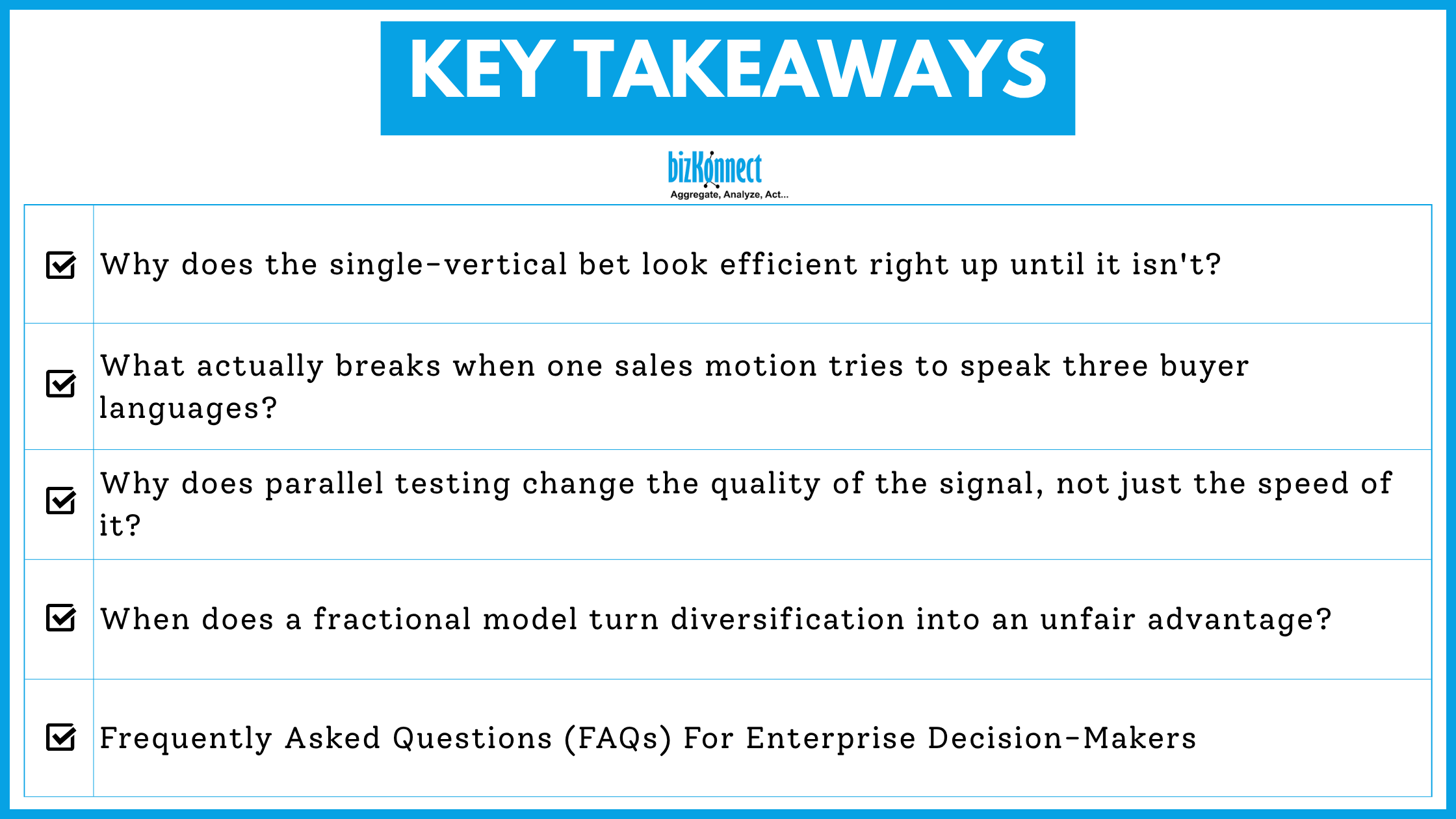
Why does the single-vertical bet look efficient right up until it isn't?
Concentrating the budget on one target market feels disciplined. Focus is treated as a virtue in early-stage go-to-market planning, and for good reason: split attention often produces mediocre execution everywhere. But that logic assumes the market response is knowable in advance, and in cross-border expansion, it rarely is.
A sales executive selling into FinTech carries a different network, vocabulary, and buying committee than one selling into Automotive or Energy. When a company commits its entire sales budget to a single vertical, it is not just choosing a market. It is choosing which blind spots it will discover last.
- A single-vertical motion produces one data point, not a market signal
- Negative results arrive only after most of the budget is already spent
- Course correction, when it happens, means starting the expansion clock over
The efficiency was in avoiding the appearance of inefficiency while the real risk, an unvalidated bet, sat untouched.
What actually breaks when one sales motion tries to speak three buyer languages?
Some companies respond to this risk by asking one salesperson to cover multiple industries at once. This rarely works, and the reason is structural, not personal.
A senior sales executive's value in a market like the US comes from an existing network built over 15 or more years inside a specific domain. That network does not transfer across industries. A FinTech buyer does not respond the same way to outreach, does not attend the same events, and does not evaluate vendors through the same lens as an Energy sector buyer.
Asking one person to represent three verticals dilutes the one asset that made a local, senior sales executive worth hiring in the first place: relevance. The visiting card, the LinkedIn connection, the warm introduction, all of it depends on the executive already being known and trusted inside that specific buyer community. Spread thin, that trust becomes generic, and generic outreach in the US market produces exactly the low reply rates that expensive campaigns were supposed to avoid.
This is the specific failure Sales-as-a-Service is built to prevent. Instead of stretching one hire across three markets, it assigns one domain-credible executive per vertical, each carrying their own network instead of borrowing relevance they do not have.

Why does parallel testing change the quality of the signal, not just the speed of it?
Running domain-specific fractional executives simultaneously across FinTech, Automotive, and Energy is not simply a faster way to cover more ground. It changes what the company is actually measuring, and it is the structural core of what Sales-as-a-Service is designed to enable.
A single-market test answers one question: did this specific approach work in this specific vertical.
A parallel structure answers a more useful one: which vertical responds fastest, converts most efficiently, and shows the clearest signs of durable demand, when each is represented by someone credible inside that world.
This works because Sales-as-a-Service separates cost from commitment. Rather than three full-time country hires, three fractional executives run in parallel, each dedicated to one domain, each billed and tracked independently. Each vertical gets:
- A seasoned local executive briefed on the product and carrying real domain credibility
- Structured lead identification and outbound targeting built around that executive's ICP
- Tracked engagement, opens, clicks, and response patterns specific to that vertical
- Meetings, demos, and event participation run by someone the buyer already half-trusts
Because each track carries its own tracking and reporting, the company is not guessing which vertical is working. It is watching three controlled experiments unfold at once, at a fraction of what three full-time hires in three countries would cost, with an exit clause measured in a week rather than a severance negotiation.
When does a fractional model turn diversification into an unfair advantage?
The advantage compounds once the data starts arriving. Instead of waiting a full sales cycle to learn that one vertical underperformed, a company sees comparative pipeline velocity, comparative response quality, and comparative deal complexity across three markets simultaneously. The budget can then shift toward whichever track is generating a qualified pipeline, without needing to unwind a single-track commitment first.
This reframes market entry from a bet into a portfolio. The company is not choosing a vertical up front, rather it is letting the market choose, using real engagement data instead of internal assumptions, while still operating at the cost structure of testing one. That reframing is the actual value proposition of Sales-as-a-Service: not cheaper sales headcount, but the ability to run three domain-specific fractional executives at once and let comparative data, not internal debate, decide where the budget goes next.
Addressing Some Frequently Asked Questions (FAQs)
Q1. How is a fractional sales executive different from a local sales consultant?
A fractional executive is embedded in the company's actual sales process, briefed on the product, carrying its materials, and accountable for pipeline outcomes, not just advisory input.
Q2. Does running three verticals simultaneously cost three times as much as one?
No. Fractional engagement is priced against dedicated deliverables per vertical, not full-time headcount, which keeps combined cost well below hiring three in-market employees.
Q3. How quickly can underperforming verticals be exited?
Most fractional sales-as-a-service structures allow exit with roughly one week's notice, which is what makes parallel testing financially viable in the first place.
Q4. What prevents inconsistent messaging across three simultaneous tracks?
Each executive is briefed against the same core product narrative, with vertical-specific framing layered on top, so positioning stays consistent while language adapts to buyer context.
Q5. How is success measured across three parallel tracks?
Through comparative pipeline metrics: response rates, meeting-to-demo conversion, MQL and SQL generation, and deal velocity, tracked separately per vertical from day one.
Q6. Is this approach only relevant for US market entry?
It applies anywhere buyer networks are vertical-specific and expensive to access cold, but it is particularly relevant in the US, where local presence and trusted introductions carry outsized weight in enterprise sales cycles.
Testing three verticals in parallel does not just reduce risk. It replaces a guess with a comparison, and comparisons are what actual go-to-market decisions should be built on. If evaluating a fractional, multi-vertical sales structure for market entry, CLICK HERE to see how BizKonnect structures this across domain-specific executives.
CLICK HERE to know more with BizKonnect.